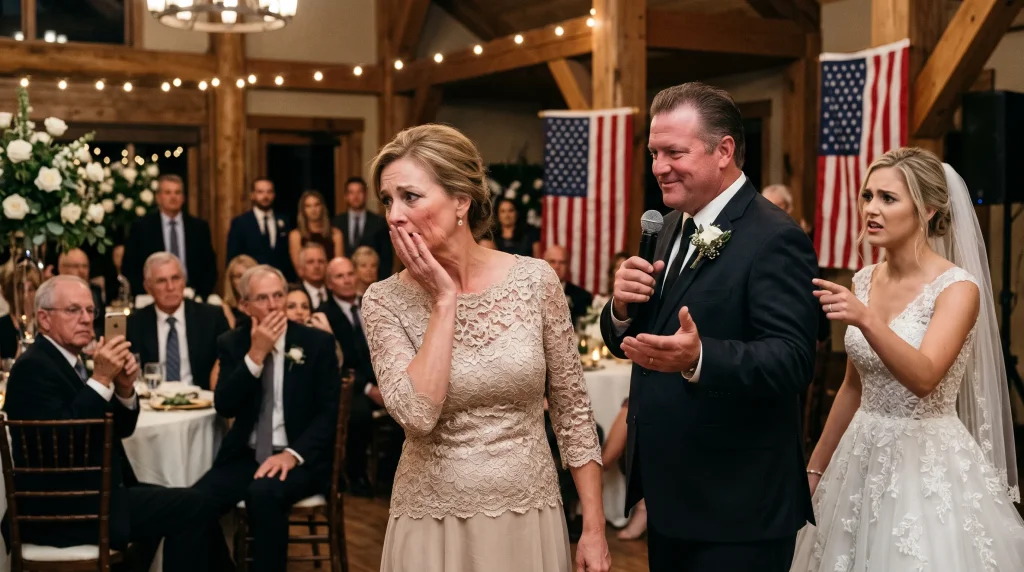
“And you believed him.”
“Yes.”
She said it without defending herself.
“I wanted my wedding to be perfect. I was thinking about the pictures and the guests and Beckett’s family. I was thinking about everything except you.”
Her voice broke.
“I saw him hit you. I saw it happen, and I still told you to apologize.”
Neither of us spoke.
There are moments when you can feel two different truths fighting for the same space.
I had missed my daughter every single day.
I had also spent seven years remembering how she looked at me when she told me to leave.
Sutton stepped closer.
“I don’t expect you to forgive me.”
“Good,” I said.
The word came out harder than I intended.
Her face tightened.
I could have softened it.
I didn’t.
“Because I don’t know whether I can,” I added.
She nodded slowly.
“Okay.”
That single word nearly undid me.
It was the first time in years that my daughter had accepted an answer from me without asking me to make it easier for somebody else.
Del checked her watch.
“Leland goes on in about ten minutes.”
I turned toward her.
“We need Harriet.”
“Already here,” Del said. “She’s at the other end of the table. I told her I’d bring you both over when you were ready.”
Sutton looked confused.
“Who’s Harriet?”
“An attorney,” I said. “Someone who’s been helping me.”
“With Dad?”
“Among other things.”
Sutton glanced toward the dining room.
“He’s really here?”
Del nodded.
“Apparently your father has decided he’s ready for another round of investors.”
Sutton gave a short, disbelieving laugh.
“He told me the dealership was almost gone.”
“It is,” I said.
She stared at me.
“How would you know?”
That was a fair question.
To answer it, I had to explain the seven years between the ballroom in Boise and the dinner in Wyoming.
And the first thing I had to explain was the Flying J truck stop in Twin Falls.
I arrived there at two in the morning with my cheek still swollen and a tank of gas that was almost empty.
I bought coffee I didn’t want and sat in my Subaru watching truck drivers come and go.
My phone kept lighting up.
Leland called six times.
Sutton called once.
Her message said, “Dad says we need to talk. Please don’t make this worse.”
I listened to it three times.
Then I turned off my phone.
In my glove compartment was the thumb drive I’d made a habit of updating every month.
Leland called it my little insurance policy whenever he caught me backing up records.
He meant it as a joke.
I never found it particularly funny.
For eleven years, I’d copied the dealership’s reconciliations, lender statements, title records, and payroll reports onto that drive. At first, it was because Leland had a talent for losing paperwork. Later, it became a habit I couldn’t explain.
Sitting in the truck stop parking lot, I finally understood why I’d kept doing it.
I called Harriet Linwood.
Harriet had handled my mother’s estate. She was seventy-one at the time, with a voice like a school principal and an extraordinary ability to make people regret lying to her.
She answered on the second ring.
“Tony?”
“How did you know it was me?”
“I saw the wedding video.”
I closed my eyes.
Someone had recorded the slap.
Of course someone had.
“Where are you?” she asked.
“Twin Falls.”
“Are you safe?”
“I think so.”
“Did he follow you?”
“No.”
“Then listen carefully. Don’t go home tonight.”
I began crying.
Not elegantly. Not quietly.
Harriet waited.
When I could speak again, I told her about the forged mortgage documents.
She asked me to photograph everything I had.
Then she asked whether I still possessed my bookkeeping records.
“I have copies.”
“Good. Preserve them. Don’t change anything, and don’t access accounts you’re no longer authorized to use.”
“What am I supposed to do?”
“First, you find somewhere safe to sleep. Tomorrow, we talk about the house, your marriage, and the documents. One problem at a time.”
I wanted her to promise me that everything would be okay.
She didn’t.
Instead, she said something far more useful.
“Tony, you don’t have to decide the rest of your life tonight.”
I drove to a motel, slept four hours, and woke up to forty-three missed calls.
I returned exactly one.
Harriet’s.
Over the next several weeks, she helped me begin the legal process of separating my life from Leland’s.
The work was slower and uglier than I expected.
There were financial disclosures, questions about marital property, arguments over records, and letters from Leland’s attorney insisting that I had abandoned the marriage without cause.
His attorney also claimed I had taken company funds.
Harriet asked for evidence.
None appeared.



