Sutton completed the assessment, interviewed with two supervisors, and received an entry-level offer.
She accepted it.
The salary wasn’t spectacular.
But it included benefits, predictable hours, and opportunities to advance.
The first week, she called me from the parking lot.
“Mom?”
“What’s wrong?”
“Nothing.”
“Then why do you sound like that?”
She laughed.
“They gave me my own desk.”
I closed my eyes.
Seven years earlier, Del had given me a desk.
A real job.
A title.
A chance to discover what I could do without Leland looking over my shoulder.
Now my daughter had one, too.
“That’s wonderful, sweetheart.”
She hesitated.
“Do you think Grandma would be proud?”
I looked at the photograph of my mother on the shelf beside my office door.
She was standing in her little blue kitchen, wearing a flowered apron and holding a pie.
“She’d probably want to know whether you’re eating enough lunch.”
Sutton laughed.
“Then she’d tell everybody at church about your new job.”
“Even if I was just doing billing?”
“Especially if you were doing billing.”
Sutton moved to Fargo that spring.
She rented a small apartment near a park.
I offered to help with the security deposit.
She refused.
I offered her my spare bedroom while she looked for a place.
She accepted that.
For three weeks, we lived under the same roof.
It was wonderful.
It was also occasionally terrible.
She left wet towels on the bathroom floor.
I asked too many questions about where she was going.
She borrowed a sweater without asking.
I rearranged the groceries she had put away because she apparently believed cereal belonged beside canned tomatoes.
One evening, she came home late and found me sitting in the kitchen.
“Are you waiting up for me?”
“Maybe.”
“Mom, I’m thirty-one.”
“I know.”
She took off her coat.
“You don’t have to wait up.”
I looked at her.
“I know that, too.”
She came over and kissed my cheek.
“Good night.”
Then she went upstairs.
I sat there another ten minutes.
Not because I was worried.
Because I was happy to hear her moving around in the house.
In April, she moved into her apartment.
I helped carry boxes.
We argued over where the couch should go.
She won.
That evening, we ate pizza on the floor because her dining table hadn’t arrived.
She looked around the room.
“Grandma would like this place.”
I smiled.
“She’d check the kitchen cabinets first.”
Sutton pointed toward the little galley kitchen.
“Already did. They’re solid.”
We laughed.
Then she grew quiet.
“Mom, can I ask you something?”
“Sure.”
“Do you think we’ll ever be normal?”
I looked at her.
I thought about the word.
Normal.
We had spent years pretending our family was normal because the lawn was mowed, the cars were clean, and Leland wore a tie to church.
I had no interest in going back to that.
“I don’t know what normal looks like for us,” I said.
She nodded.
“But I think we can be good.”
She smiled.
“Yeah?”
“Yeah.”
That summer, Sutton began coming to my house for Sunday dinner.
Not every Sunday.
Sometimes she had plans.
Sometimes I did.
But often enough that I started buying extra potatoes without thinking about it.
One afternoon, she arrived carrying a small paper bag.
“What’s that?” I asked.
“Something I found.”
She took out a champagne-colored earring.
My earring.
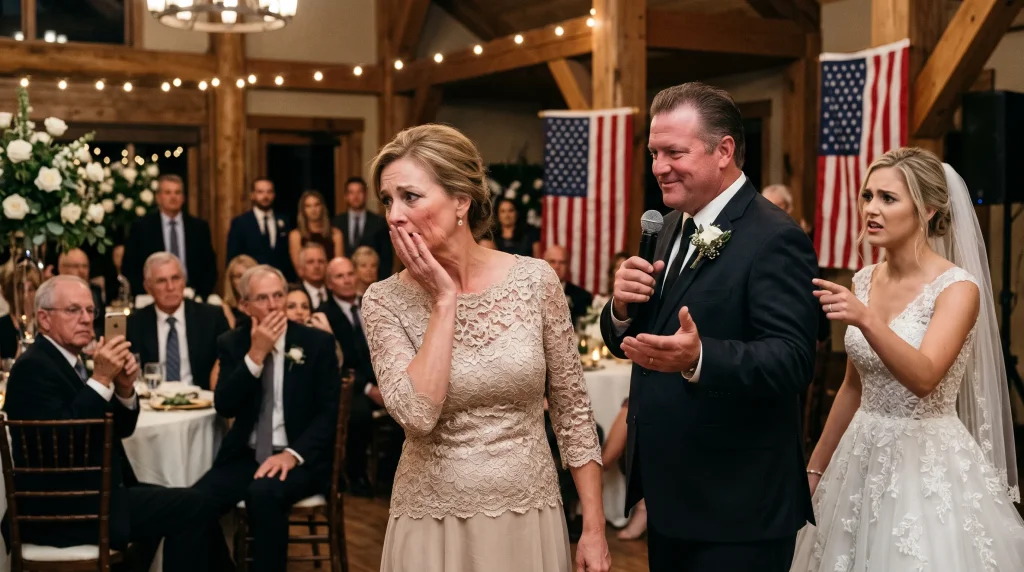
The one that had flown off when Leland slapped me at her wedding.
I stared at it.
“I thought that was gone.”
“So did I.”
She placed it on the table.
“One of the bridesmaids picked it up that night. She gave it to me before we left the lodge. I put it in a jewelry box.”
I touched the earring.
The clasp was bent.
“I kept meaning to throw it away,” Sutton said. “But I couldn’t.”
I looked at her.
“Why?”
She sat down.
“Because I knew.”
I waited.
“Even when I believed Dad’s story, I knew what I’d seen. I knew he hit you. Every time I opened that box, there it was.”
Her eyes filled.
“I think I kept it because some part of me wanted proof that I hadn’t imagined it.”
I picked up the earring.
For years, I’d remembered the sound it made when it struck the ballroom floor.
A tiny metallic click beneath the noise of everyone gasping.
Now it lay in my palm.
Bent.
Still beautiful.
Sutton wiped her eyes.
“I’m sorry I waited so long.”
I looked at my daughter.
I thought about the nine-year-old whose wrist I had bandaged.
The twenty-four-year-old who stood beside her father.
The thirty-one-year-old who had served water to strangers because she was trying to pay debts she never should have owed.
And the woman sitting across from me now, who had found a way to tell the truth even when she was afraid.



