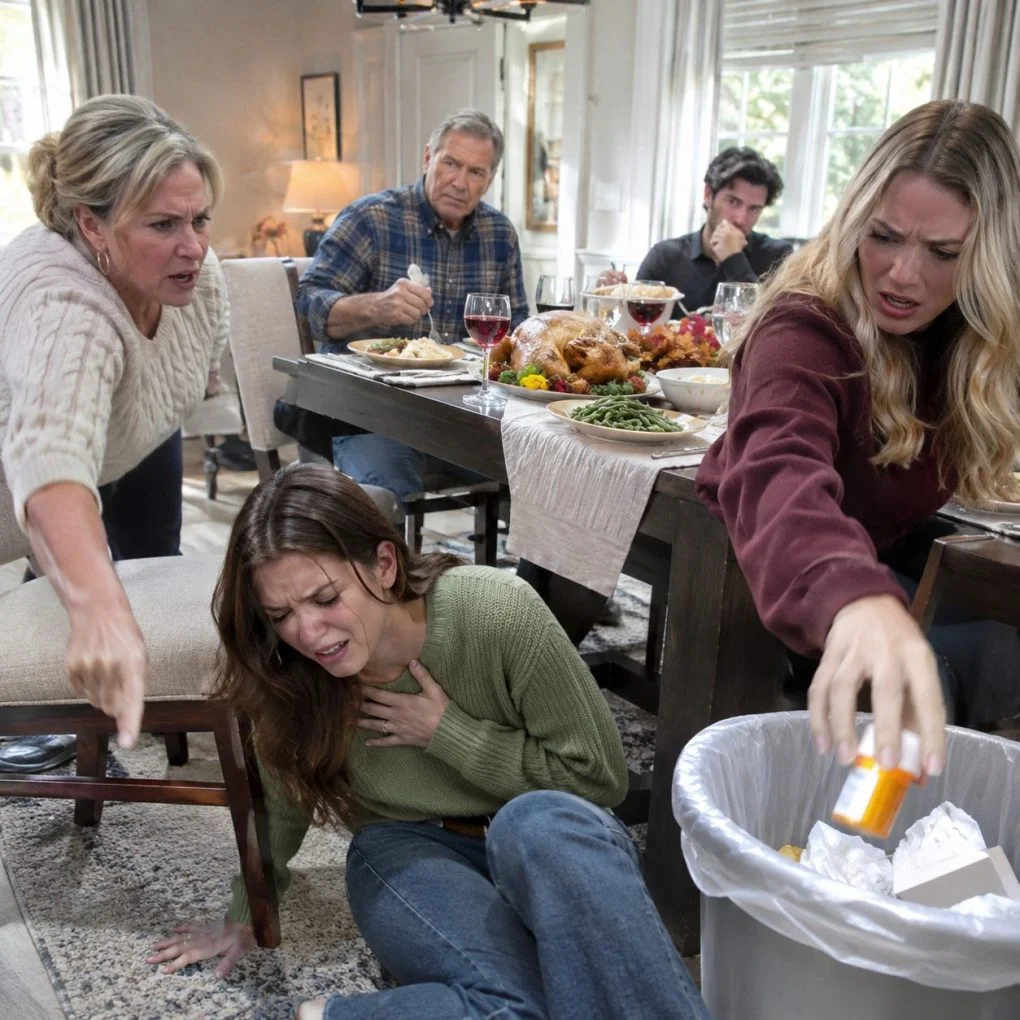
At Thanksgiving dinner, I collapsed beside my chair. Mom rolled her eyes. “Stop performing.” My sister tossed my prescription bottle into the trash while Dad kept eating. At the emergency room, a doctor called my family and asked who had taken away the medication keeping my heart stable…
“Stop being dramatic, Claire! You’re ruining Thanksgiving!”
My mother shouted those words while I was struggling to breathe on her dining room floor, one hand pressed against my chest and the other gripping the leg of a wooden chair. My sister Brooke stood beside the kitchen trash can, holding the orange prescription bottle she’d just snatched from my purse.
“Seriously, Claire?” she laughed. “You need medication just because nobody’s paying attention to you?”
Then she dropped the bottle into the garbage.
I tried to tell her to give it back, but my heartbeat was hammering so violently that I couldn’t get enough air to finish a sentence. Across the table, Dad continued cutting his turkey, shaking his head as though I were an embarrassing child.
My name is Claire Bennett. I’m thirty-three, an accounts manager in Columbus, Ohio, and until that afternoon, I’d spent most of my life apologizing whenever my health became inconvenient for my family.
Three weeks earlier, a cardiologist had prescribed medication after repeated episodes of dizziness, chest discomfort, and an irregular heartbeat. I was wearing a small cardiac monitor while awaiting further tests, but my parents insisted the symptoms were caused by stress.
“Everybody gets anxious,” Mom had told me. “You just like making a production out of it.”
I’d tried explaining that the cardiologist was concerned about something more serious. Brooke interrupted, reminding everyone that she’d managed two children and a full-time job without needing special attention.
That afternoon, I’d arrived carrying homemade sweet potatoes and the pumpkin pie Dad always requested. I’d spent the previous evening preparing everything, taking breaks whenever the pressure in my chest became uncomfortable.
Now the pie sat untouched beside the turkey while I struggled to remain conscious.
“Mom,” I whispered, “please call an ambulance.”
She folded her arms.
“You were perfectly fine ten minutes ago.”
My sixteen-year-old niece, Ruby, pushed away her chair.
“Grandma, her lips are turning pale.”
“Sit down, Ruby.”
But Ruby was already reaching for her phone.
“I’m calling 911.”
The next thing I remembered was the cold floor against my cheek and someone saying my name from very far away.
When the paramedics arrived, my heartbeat was dangerously fast and irregular. They immediately connected me to a cardiac monitor and asked about my prescriptions.
I looked toward Brooke.
She wouldn’t meet my eyes.
At the hospital, an emergency physician reviewed the rhythm recorded by the paramedics. A cardiologist ordered an ultrasound of my heart, then returned with an expression that made me stop twisting the hospital blanket between my fingers.
“Claire, we found something concerning in your heart muscle, and the rhythm you experienced wasn’t a panic attack.”
I stared at him.
“Am I going to be okay?”
“We’re treating you and monitoring you closely. But I need to ask about your family history.”
He looked at the notes I’d provided.
“You mentioned an aunt who died suddenly at thirty-six. Are you absolutely certain your family told you the truth about how she died?”
The cardiologist’s name was Dr. Andrew Mitchell, and he spoke slowly while showing me the ultrasound images of my heart. He explained that the wall separating its lower chambers was abnormally thick, a finding consistent with hypertrophic cardiomyopathy, a condition that can sometimes cause dangerous heart rhythms.
The paramedics had recorded an episode of ventricular tachycardia, and my symptoms had continued long enough to require emergency treatment. I was being admitted for further monitoring, and the cardiology team would need to evaluate my risk of another serious episode.
“Is that why I’ve been fainting?” I asked, remembering the afternoons I’d spent sitting in my car until the dizziness passed.
“It’s very likely connected,” he answered. “And because this condition can run in families, we need to know exactly what happened to your aunt.”
I had been nine when Aunt Rebecca died. Dad told me she’d become sick with a respiratory infection and passed away unexpectedly, and whenever I asked why someone so young could die, he said some things were better left alone.
At 6:40 the following morning, Mom called my hospital room.
“Claire, your sister was up all night crying because Ruby called an ambulance. I hope you’re ready to apologize for frightening everyone.”
I closed my eyes.
“Mom, I have a serious heart condition.”
She sighed.
“That’s what you said last month, and they sent you home.”
I looked toward Dr. Mitchell, who’d returned to discuss additional testing, and asked whether he could explain the findings to my parents. With my permission, he agreed to speak with them when they arrived.



