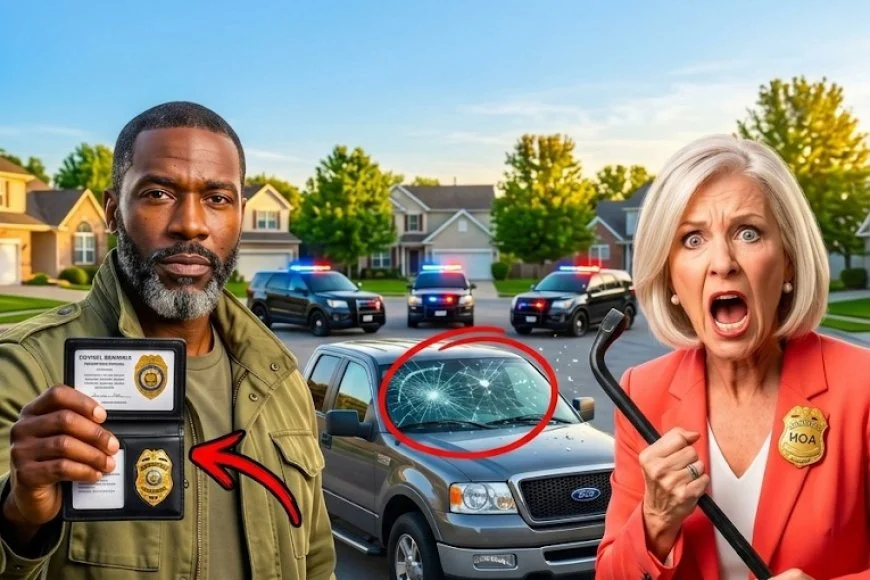
The first blow shattered the windshield.
The second crushed the driver-side headlight.
By the time Marjorie Kesler raised the tire iron for a third swing, half of Oakmont Heights was standing on porches with their phones pointed at her.
She didn’t care.
“Maybe now you’ll learn what happens when you ignore community rules!”
The man beside me didn’t move.
Daniel Brooks watched pieces of his late father’s windshield slide down the hood of the old gray pickup and hit the pavement.
His hands stayed at his sides.
His voice was almost unnervingly calm.
“Ma’am, put the tire iron down.”
Marjorie turned toward him.
“Or what?”
She looked at his faded work boots, old jeans, and flannel shirt.
“You’ll complain to your plumbing supervisor?”
Daniel’s jaw tightened.
Then he leaned slightly toward me.
“Nate.”
“Yeah?”
“Don’t tell her who I am.”
I stared at him.
“What?”
“Not yet.”
My name is Nathan Reyes, and I restore old houses for a living.
Three years earlier, my wife, Claire, and I bought a 1920s Craftsman in Oakmont Heights, a neighborhood of mature maples, wide porches, clipped hedges, and people who pretended not to look through their curtains.
The house needed everything.
Roof.
Wiring.
Windows.
Plaster.
That was exactly why I wanted it.
What I hadn’t known was that Oakmont Heights came with Marjorie Kesler.
She had been HOA president for nine years.
Nine.
That’s practically a monarchy in suburban government.
Neighbors had been fined for porch colors, basketball hoops, mailbox posts, and holiday decorations left up four days too long.
Walt Dorsey, the retired machinist two doors down, had once received a $2,400 assessment because the American flag on his front porch exceeded an architectural guideline by slightly more than an inch.
The strangest part wasn’t the fines.
It was where the money went.
Every notice instructed homeowners to pay through Kesler Property Services.
Marjorie’s company.
Whenever anyone questioned that arrangement, she said the board had approved an outside management contract.
Nobody challenged her for long.
Then Daniel came to visit.
We had been college roommates.
I hadn’t seen him in almost two years.
He arrived Saturday morning in an old gray Ford pickup with sun-faded paint, a ladder rack, and a dent in the passenger door.
I hugged him.
“You still driving this thing?”
“It was Dad’s.”
That shut me up.
His father had died the year before.
Daniel climbed out carrying an overnight bag and a thick folder.
His phone buzzed before we reached the porch.
He looked at the screen, frowned, and turned it face down.
“Work?”
“Not today.”
Over breakfast he told me:
“Today I’m just Danny.”
“No titles?”
“No politics.”
“No people calling you sir?”
“Especially that.”
I agreed.
Daniel had spent years in public service, and our friendship had survived mostly because I refused to care about his résumé.
I didn’t ask what was inside the folder.
I should have.
Around ten, we parked his truck at the curb in front of my house.
Oakmont’s rules allowed guest vehicles for up to seventy-two hours.
I knew because Marjorie had trained all of us to know the rules better than she probably did.
Five minutes later, her white Lexus rolled slowly past.
She looked at Daniel’s truck.
Stopped.
Backed up.
Then drove away.
“Who was that?” Daniel asked.
“Local government.”
“What?”
“You’ll see.”
Three minutes later, Marjorie crossed my lawn.
She wore white slacks, a fitted navy jacket, and the expression of someone arriving to terminate an employee.
“That vehicle cannot remain there.”
I opened the HOA rules on my phone.
“It can. Guest parking. Section 9.2.”
“It’s a commercial vehicle.”
“It’s privately registered.”
“It has a ladder rack.”
Daniel glanced at me.
I could practically hear him filing away the logic.
Marjorie pointed toward the truck.
“Fifteen minutes.”
I held up the rule.
“Seventy-two hours.”
She barely looked.
“I interpret the covenants for this association.”
Daniel finally spoke.
“Ma’am, I think the written rule is pretty clear.”
Marjorie looked him over.
Slowly.
Then she said:
“You people always think rules are suggestions.”
There are sentences where everyone hears the words.
And then there are sentences where everyone hears what sits underneath them.
Daniel heard it.
So did I.
He simply said:
“We’ll move it later if necessary.”
That almost seemed to irritate her more.
Marjorie turned and walked away.
Inside, Daniel looked out the window.
“She does that often?”
“Depends what you mean by often.”
“Nate.”
“Yes.”
He nodded toward the folder on my dining table.
“That’s interesting.”
Before I could ask why, we heard the first impact.
CRACK.
Then glass.
We ran outside.
Marjorie stood beside Daniel’s truck holding a steel tire iron.
She swung again.
The windshield collapsed inward.
“MARJORIE!”
She smashed the headlight.
Neighbors appeared everywhere.
Walt Dorsey shouted from his driveway:



