The number was ugly enough without exaggeration.
Then came the board meeting.
Oakmont’s clubhouse had never held that many residents.
People stood along the walls.
Others watched remotely.
Marjorie attended by video with her attorney.
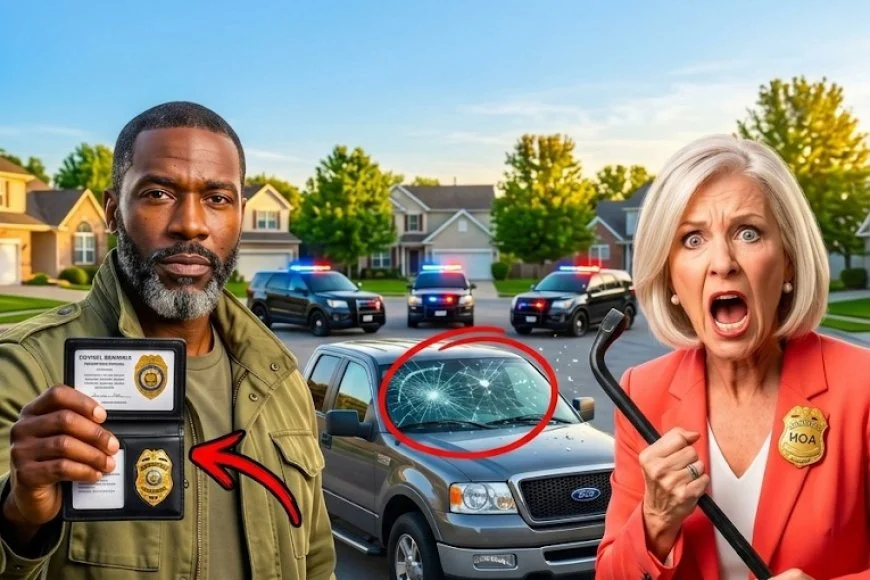
She had temporarily stepped away from HOA duties after the truck incident but had refused to resign.
The independent accountant presented first.
No speeches.
Numbers.
Then conflict-of-interest disclosures that had not been made clearly.
Then the management agreements.
Walt raised his hand.
“What about my flag fine?”
The accountant answered carefully.
“The rule itself existed. The question is whether the amount and collection charges were applied properly.”
“Was twenty-four hundred dollars proper?”
The HOA attorney looked miserable.
“No.”
Walt sat back.
“That’s all I wanted to hear.”
Then Carol Stein stood.
“Why did nobody stop this?”
Nobody answered.
Finally Gilbert did.
“Because I didn’t.”
Carol looked at him.
He continued.
“I was treasurer. I knew enough to ask questions. I didn’t ask loudly enough.”
Marjorie appeared on the screen.
“This is absurd. Every contract was approved by the board.”
One former director responded:
“Approved based on the information you gave us.”
“You had the right to review everything.”
“We asked.”
Marjorie leaned toward her camera.
“And you received summaries.”
That sentence was almost identical to the defense people had heard from her for years.
You received notice.
You had a hearing opportunity.
You knew the rules.
Technically correct.
Practically useless.
The homeowners voted to terminate Kesler Property Services.
Then they voted to remove Marjorie as president under the HOA’s procedures.
It wasn’t unanimous.
Nothing involving sixty-eight households ever is.
But it wasn’t close.
Walt Dorsey became interim president because nobody else was foolish enough to raise a hand.
His first statement was:
“I don’t want this job.”
Everyone laughed.
“That,” I told Claire, “may be the strongest qualification we’ve had in a decade.”
The criminal and civil cases moved separately.
Marjorie eventually resolved the truck-damage charge through the local court.
The financial case took longer.
Some disputed transactions became civil repayment obligations.
Others supported additional charges.
Ultimately, Marjorie entered negotiated pleas on offenses tied to financial misconduct and agreed to restitution requirements as part of the resolution.
Her attorney disputed several accusations all the way through settlement.
That was her right.
What mattered to Oakmont was that money began coming back.
Not all at once.
Not magically.
The HOA’s insurer responded to certain covered losses.
Kesler Property Services returned funds under settlement.
Some affiliated vendors credited overpayments.
The association used reserves to issue additional reimbursements after recalculating excessive charges.
Homeowners received different amounts depending on what they had actually paid.
Walt received his $2,400.
He brought the check to my house.
“You framing it?”
“I’m cashing it.”
“Smart.”
“I’m buying a flag.”
“Same size?”
He thought about it.
“Bigger.”
Officer Henry’s situation was handled separately too.
His body-camera footage showed he had accepted Marjorie’s version too quickly and had threatened me with detention before establishing basic facts.
An internal review did not conclude that every decision he made was malicious.
It did conclude that his response fell below department standards.
He received discipline and additional training.
Officer Alicia Park received a departmental commendation.
Not because she recognized Daniel.
She hadn’t.
Because before anyone knew who he was, she looked at the broken glass, noticed the tire iron, asked questions, and tried to establish what actually happened.
That distinction became important to Daniel.
A reporter asked him about it later.
“Did Officer Park treat you differently after learning your identity?”
Daniel answered:
“The goal is for the process to work before anyone knows a person’s identity.”
That quote made the evening news.
Marjorie hated it.
I loved it.
About two months after the truck incident, Daniel finally brought the Ford back to Oakmont.
He had repaired the mechanical damage.
The windshield was still temporary.
Walt saw it.
“What are you waiting for?”
“A glass appointment.”
Walt shook his head.
“Nope.”
The following Saturday, I woke at eight and found twenty neighbors in my driveway.
Walt had coordinated the whole thing.
One guy worked at an auto-glass shop.
Another had restored old trucks.
Someone brought polishing equipment.
Someone else brought breakfast.
A new windshield leaned against my garage wall.
Daniel arrived twenty minutes later.
He stopped in the driveway.
“What is this?”
Walt held up a socket wrench.
“Court-ordered community service.”
Daniel looked alarmed.
“I didn’t order anything.”
“That’s why it’s funny.”
For six hours, Oakmont rebuilt Walter Brooks’s truck.
Not completely.
We weren’t magicians.
But the windshield went in.
The headlight was replaced.
The ladder rack was straightened.
The hood was repaired as well as it could be without destroying the old paint.
Daniel refused a full repaint.
“Dad put half those scratches there.”
Around noon, I caught him sitting alone in the driver’s seat.



