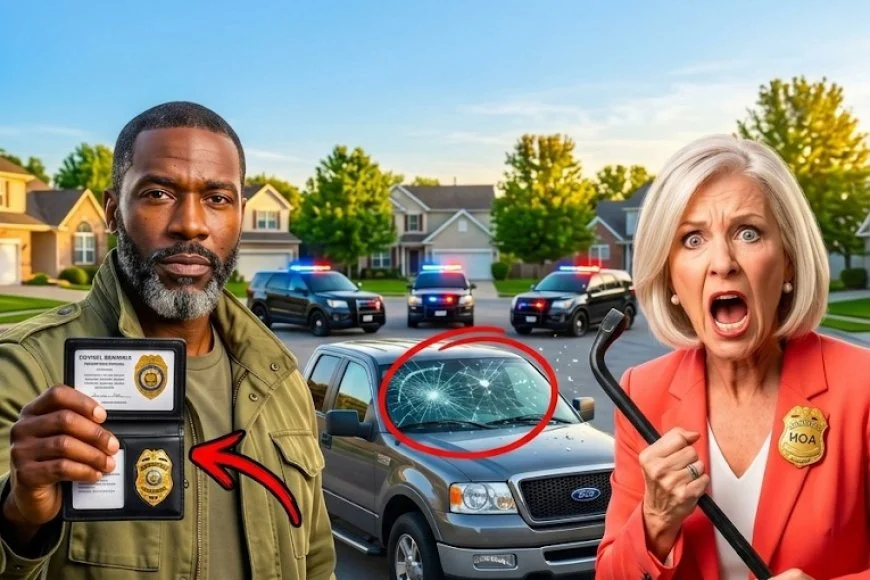
His hand rested on the steering wheel.
I climbed into the passenger side.
“You okay?”
“Yeah.”
He looked through the new glass.
“Dad drove this to my law-school graduation.”
“I remember.”
“He wore overalls.”
“I definitely remember.”
Daniel smiled.
“He told the dean lawyers were mechanics who refused to get dirty.”
“Your father was wise.”
“He hated lawyers.”
“That too.”
Daniel’s eyes stayed on the dashboard.
Then he said:
“He used to tell me a title only matters when people can’t do anything for you.”
I thought about Marjorie.
Then Henry.
Then Park.
Then nine years of homeowners staying quiet because they were afraid of another envelope taped to the mailbox.
“Maybe Oakmont finally learned that.”
Daniel nodded.
“Maybe I did too.”
The HOA rewrote its operating rules that fall.
Not the architectural covenants.
The governance rules.
No HOA president could unilaterally authorize towing except in defined emergencies.
Fine appeals were reviewed by a panel that did not include the person who issued the violation.
Management contracts had to disclose related-party ownership.
Major vendor contracts required competitive bids.
Financial statements were posted quarterly.
Homeowners received itemized explanations of collection fees.
Board members had term limits.
And perhaps most importantly, Kesler Property Services disappeared from every envelope.
Walt served one year as president.
Then he stepped down voluntarily.
“I’ve become everything I hate.”
“You’ve been president twelve months.”
“Exactly.”
A younger homeowner named Priya Shah replaced him.
Her campaign promise was simple:
“No surprises.”
She won easily.
Oakmont changed socially too.
For years, people had avoided discussing problems because everyone assumed nobody else wanted trouble.
Once Marjorie’s grip disappeared, neighbors discovered they had spent a decade being afraid separately.
Claire organized a fall porch night.
No committee.
No budget.
People just brought chairs and food.
Walt flew his oversized flag.
Priya laughed when she saw it.
“How big is that?”
“None of your business.”
“Perfect answer.”
Daniel came back for dinner around Thanksgiving.
This time he drove the repaired pickup.
No folder.
No calls from the governor during breakfast.
He parked in exactly the same spot along the curb.
I noticed.
“You doing that on purpose?”
“Doing what?”
“You know what.”
He smiled.
“Guest parking. Seventy-two hours.”
We sat on the porch after dinner.
The truck looked almost exactly as it had before Marjorie attacked it.
Almost.
One deep mark remained near the headlight.
Daniel had refused to repair it completely.
“Why leave that?”
He looked at the scar.
“Because Dad believed tools should show work.”
“That’s not work.”
“No.”
He took a sip of beer.
“But it reminds me of something.”
“What?”
He thought for a moment.
“That morning, Marjorie believed she had power because she thought I didn’t.”
I nodded.
“Then when she saw the credential, she suddenly thought I mattered.”
He looked toward the street.
“That’s the part I don’t want to forget.”
People loved telling the story afterward as if the lesson was:
Be careful who you mistreat because they might secretly be important.
I never liked that version.
Daniel didn’t either.
You shouldn’t treat a plumber with dignity because he might secretly be the attorney general.
You should treat a plumber with dignity because he is a person.
Same for the delivery driver.
The landscaper.
The neighbor who cannot afford a lawyer.
The widow who doesn’t understand HOA paperwork.
The kid parking an old car outside his parents’ house.
Anyone.
Power reveals itself most clearly when the person across from you appears unable to fight back.
Marjorie failed that test long before she touched Daniel’s truck.
The truck just made it impossible to hide.
A year later, Oakmont held its annual meeting.
I sat in the back.
The financial report took twenty-five minutes.
Every category was explained.
Nobody shouted.
Nobody threatened anyone.
Priya apologized because a landscaping invoice had been uploaded two days late.
Walt leaned toward me.
“This is boring.”
“It’s wonderful.”
He nodded.
“Extremely boring.”
Afterward, I walked home beneath the maple trees.
Daniel’s truck incident had become neighborhood folklore.
New homeowners heard some exaggerated version where helicopters landed, federal agents surrounded Marjorie’s house, and Daniel arrested her personally.
None of that happened.
Reality was slower.
Cleaner.
And more important.
One officer paid attention.
One treasurer decided to stop being afraid.
Neighbors compared records.
Auditors followed money.
A board lost legitimacy.
Rules changed.
People got refunds.
A truck got repaired.
That was enough.
When I reached my porch, Claire was sitting outside.
She handed me a drink.
“How was the meeting?”
“Terrible.”
“What happened?”
“Nothing.”
She smiled.
“Sounds like progress.”
Across the street, Walt’s flag moved in the evening breeze.
It was definitely larger than the old rule allowed.
Nobody measured it.
Nobody photographed it.
Nobody sent him an invoice.



