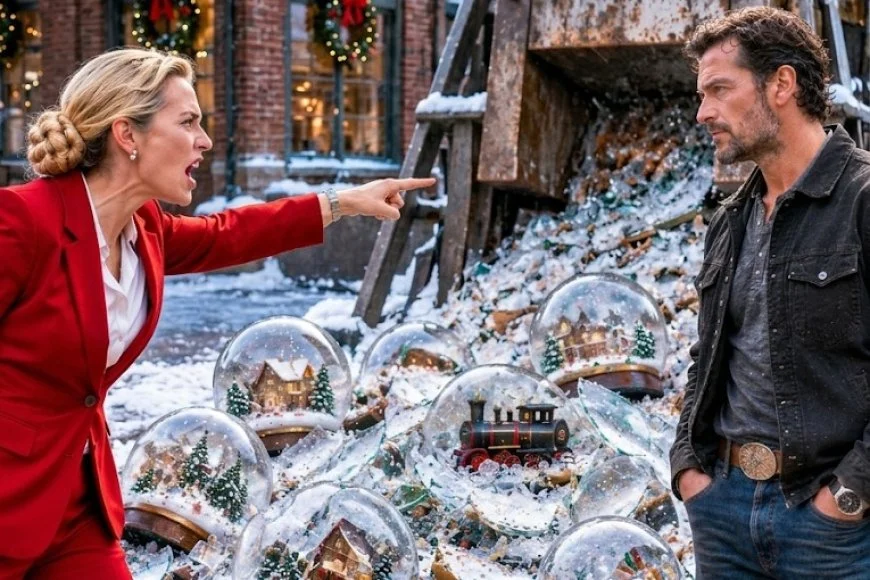
The first snow globe shattered at 7:14 on Christmas Eve.
By the time I reached Hearthstone Arts Depot, sixty handmade winter worlds were spread across the loading yard in glittering pieces.
Glass.
Brass.
Tiny painted houses.
Bent gears.
Artificial snow mixed with dirty water and frozen pavement.
A hydraulic crusher idled beside the wreckage.
And Karen Stroud stood ten feet away in a red wool coat, holding a clipboard.
She smiled when she saw me.
“There you are.”
I couldn’t speak.
Eight years of my life lay under her boots.
My name is Thomas Brantley. I restore antique glass and build mechanical art pieces for collectors and museums.
The collection Karen destroyed was called Sixty Winters.
Every globe contained a different winter scene.
One had a railway station where a brass train moved beneath tiny lights.
One contained a clockmaker’s shop with working gears.
Another showed a frozen river crossed by a miniature bridge no wider than my thumb.
I cast some of the metal myself.
Other parts came from craftsmen I had worked with for years.
The glass domes were mouth-blown.
Each piece had build photographs, provenance files, and an independent appraisal because I hoped to take the collection on tour the following spring.
Now it looked like somebody had crushed a Christmas village with construction equipment.
I bent down.
Among the fragments was a tiny brass snowflake.
Number stamped on the back:
37 OF 60.
It came from Last Train Home.
I picked it up.
Karen stepped closer.
“The city declared the exhibit unsafe.”
I looked at her.
“What?”
“Chemical contamination.”
She handed me a violation notice.
At the bottom was an invoice.
HAZARDOUS MATERIAL DISPOSAL — $18,400.
I actually thought I had misread it.
“You destroyed my work and you’re billing me?”
“The association had to act.”
“This property doesn’t belong to your HOA.”
“The festival uses the shared service lane.”
“That doesn’t give you ownership of this building.”
“It gives us a responsibility to protect visitors.”
I turned on the recording app in my coat pocket.
Then asked the question that mattered.
“Who authorized you to destroy private artwork?”
Karen didn’t hesitate.
“I did.”
She lifted her chin.
“And I’d do it again.”
Nine days earlier, none of this seemed possible.
Hearthstone Arts Depot was an old brick railway station operated by the Willow Mere Cultural Trust.
I had signed a holiday exhibition lease months before.
The opening was scheduled for Christmas Eve.
Collectors were coming.
Several arts foundations had sent representatives.
Ticket revenue would help fund apprenticeships in traditional glasswork and miniature metal fabrication.
Karen first visited during installation.
She was president of Evergreen Terrace HOA, whose large Christmas festival occupied the property next door.
She also owned a private event company called Stroud Holiday Productions.
At the time, I didn’t know how important that distinction would become.
Karen walked through the exhibition slowly.
“These are extraordinary.”
“Thank you.”
“I could put you in front of serious buyers.”
Then she handed me a proposed contract.
Her company wanted exclusive seasonal exhibition rights.
Control over ticket pricing.
Image licensing.
Merchandising rights.
And permission to move the collection into the festival’s VIP pavilion.
I read it twice.
“No.”
Her smile stayed in place.
“You haven’t heard the revenue proposal.”
“I don’t need to.”
“You could make more money in three weeks than you make in a year.”
“That isn’t why I built these.”
Something cooled behind her eyes.
She looked around the hall.
“Glass, electricity, moving mechanisms…”
“What about them?”
“A lot of liability.”
“They’ve passed inspection.”
“Things change.”
She left.
Two days later, the HOA festival installed an enormous sponsor billboard directly in front of the depot entrance.
Then came safety complaints.
Electrical concerns.
Trip hazards.
Chemical concerns about the globe fluid.
I answered everything.
The fluid was purified water and glycerin.
Electrical systems were low voltage.
Cases had anti-vibration mounts.
The depot’s insurance documentation was current.
City inspector Graham Sutter visited.
He walked the hall.
Checked my paperwork.
Found nothing requiring closure.
Then, the morning before opening, a janitor found a pale liquid near the rear loading bay.
It smelled chemical.
Graham returned.
He couldn’t identify the source immediately.
With a public opening less than twenty-four hours away, he did exactly what a responsible inspector should do.
He temporarily suspended visitor access to the loading area and exhibition hall until the spill could be cleaned and identified.
The notice said nothing about removing artwork.
Nothing about destruction.
I hired a cleaning contractor.
Requested reinspection for Christmas Eve morning.
Then emailed Karen and the Cultural Trust:
No artwork may be moved, handled, or removed without my written authorization and trained art handlers present.
Karen never responded.
At 5:05 the next morning, somebody entered the loading-yard access code.
At 6:52, my security alert woke me.
Heavy equipment detected.



