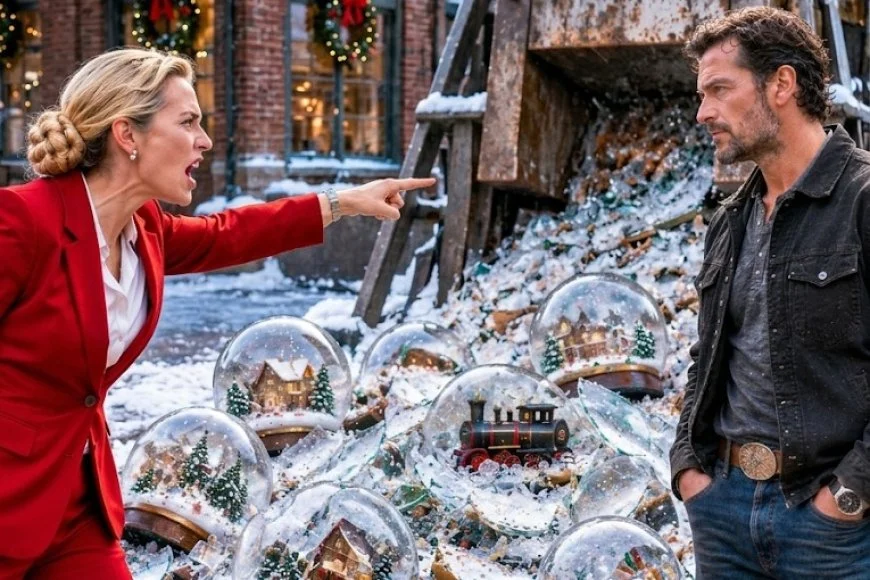
I called Walt, the depot caretaker.
He answered whispering.
“Thomas, there are trucks here.”
“What trucks?”
“Industrial disposal. They say the city ordered everything removed.”
“The city did not order that.”
Then I heard glass break through the phone.
I drove twenty-five minutes in seventeen.
By the time I arrived, most of Sixty Winters was already gone.
A worker lifted another globe.
“STOP!”
He froze.
Karen raised one gloved hand.
“Continue.”
The crusher closed.
That was the moment I knew I wasn’t dealing with confusion.
Someone had planned this.
Not only because the crew was there.
Because every protective display case had been unlatched first and stacked neatly against the wall.
If the globes were supposedly leaking dangerous chemicals, why had workers carefully opened the cases before destroying the art?
I photographed everything.
Crusher.
License plate.
Contractor name.
Display cases.
Broken mechanisms.
Then a city vehicle turned into the yard.
Karen’s expression changed instantly.
Inspector Graham Sutter stepped out.
He looked at the debris.
Then the machine.
Then Karen.
Nobody spoke.
Finally Graham said:
“Who told you my closure notice authorized demolition?”
Karen’s face went blank.
He walked closer.
“My order was temporary closure pending identification of a spill.”
He pointed at the crushed collection.
“I did not authorize one piece of property to be removed.”
For the first time that morning, Karen looked afraid.
Then the manager of the demolition crew stepped forward.
And said:
“That’s not what we were told.”
The demolition manager was Reed Calloway. He said his company had received a written disposal order describing my collection as “decorative materials prohibited from the festival site due to contamination.” He would not name the customer until his company’s lawyer reviewed the contract, but he agreed to preserve every work order, dispatch recording, and email.
Karen immediately changed her story. The contractor, she claimed, had misunderstood the city’s safety notice. She had only been present to monitor the cleanup.
My phone had already recorded her saying, “I did, and I’d do it again.”
I hired attorney Maris Pritchard that afternoon. Her first instruction was simple: touch nothing until it had been documented. We photographed every fragment, sealed liquid samples, preserved surveillance footage, and hired art conservator Nadine Mercer to assess the pieces.
Nadine noticed something important.
“If this were emergency hazardous disposal,” she said, pointing at the neatly stacked cases, “nobody would spend time opening sixty reinforced displays one by one.”
Then the laboratory results came back.
The liquid found near the loading bay did not match the water-and-glycerin mixture inside my globes.
It contained additives associated with commercial artificial-snow equipment.
I remembered seeing festival workers move a snow machine through the rear service area days earlier.
We still couldn’t prove who caused the spill.
But Karen’s claim that my collection had leaked was suddenly much weaker.
Then an anonymous envelope arrived at my studio.
Inside was one page from a sponsorship presentation.
Across the top:
STROUD HOLIDAY PRODUCTIONS
SNOW GLASS NIGHTS — EXCLUSIVE WINTER EXPERIENCE.
The photographs showed illuminated miniature winter villages inside enormous glass domes.
At the bottom was a promise to the sponsoring hotel:
NO COMPETING GLASS-WINTER EXHIBITION WITHIN THE FESTIVAL DISTRICT.
I stared at it.
Karen hadn’t merely wanted my exhibit moved.
Her private company had promised a sponsor that nothing like mine would be operating nearby.
And Sixty Winters was supposed to open the very next morning…
PART 3
Maris warned me not to confuse motive with proof.
“That slide is important.”
“So she destroyed the collection to protect her hotel contract.”
“We don’t know that yet.”
“What else could it mean?”
“It means she had a financial reason to want your exhibit closed.”
“That’s what I just said.”
“No.”
Maris leaned across the table.
“You said she destroyed it because of the contract. A courtroom requires us to prove the path between those two things.”
That distinction became the foundation of everything we did next.
We preserved records.
Not rumors.
Contracts.
Not accusations.
The Silver Pine Grand was the main commercial sponsor of Karen’s festival.
Its general manager, Daphne Ellery, agreed to meet after seeing photographs of the destroyed works.
At first she guarded every answer.
Then I showed her the sponsorship slide.
She looked genuinely disturbed.
“Karen promised us exclusivity.”
“What exactly did that mean?”
“We understood it to mean her company controlled the festival programming.”
“Did your hotel ask her to eliminate other exhibitions nearby?”
“No.”
“Did you ask her to close mine?”
“Absolutely not.”
“Did you know she was trying to acquire rights to my collection?”
“No.”
Daphne explained that Stroud Holiday Productions had been paid a substantial sponsorship fee for creating an exclusive luxury winter program.
Karen had voluntarily guaranteed there would be no competing glass-based winter exhibition in the immediate festival district.



