“The work travels.”
I gave her my terms.
Independent art venues.
Community exhibition days.
Free admission periods.
Educational workshops.
No sponsor gets ownership of the collection.
No sponsor controls where it can appear afterward.
Daphne read everything.
Then smiled.
“Deal.”
I spent the next year rebuilding.
Not copies.
New pieces.
That mattered.
Fifty-nine new winter worlds emerged from the studio.
A mountain observatory.
A river ferry.
A glassblower’s workshop.
An old cinema under snow.
A lighthouse in a frozen harbor.
I rebuilt nothing exactly as it had been.
Except the sixtieth place.
That pedestal held a clear globe.
No village.
No train.
No moving mechanism.
Inside, on black stone, sat the bent brass snowflake.
37 OF 60.
The title:
The Winter That Could Not Be Erased.
One year after the crusher arrived, Hearthstone Arts Depot reopened the exhibition.
People filled the old station.
Miniature bells chimed.
Tiny trains moved.
Warm lights appeared in windows.
I stood near the entrance watching strangers lean toward the glass.
A reporter asked:
“Do you feel vindicated by the $780,000 judgment?”
I thought about it.
“No.”
She looked surprised.
“What would vindication look like?”
I pointed toward the hall.
“This.”
“Not the money?”
“The money is compensation.”
I looked toward the final globe.
“Accountability was making sure nobody could call destruction an emergency service just because they had a title and a clipboard.”
Later that evening, after the crowd thinned, I walked alone to the sixtieth pedestal.
The brass plaque beneath it read:
YOU CAN BREAK THE GLASS.
YOU CANNOT ERASE THE HANDS THAT MADE IT.
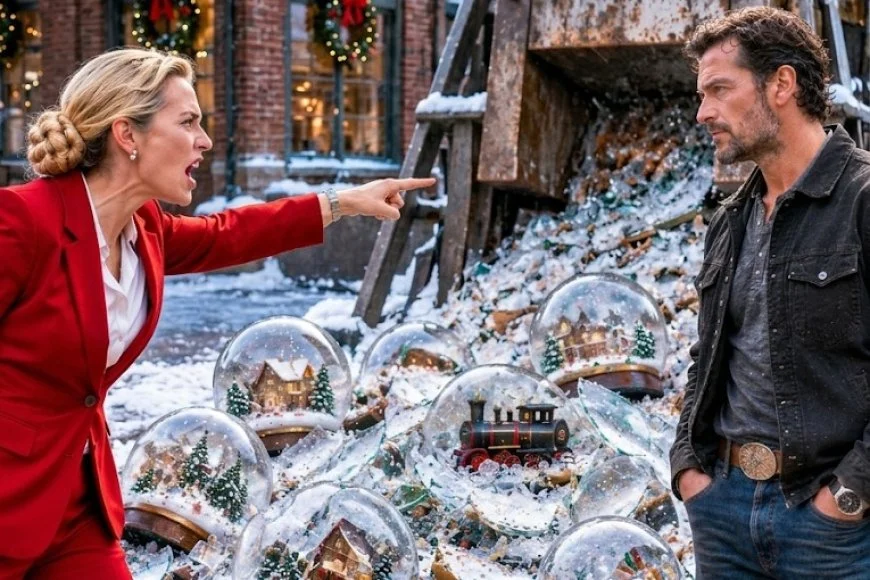
I remembered Karen standing in the loading yard.
Your little snow globes are gone.
At the time, she was right.
Those sixty objects were gone.
No lawsuit changed that.
No judgment restored them.
No apology could rewind the crusher.
But destruction had not given her the final word.
I had spent eight years building one collection.
Then one morning somebody took nine minutes to destroy it.
The second collection taught me something the first never could.
Making art is not the same as protecting it.
Contracts matter.
Records matter.
Ownership matters.
Evidence matters.
And sometimes the most important thing an artist can preserve after the work itself is gone is the truth about who chose to destroy it.
I put my hand against the glass of the final globe.
Inside, the bent snowflake caught the warm light.
Then somewhere behind me, one of the miniature chapel bells rang.
The sound moved through the old railway station.
Small.
Clear.
Impossible to crush.
The end
Disclaimer: This content is entirely AI-generated for fictional and entertainment purposes only. Any resemblance to actual persons, living or dead, events, or locations is purely coincidental, and the creator assumes no liability for any interpretation of this content.



