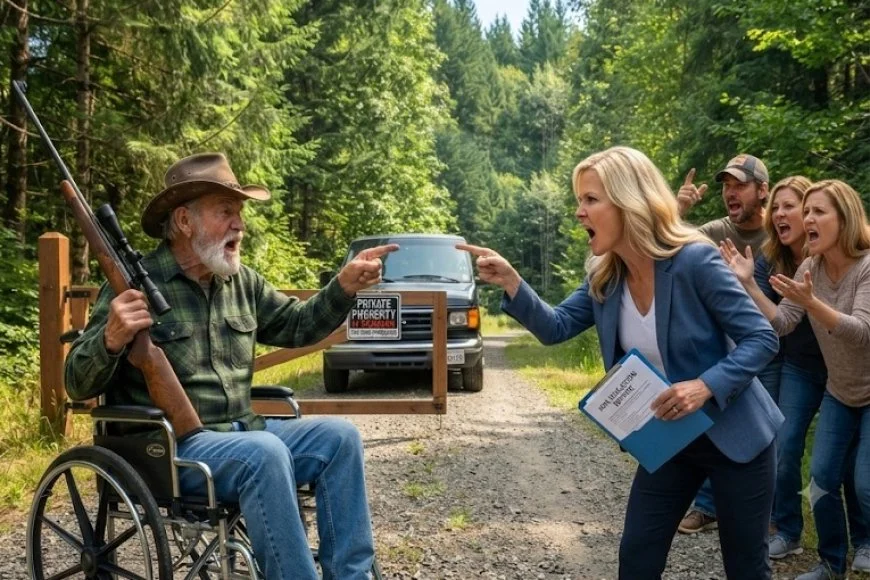
The HOA president was standing outside my locked forest gate with a $12,400 fine in one hand and fifty angry people behind her.
Two shuttle buses idled along the road.
A tour guide held a microphone.
Parents carried backpacks and binoculars.
And Patricia Vale was shouting that I had no right to keep Timber Creek residents out of “their forest.”
I was seventy-one years old, leaning against my ranch truck, wondering how anybody could become that confident while being that wrong.
Then Sheriff Thomas Reed arrived.
He read the sign I had installed that morning.
ELK RIDGE RANCH — PRIVATE FOREST — NO HOA ACCESS
Patricia marched toward him.
“Sheriff, this man is interfering with an established community amenity.”
Thomas looked through the locked gate toward six hundred acres of pine, creek bottoms, and mountain timber my family had owned for nearly seventy years.
Then he looked at Patricia.
“Mrs. Vale, do you have a deed?”
She blinked.
“A permanent easement?”
“The developer promised—”
“A recorded ownership document?”
Patricia raised the fine notice instead.
“He’s been hunting inside a protected recreation zone.”
Thomas turned toward me.
“Silas, you hunting lawfully on your own ranch?”
“Yes.”
“Licensed?”
“Yes.”
“Following state safety requirements?”
“Yes.”
He looked back at Patricia.
“Then your HOA can’t fine him for lawful activity on land outside your association.”
Her face changed.
Not because she suddenly understood.
Because fifty residents had just heard it.
“The forest has been used by Timber Creek for years.”
“Used,” I said. “Not owned.”
Patricia pointed at the gate.
“You cannot simply revoke access because you’re angry.”
“I revoked it because your HOA sent children into an unsafe fire lookout, hired contractors inside my forest, and tried to ban me from hunting on my own land.”
A murmur moved through the crowd.
Then my ranch hand Joe came running from the northern road.
He was carrying a broken padlock.
And a bright orange trail ribbon.
“Silas,” he said, breathing hard, “somebody opened the old logging gate.”
Thomas straightened.
“When?”
“Less than an hour ago.”
Joe pointed toward the northern ridge.
“Fresh tire tracks. They head toward Frank Bennett’s lookout.”
My father’s lookout.
The same abandoned wooden tower Patricia had recently advertised as a “Wildlife Overlook” despite repeated warnings that the stairs were unsafe.
Patricia stopped shouting.
Thomas noticed.
“So,” he said quietly, “what’s up there that you don’t want us to find?”
But the fight had begun months earlier with something much smaller.
A photograph.
Patricia first came to Elk Ridge Ranch carrying a picture of me walking through my northern woods with a rifle.
She had taken—or obtained—the photograph from somewhere near Timber Creek’s property line.
“You cannot hunt that close to our community,” she told me.
“I’m more than a mile from your houses.”
“Our residents hear gunshots.”
“Occasionally. During legal hunting season.”
“Families moved here for peaceful mountain living.”
“So did the deer.”
She did not appreciate that.
I explained that my father had taught me to hunt responsibly when I was twelve. I carried the right tags. I knew the terrain. I never fired toward roads, homes, trails, or the eastern boundary where Timber Creek residents sometimes walked.
That walking access existed because I allowed it.
Timber Creek had been built beside our ranch after a developer bought neighboring land. Its first HOA president, Robert Hayes, had asked whether residents could use one old trail crossing the southeastern corner of my forest.
I agreed.
My attorney, Julia Hart, drafted the terms.
One marked trail.
Daylight use.
No vehicles.
No construction.
No organized events beyond ordinary walks.
No access to the northern forest.
No permanent easement.
For two years, it worked perfectly.
Then Patricia became president.
Three days after our hunting argument, I received an HOA violation.
Then another.
Then an $800 fine.
Patricia called the northern woods a “protected recreation zone.”
My attorney replied that Timber Creek had no authority to create a recreation zone across property it did not own.
Patricia kept issuing fines.
Then she changed the neighborhood map.
A green trail appeared beyond the permitted route.
It crossed my logging road and ended at my father’s old fire lookout.
TIMBER CREEK WILDLIFE OVERLOOK
That tower had been closed for years.
Loose railing.
Rotten steps.
A chain across the entrance.
I called Patricia.
“Remove that route.”
“We’re improving the resident experience.”
“You’re advertising an unsafe structure on private land.”
“Our families deserve access to the wilderness around their homes.”
“They bought houses beside wilderness. They did not buy the wilderness.”
The next morning, Joe and I found fresh orange ribbons leading toward the tower.
Someone had removed my private-property sign.
A green Timber Creek Nature Trail sign stood in its place.
The chain was still there, but the padlock had fresh tool marks.
Julia demanded the HOA stop immediately.



