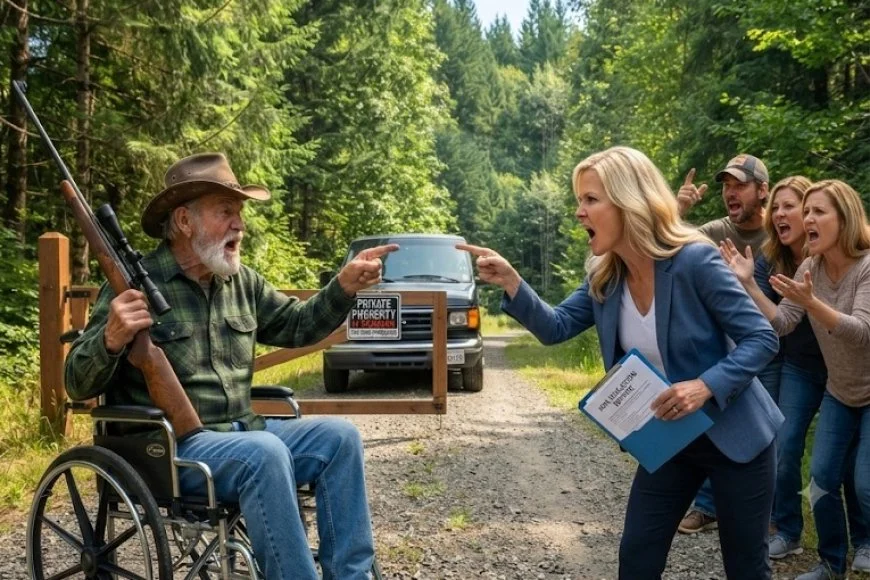
Somewhere between that report and Timber Creek’s later development handover, “ready for final approval” became “permanent forest access secured.”
That phrase appeared in old association documents for years.
But there was never a recorded agreement supporting it.
The irony was almost painful.
Timber Creek’s first president, Robert Hayes, had apparently understood the problem. That was why he came to me years later and negotiated the limited walking arrangement.
If the HOA already owned permanent forest rights, Robert would never have needed my permission.
Patricia had inherited an old statement, ignored the later agreement proving its limits, and treated the broadest interpretation as fact.
Maybe that explained how the delusion started.
It did not excuse what happened after my attorney showed her the deed.
The board’s independent review found Patricia had received repeated written warnings that Elk Ridge Ranch lay outside Timber Creek’s boundaries. She had also received notice that the lookout was unsafe, that organized access beyond the eastern trail was forbidden, and that North Valley’s work had to stop.
Then she continued anyway.
The $12,400 hunting fine disappeared first.
Timber Creek formally withdrew every charge and corrected its records to show that the HOA’s rules did not apply to lawful hunting on Elk Ridge Ranch.
That should have felt satisfying.
Instead, I stood on my porch looking at a black scar across the northern ridge.
Paper fines vanish quickly.
Burned trees do not.
North Valley’s manager, Steven Brooks, met with Julia and me after investigators finished their first site review.
He looked exhausted.
“Two of my men returned after I said the job was suspended.”
“Why?”
“Mrs. Vale called me directly.”
“You had a letter from my attorney.”
“I know.”
“She told you she had authority?”
“Yes.”
“And you believed her?”
Steven looked down.
“I should have checked.”
Those four words summed up almost every failure in the story.
Patricia should have checked the deed.
The contractor should have checked the worksite authorization.
Parents should have been told the lookout was closed.
Board members should have checked where the forest-improvement money was going.
Everybody kept accepting the version that allowed them to move faster.
The official fire investigation eventually connected the origin area to the temporary equipment setup near the lookout project. Investigators addressed electrical equipment, fuel storage, dry vegetation, and the unauthorized work conditions that allowed the fire to spread. I let professionals decide exactly how responsibility should be divided.
Julia handled the property claim.
I did not want imaginary millions.
I wanted the damaged gate repaired.
Unsafe materials removed.
Forestry assessments paid.
Restoration funded.
And I wanted Timber Creek’s organized activities out of my woods permanently.
The HOA board suspended Patricia from office while the financial, safety, and insurance reviews continued.
Robert Hayes reluctantly returned as acting president.
At the next community meeting, the clubhouse was packed.
Jennifer Clark sat near the front with Olivia, whose knee had healed but who still refused to look at photographs of the old lookout.
Daniel and Linda sat beside them.
Paul Harris, the treasurer, presented the forest-project expenses.
Signs.
Trail clearing.
Transport planning.
Equipment rentals.
Lighting.
Viewing-platform materials.
Thousands of dollars spent improving land the association did not own.
A man in the second row finally asked the question that cut through everything.
“Why were we paying to improve somebody else’s forest while fining him for using it?”
No one answered immediately.
Then Linda raised her hand.
“Because some of us forgot that being welcomed somewhere doesn’t make it ours.”
I looked at her.
That was exactly right.
Patricia eventually spoke.
She said she believed Timber Creek possessed broader recreation rights and that her actions were intended to protect residents, improve safety, and preserve the identity of the neighborhood.
Jennifer stood.
“My daughter was trapped on rotten stairs.”
Patricia’s lawyer leaned closer to her.
Jennifer held up the original wildlife-walk invitation.
“This promised families access to the lookout. We were never told the ranch owner had forbidden it. We were never told the stairs were unsafe.”
Patricia looked away.
Jennifer continued.
“You keep saying safety. Why didn’t you listen to the person who knew the forest?”
That was the moment the room changed.
Not when the hunting fine disappeared.
Not when the money records appeared.
When a mother whose child had nearly fallen from the tower asked a simple question Patricia could not answer.
The board removed Patricia as president under its governing procedures.
Robert took over until a regular election.
He looked miserable.
I considered that proof he might do a decent job.
After the vote, he asked whether I wanted to speak.
I stood slowly.
“My family has lived beside this forest for seventy-one years. My father taught me to respect wildlife, neighbors, fire, weather, and the simple fact that land can be dangerous when people stop paying attention.”



