Instead, Patricia announced a guided sunset wildlife walk to the lookout.
Parents were encouraged to bring children.
She told residents I had finally approved it.
I had not.
That night, before the public event even happened, several HOA volunteers entered to prepare the route.
Joe and I were sitting on my porch when we saw lights moving high on the ridge.
Then came a crack.
Old timber breaking.
A woman screamed.
We reached the lookout with emergency crews twenty minutes later.
A nine-year-old girl named Olivia Clark was trapped on the second landing.
A stair had broken beneath her.
Her mother stood below crying while firefighters stabilized the structure and brought Olivia down safely.
She escaped with a scraped knee.
It could have been much worse.
Beside the stairs lay my cut chain.
After that, I ended Timber Creek’s walking permission.
Patricia responded by raising my accumulated HOA fines to $12,400.
Then I discovered stacks of new signs waiting inside my forest.
TIMBER CREEK FOREST PRESERVE
NO HUNTING
HOA RULES ENFORCED
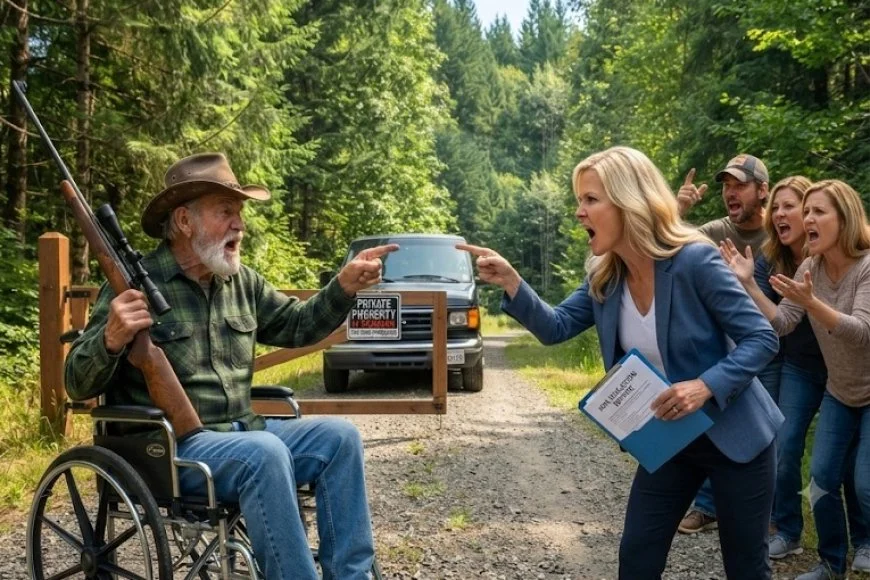
That was when I installed the new locked gate.
And that was why Patricia arrived with two shuttle buses and fifty paying participants for an annual forest walk that no longer had permission to enter.
Now Joe stood beside Sheriff Reed holding a broken padlock from another gate.
Thomas looked at Patricia.
“What is your HOA doing near that lookout?”
“Nothing.”
Joe shook his head.
“Then somebody else is driving Timber Creek vehicles through Silas’s forest.”
Thomas reached for his radio.
Patricia’s face went pale.
And from somewhere beyond the northern ridge, smoke began rising through the trees…
The first thing I smelled was gasoline.
Joe and I stayed on the ranch road while Sheriff Reed called fire crews. Near the lookout clearing, somebody had installed temporary work lights, a portable generator, extension cords, fuel cans, and stacks of building material for a viewing platform I had never approved.
Dry grass was already burning.
Then a Timber Creek utility vehicle appeared through the smoke.
Patricia was driving.
Two people were with her, including a photographer hired to document the “forest improvements.”
The wind shifted.
Flames crossed the road behind them.
For one ugly second, Patricia Vale—the woman who had spent months trying to take control of my woods—was trapped inside them.
I called 911 again and gave rescuers the western service-road route my father had built decades earlier. Firefighters reached Patricia’s group from the safer side and got all three people out.
Then the fire turned east.
Toward Timber Creek Estates.
Ninety-four homes sat below the ridge.
Sheriff deputies began evacuating the nearest streets while crews used our ranch roads and water tanks to fight the fire.
Nobody talked about HOA fines anymore.
By morning, the homes were safe.
Parts of my northern forest were not.
Investigators found the fire’s origin near the equipment installed for the unauthorized lookout project. They still needed to determine the exact cause, but one fact was already clear: North Valley Outdoor Services had returned to my ranch after its manager told my attorney all work was suspended.
Patricia had contacted them directly.
Then Timber Creek’s treasurer found something else.
The HOA had spent thousands on trail clearing, signs, transportation planning, lighting, and the proposed viewing platform.
All inside a forest it did not own.
And buried in older development records was a mysterious $65,000 payment labeled:
FOREST ACCESS ACQUISITION.
For the first time, I wondered whether Patricia’s claim had started with more than arrogance.
Maybe somebody had once paid for rights to my father’s land.
The question was—
who received the money?
Part 3
My father had been dead for years, but he had left behind the one thing Patricia never seemed to respect: paperwork. Two days after Julia told me about the $65,000 “Forest Access Acquisition” entry, I opened Dad’s old filing cabinet in the farmhouse office and began going through envelopes I had not touched since settling his estate.
Near the bottom was one from Ridgeway Land Services.
The proposal inside offered Dad exactly $65,000 for permanent recreation rights across part of Elk Ridge Forest. The developer wanted guided trails, maintenance access, the old lookout, and the ability to advertise the surrounding woodland as part of Timber Creek’s recreation network.
Dad’s answer was handwritten beneath the offer.
Not interested.
No signature accepting the deal.
No check.
No easement.
Nothing.
I called Julia.
“The amount matches.”
“That doesn’t mean the money was paid to your father.”
“It means somebody expected to spend sixty-five thousand dollars.”
“Exactly. Now we find out where it went.”
The original developer eventually produced accounting records. Ridgeway had been paid $65,000 as a consulting and acquisition fee to secure forest access rights. It was not payment to Dad. Ridgeway’s later report said negotiations were “ready for final approval,” even though Dad had already rejected the proposal.



