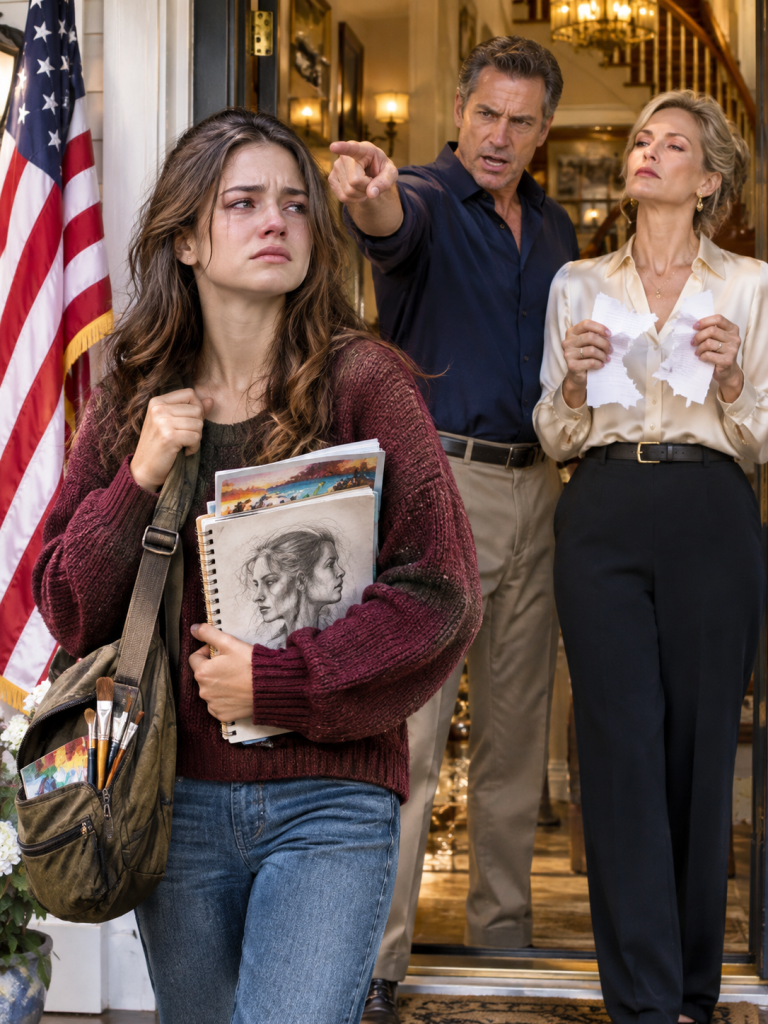
The door swung shut behind her with a soft thud that sounded far too much like the night my dad had slammed it in my face. After she left, something unexpected happened.
A small crowd gravitated toward my series, whispering about the confrontation they’d just witnessed. A local blogger asked if he could feature the paintings and the story behind them.
Invitations for smaller exhibits followed. The humiliation she tried to throw over me like a net had slipped, landing squarely on her instead.
I looked at the empty doorway and felt something twist inside me. Not sadness, not fear, but a cold, sharp resolve.
If my parents insisted on turning my life into a battlefield, I would make sure every wound left a mark they couldn’t scrub off their reputation. When the applause for the evening’s awards started a few minutes later and I heard my name called for most impactful series, a question echoed in my mind, louder than the clapping.
When the people who are supposed to love you turn their backs, would you choose to forgive them or let your success slice back in their direction? After the exhibition, life didn’t magically get easier.
The tiny cash prize barely covered a month’s rent, and my parents rage escalated in all the ways that didn’t leave bruises, but left scars.
Anyway, first came the emails, long, furious paragraphs about how I was smearing the family name and using trauma as a cheap marketing trick.
I blocked them. Then came the calls from relatives repeating my parents’ version of the story that I had run away, that I was sick, that I was being manipulated by bad influences.
One aunt even sent a voice message saying my art was demonic. I laughed so I wouldn’t cry.
The worst hit came a few months later. I was walking back from the night shift at the diner when a police car rolled slowly up beside me.
My throat tightened. The officer stepped out and asked my name, then said they’d received a report of a missing minor believed to be in danger.
That minor was me. That concern was my parents trying to drag me home in handcuffs like I was property.
At the station, after what felt like hours of questions, an officer finally slid a paper across the table for me to sign, acknowledging that I was safe, enrolled in school, working, and under no threat. Legally, they couldn’t force me home.
The report would be closed. The officer gave me a sympathetic look as I signed.
“Some parents don’t know when to let go,” he murmured. I walked out into the night air, hands trembling, fury boiling just under my skin.
They had tried to paint me as helpless, unstable, incapable. Fine, I thought.
Then I’ll paint you exactly as you are. That night, I opened my journal, a battered notebook filled with unfinished sketches and angry scribbles, and began to write like a confession to my future self.
I described every manipulation, every threat, every burned sketch and shredded canvas. I taped in old photos, my dad throwing away my art supplies, my mom tearing up a drawing she’d found under my pillow.
I didn’t know why, but it felt important to document it all, like evidence. A month later, a flyer appeared on the school bulletin board, a regional competition themed truth and consequences sponsored by a major gallery.
The winner would receive a sizable grant and a chance to show their work to serious collectors. The phrase truth and consequences buzzed in my mind.
I knew exactly which truth I wanted to put on a wall. I designed a piece that terrified even me, a towering, distorted family portrait.
The parents’ faces were photorealistic, recognizable to anyone who knew them, but cracked down the middle like shattered porcelain. Behind them, instead of a home, loomed a courtroom, a hospital, and a house with foreclosure signs, images of the future I wished on them each time they said I’d come crawling back.
The child in the painting, me, turned her back on the frame entirely, walking toward a blank canvas that glowed like a doorway out. I painted until my fingers achd and my vision blurred.
During breaks, I reread my journal entries, letting the memories sting so I could drag that pain onto the canvas. One evening, my phone lit up with my mother’s name.
Against my better judgment, I answered. We heard you caused a scene with the police, she began without greeting.
Do you know how that makes us look? People think we don’t care about our own daughter.
I laughed bitter. You care a lot about how you look, not so much about me.



