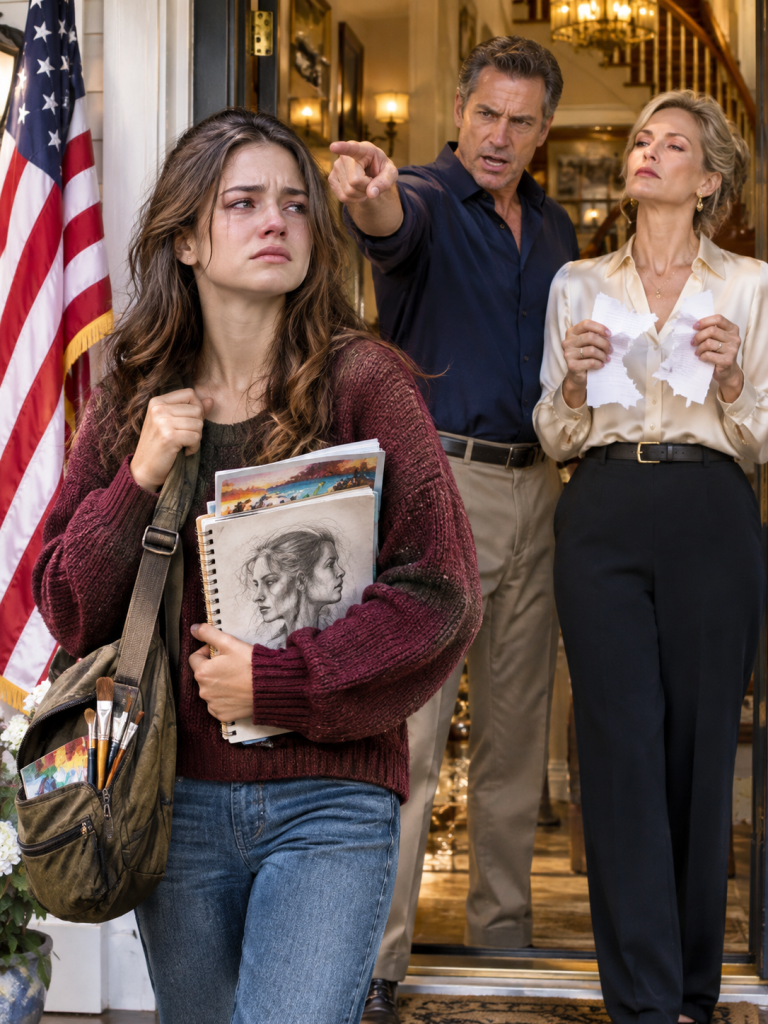
So, you’re not here to understand me, I said quietly. You’re here to ask me to protect you again.
She swallowed, unable to deny it. You could paint something else, she said.
Something less personal. If you pull that piece from the competition, your father and I can help you.
We can pay your tuition. We can fix the scholarship issues.
We can make this right. The offer hovered between us like a poisonous flower.
safety, stability on the condition that I erase the truth. I looked at her and saw flashes of memory.
Her ripping up my first painting. Her standing silent while my dad told me to get out.
Her calling the police instead of calling to ask if I was okay. “You’re not trying to make this right,” I said finally.
“You’re trying to rewind to a version of me that doesn’t exist anymore.” She flinched.
For a moment, the cafe noise faded, and it was just us, mother and daughter, balancing on the edge of a choice that would decide everything. “You want to know what kind of mother you are?”
I asked softly. “You are the reason my art has teeth.”
I stood, sliding my chair back. “I’m not pulling the painting.”
She stared up at me, eyes shining with a mix of fury and hurt. If you do this, don’t come to us when it all falls apart.
I almost laughed. You already made sure there was nowhere to come back to.
As I walked out of the cafe, my hands trembled, not from fear, but from the raw power of finally refusing to be bought. One thought echoed in my mind like a drum beat.
Can a single apology ever erase years of being told that your dreams were worthless? or is there a point where sorry comes too late to matter?
The week of the regional competition felt like standing in the eye of a storm, unnaturally calm, with chaos swirling just out of sight. I barely slept, but this time it wasn’t from doubt.
It was from the adrenaline of someone about to light a match in a room full of dry paper. The competition venue was massive.
A converted warehouse with high ceilings and white walls that made every color scream. My peace, truth, and consequences hung on a central wall impossible to miss.
The towering cracked faces of my parents watched over the room like broken saints in a stained glass window. The foreclosure signs and hospital corridors behind them drawn with ruthless precision.
The walking away child glowed at the edge of the frame, heading toward that bright blank canvas. During setup, I ran my fingers lightly along the dried paint, remembering the nights I’d painted until my hands went numb.
I’d hidden small details in the work. Subtle references only people who knew our family would catch.
My father’s watch, my mother’s favorite necklace, the engraved plaque from his once thriving business, now splintered and half buried in the background. This wasn’t just art.
It was a testimony. The morning of the opening, my inbox pinged with an email from my father, a cold block of textthreatening legal action if I continued to defame this family.
I forwarded it to my professor who forwarded it to the competition organizers. A succinct reply came back.
Artistic expression is protected. We stand by our artists.
For the first time in my life, adults with power were standing on my side instead of against me. When the doors finally opened to the public, the room flooded with people.
Critics, local news, collectors, students. I kept my distance at first, watching from a corner as they approached my piece.
Faces shifted. Curiosity, discomfort, fascination.
Someone murmured, “That’s brutal.” Sounding almost impressed.
I saw a woman snap a photo, then another of the name tag below. Sarah Tran, age 16.
My age became part of the shock. Then I saw them.
My parents entered together, dressed as if they were going to a gala instead of a trial they didn’t know they were on. My father’s jaw was already set, shoulders stiff.
My mother’s eyes darted nervously around the room until they landed on the painting. I watched the exact moment recognition hit.
Their steps faltered. My father’s face went from confusion to fury in seconds.
My mother’s hand flew to her mouth. They stood there frozen in front of a larger than-l life reflection of their worst selves.
A few people nearby realized who they were. Whispers started, sharp and quick.
A man I recognized as a local journalist raised his eyebrows, glancing between the canvas and my parents like he’d just stumbled into the story of the year. My father turned, searching the crowd, and found me, our eyes locked.



