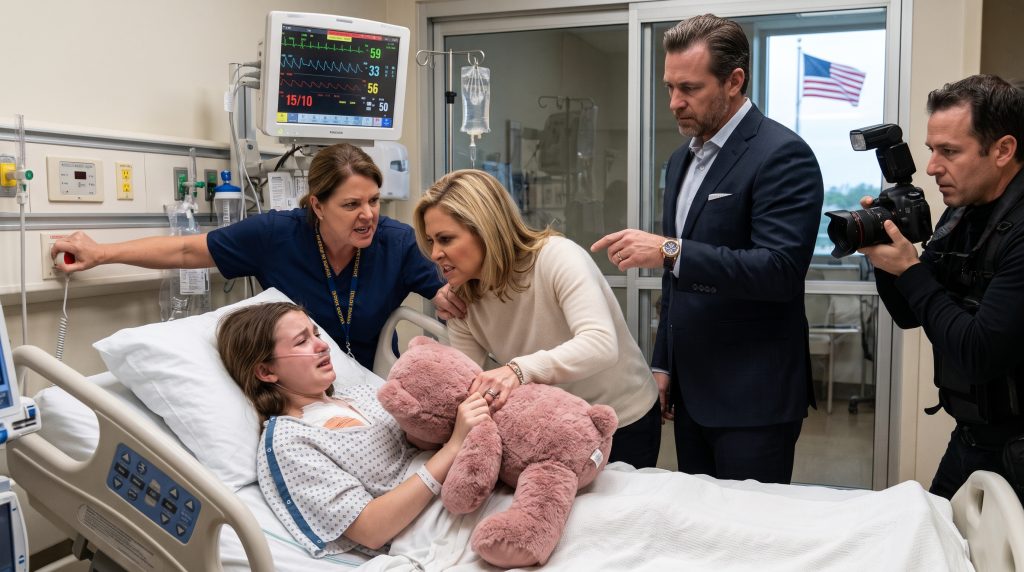
He hadn’t touched a livestreaming gimbal in three years. After two years of intensive trauma therapy and transferring to our local public high school—where nobody knew what a Patek Philippe was or cared what his father used to manage—he had grown into a quiet, lanky kid with grease under his fingernails who built automated irrigation sensors for the school greenhouse and fiercely checked my pulse ox whenever I ran up the stairs too fast.
“Sienna!” Elena’s voice floated out through the kitchen window. “If you leave that envelope on the damp porch boards, the ink is going to run before I can put it in the frame!“
I smiled, looking down at the thick cream envelope resting across my knees.
University of Connecticut — School of Nursing. Early Action Admission: Class of 2031.
I was going to be a pediatric cardiac nurse. Dr. Foster had already written my recommendation letter and promised me a summer clinical rotation at Greenwich Hospital as soon as I finished my sophomore prerequisites. I wanted to be the person standing beside Trauma Bay 2 when a terrified kid came through the doors with nobody in the waiting room.
Out of habit—an old, protective reflex I was finally starting to outgrow—I picked up my iPad from the porch planks and scrolled through the regional business section of the Hartford Courant.
Greenwich society is a brutal, Darwinian ecosystem. It will forgive insider trading. It will forgive three divorces and a mistress in Tribeca. What it will never forgive is becoming toxic to the money.
Once Judge Mercer’s criminal referral hit the U.S. Attorney’s desk and the uncut forty-five-minute Chanel video was entered into the public docket, investors pulled three hundred and eighty million dollars out of Wexler-Vance Capital in seventy-two hours. Worse, when the federal forensic auditors subpoenaed Richard’s trust ledgers to separate my restitution lien, they discovered why he had been so frantic about the insurance underwriters looking too closely at the family umbrella entities: for six years, he had been quietly pledging his clients’ liquid reserve accounts as collateral for his own leveraged commercial real estate bets in Manhattan.
He didn’t go to prison for leaving me to die on the operating table—Arthur Sterling managed to plea the child endangerment charges down to a suspended sentence and five years’ probation by arguing diminished capacity under financial stress. Instead, the Southern District of New York indicted him four months later for wire fraud and fiduciary embezzlement.
The divorce between Richard and Vanessa had played out across Page Six like two starving wolves locked in a cellar. Vanessa had testified against him in the SEC asset-forfeiture hearings in exchange for immunity, claiming she didn’t know how to read a tax return, only for the federal receiver to seize the Round Hill Road estate, the Nantucket house, and forty-two cataloged Hermès and Chanel handbags—including a certain emerald green caviar-leather flap bag—to satisfy the fraud judgment. Last I had heard from Julian Stone, she was living in a rented one-bedroom apartment in Fort Lee, New Jersey, working on commission at a consignment showroom and blocked by every charity committee in Fairfield County.
Richard had served twenty-two months in the federal minimum-security camp at Otisville before being released to a halfway house in Stamford last Tuesday, completely bankrupted, barred for life by the SEC, and owing eleven million dollars in federal restitution.
As if reading the headline had summoned a ghost, my iPhone vibrated against the wooden porch step beside my sneaker.
I picked it up. It was an unsaved number with a 203 Stamford area code.
Sienna. It’s Richard. I saw the honors list in the Hartford paper—congratulations on UConn. I’m out and working consulting in Stamford. My health hasn’t been great since upstate. I’m thirty minutes down I-84 and would really like to buy you a coffee for five minutes. There are also some tax carryover documents on the 2012 educational trust that only require your signature as an adult beneficiary at eighteen to release an administrative reserve account. I miss my daughter. Please.
I sat on the sunny porch steps and read the message twice.
Three years ago, seeing his name pop up on a screen would have made my throat close up and my heart slam against my ribs until I tasted copper. I would have wondered if I was being cruel. I would have wondered if maybe, underneath the spreadsheets and the cold stares, he had finally realized what he’d lost.
Now, at seventeen, with a steady sixty-two beats per minute humming smoothly behind my silver scar, I dissected the paragraph with the exact same surgical clarity he had taught me at that marble kitchen island.



