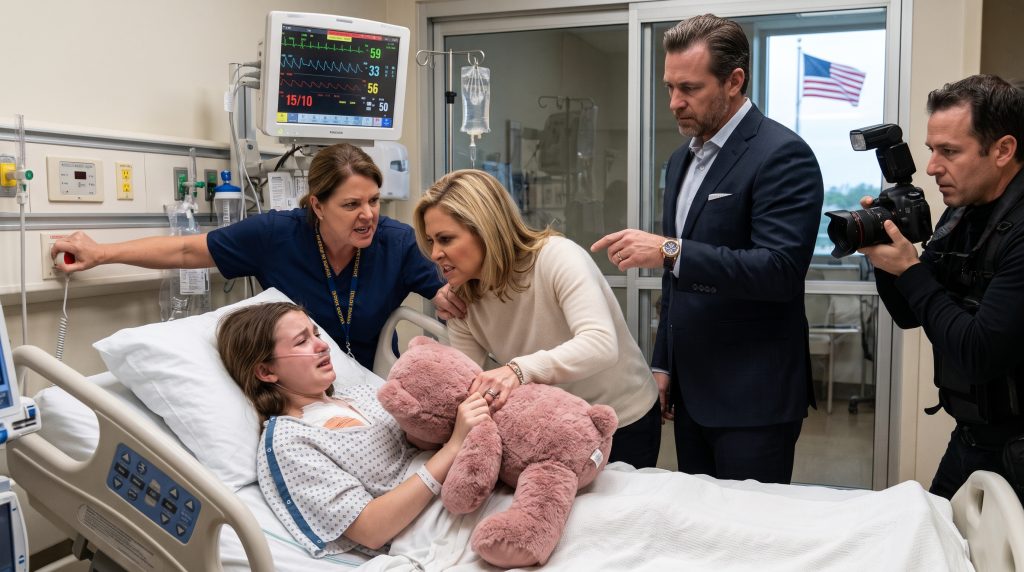
“A court order takes forty minutes, Karen—she has four!” Dr. Foster slammed his closed fist down onto the stainless steel instrument tray so hard that three hemostats and a kidney basin went flying across the linoleum. “Start compressions! Code Red!”
He ripped the top admission sheet off my aluminum clipboard, crumpling Richard’s restrictive legal rider in his fist.
“Log that speakerphone audio for the state prosecutor as willful medical abandonment of a minor!” Foster roared over the thud of a resident pumping on my chest. “Under Connecticut statute, active parental abandonment in a lethal emergency voids custodial exclusivity! Karen, get off this floor right now—run to central records, pull the archived paper intake files from five years ago, and find the name of that public school nurse who signed her urgent care waiver when she had the acute asthma attack at age nine! If that woman signed a secondary financial liability guarantee that was never formally revoked by the family attorneys, I will use her signature to cut right now—because I am not letting this girl die over a damn handbag!”
I didn’t hear Nurse Karen run out the double doors. The resident’s hands came down on my breastbone again, driving me into a deep, merciful velvet blackness where there were no stock tickers, no ring lights, and no empty velvet chairs.
When I finally surfaced, the world smelled like iodine, starch, and rain-damp wool.
It took me a long time to figure out why I wasn’t drowning anymore. The plastic tube was gone from my throat, replaced by the soft, dry hiss of nasal cannula prongs resting against my upper lip. My chest didn’t feel like it was being crushed by a vise anymore; instead, it felt heavy, rigid, and fiercely hot down the center line, bound together under thick surgical gauze and stainless steel sternal wires.
I tried to shift my right hand and realized my fingers were already enclosed in someone else’s.
Instinctively, my shoulders flinched against the mattress. In my house, nobody touched you unless they were yanking your arm toward a photographer or checking your forehead to see if you were going to embarrass them at dinner. I braced for the cold, sharp bite of Vanessa’s three-carat pave band.
Instead, the palm wrapped around mine was warm and slightly rough at the knuckles, the skin dry from twenty years of scrubbing with antibacterial school-infirmary soap. The fingernails were clipped short, clean, and completely unpolished.
I forced my eyelids open against the dim amber glow of the ICU wall sconce.
Sitting in the stiff vinyl bedside chair, her chin propped on her fist and dark purple hollows bruised beneath her hazel eyes, was a woman wearing faded navy scrubs with a laminated HARTFORD PUBLIC HIGH SCHOOL — HEALTH SERVICES badge clipped to the V-neck.
“Aunt Elena,” I rasped. It barely sounded like a word—more like two pieces of gravel rubbing together in the back of my throat.
Elena’s head jerked up so fast her plastic hair clip clicked against the chair back. For a second, she just stared at me, her lower lip trembling so violently she had to bite down on it before she stood up and leaned over the aluminum bedrail.
She didn’t look anything like her younger sister. Vanessa had spent fifty thousand dollars over the last decade erasing every family feature from her face—planing down their father’s slightly crooked Polish-American nose, filling the laugh lines around her mouth until she looked like glazed porcelain. Elena still had the crooked bridge, the silver threads woven through her thick chestnut braid, and the warm, crinkling corners around her eyes that I remembered from the one afternoon in 2021 when I had collapsed wheezing at a regional spelling bee near Hartford while Vanessa’s phone was on Do Not Disturb at a spa in Tribeca. Elena had driven twenty minutes in her dented green Forester, carried me into an urgent care clinic in her arms, and put a three-thousand-dollar respiratory stabilization bill on her personal credit card—a sin for which Richard had banned her from the Greenwich estate permanently, calling her a “opportunistic blue-collar parasite trying to establish leverage.”
“Hey, kiddo,” Elena whispered, her voice thick with thirty hours of unshed tears. She brushed a damp tangle of hair off my forehead with fingers so gentle it made my newly wired chest ache in a completely different way. “Hey, brave girl. Don’t try to talk yet, your vocal cords are bruised from the tube. Dr. Foster cleared the blockage. You’ve got a brand-new outflow tract and a heartbeat you could set a Swiss watch to.”
I couldn’t speak, so I just turned my wrist over and squeezed her rough, warm fingers as hard as my IV-tethered arm would allow.



