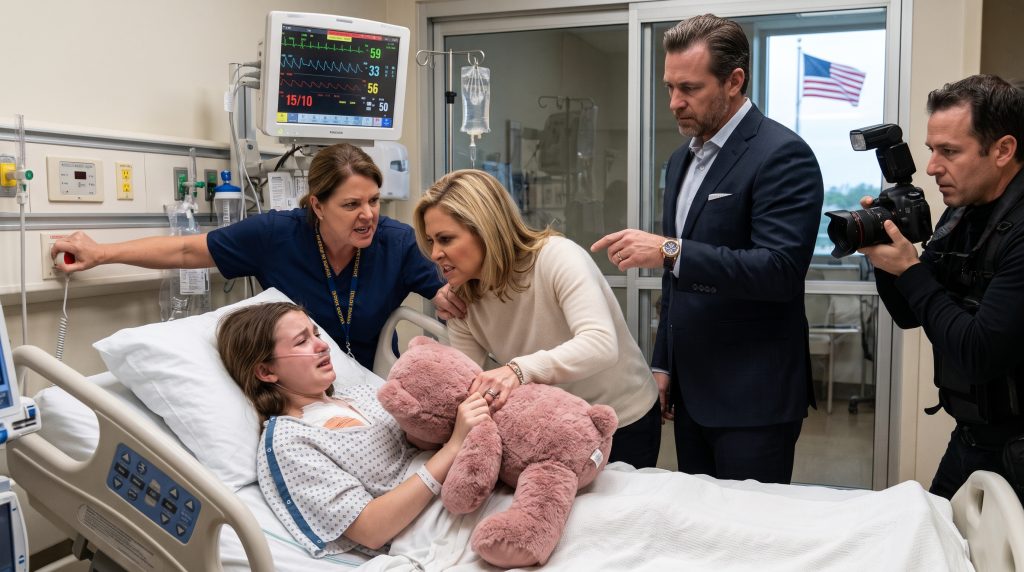
Dr. Aris, the head of the upper school science department, stepped back from the oak lectern and applauded. Four hundred girls in identical tartan kilts and navy blazers clapped politely.
My legs felt detached from my hips as I walked across the polished maple stage. The theatrical spotlights overhead were blindingly hot, searing against my corneas as I adjusted the gooseneck microphone. Automatically, out of sheer pathetic habit, I looked down past the brass footlights toward the center section of the first row.
Two velvet seats had white cardstock signs taped to their backs: RESERVED — MR. & MRS. RICHARD WEXLER.
Both were empty.
I took a shallow breath. “Cellular respiration,” I began, my voice booming hollowly through the ceiling speakers, “is the metabolic pathway by which human cells convert biochemical energy into adenosine triphosphate—”
I never made it to the second slide.
Four minutes in, right as I raised my laser pointer toward the projection screen, a blacksmith’s hammer came down squarely on the center of my breastbone.
It wasn’t an ache. It wasn’t a cramp. It was a violent, mechanical crushing sensation, as if an industrial hydraulic press had clamped around my ribcage and begun ratcheting inward. A sound came out of my throat—a wet, strangled click—as my lungs locked completely shut.
My fingers opened. The microphone slipped from my palm and hit the hardwood stage with a deafening electronic shriek that tore through the auditorium.
I grabbed at the silk crest over my heart, tearing a button loose. Looking down at those two empty velvet chairs, a terrible, lucid thought cut through my rising panic: There’s nobody in this town who is going to sign for me.
Then my knees hit the wood, the stage tilted ninety degrees sideways, and the applause sign above the exit doors dissolved into a roaring black tunnel.
I didn’t stay unconscious. That was the cruelest part of the next forty minutes.
Hypertrophic obstructive cardiomyopathy doesn’t always kill you cleanly on the first collapse; sometimes your heart quivers in ventricular fibrillation, starving your brain just enough to paralyze your limbs while leaving your auditory cortex wide awake in the dark.
I remember the cold steel blades of the paramedic’s trauma shears slicing up the center of my uniform blouse. I remember the shriek of the siren bouncing off the stone overpasses of Route 1, and someone shouting that my blood pressure was sixty over palp. Mostly, I remember the blinding fluorescent glare of Trauma Bay 2 at Greenwich Hospital and the suffocating, paralytic weight of the etomidate they pushed into my IV line right before they shoved an endotracheal tube down my windpipe.
I couldn’t blink. I couldn’t twitch a finger. I was trapped behind my own closed eyelids, listening to the chaotic symphony of ten medical professionals trying to keep a fourteen-year-old girl from dying on a vinyl gurney.
“V-fib again! Charging to two hundred—clear!”
The shock was like having molten copper poured directly into my spine. My back arched off the table; I felt the violent thud of my shoulder blades slamming back down against the mat, tasted blood where my teeth had bitten my tongue around the plastic bite block, and heard the monitor sputter back into a ragged, panicked staccato.
“Dr. Foster, she’s throwing runs of V-tach every forty seconds!” a woman’s voice shouted near my left ear. Nurse Karen. I knew her voice from the one time I’d snuck into the ER for an inhaler refill in seventh grade. “Her outflow tract is almost completely occluded. The epinephrine is making the gradient worse!”
“Kill the epi drip!” Dr. Foster roared. He wasn’t wearing a suit today; when my eyelids fluttered open for a fraction of a second during a chest compression, I saw him in wrinkled blue surgical scrubs, sweat dripping off the bridge of his nose onto my collarbone. He had been doing rounds on the third floor when my ambulance code came over the hospital PA. “It’s the septal hypertrophy I flagged four years ago! The anterior mitral leaflet is getting sucked straight into the left ventricular outflow tract. She’s in refractory cardiogenic shock—if we don’t put her on cardiopulmonary bypass and do an emergency septal myectomy in the next fifteen minutes, we’re going to lose her on this table. Call OR 3 and tell Dr. Miller to scrub in now!”
“Doctor, she’s fourteen!” Nurse Karen’s voice cracked with sheer terror. “The surgical desk won’t release the bypass pump without a guardian authorization on the chart! Richard Wexler has a legal rider on file with hospital administration—no invasive procedures without explicit dual-parent verification!”
“To hell with hospital administration, Karen, her brain is hypoxic!” Foster shouted, his gloved hands flying across the ultrasound probe on my ribs. “Dial the emergency contact on the wall speaker! Let them hear the damn monitor while they try to tell me no!”



