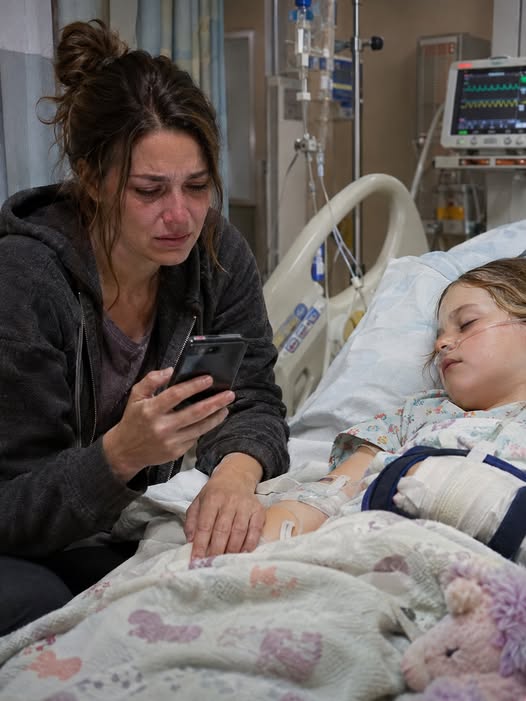
At 8:41 on a Friday night, I sent my parents and my brother a photograph of my seven-year-old daughter, Hazel, lying in a hospital bed.
She had just survived emergency surgery.
Her left arm was in a splint, an IV was taped to her other arm, and a long bandage covered the incision where surgeons had removed her spleen.
My mother answered in less than two minutes.
“She survived. Stop seeking attention.”
Then she added, “Your father has worked two years for tonight. Don’t do this to him.”
Three minutes later, my brother Travis wrote, “Handle your own kid. Don’t drag us into your drama.”
My father read both messages.
He didn’t reply.
I stared at the screen beside my daughter’s hospital bed, typed three different responses, and deleted every one.
Finally, I sent a single word.
“Okay.”
At 10:12 that night, my mother called me screaming.
She had seen something on the local news that frightened her far more than the photograph of her granddaughter.
And the first thing she wanted was my silence.
My name is Patricia Doyle. I’m thirty-six, and I live near Dayton, Ohio.
Until that August, I thought I understood my family’s priorities.
My older brother, Travis, came first. Our family’s bar came next. I was welcome as long as I didn’t make either of them uncomfortable.
I’d been accepting that arrangement since childhood.
My father opened Doyle’s Tap House in Miamisburg in 1994, when I was four and Travis was eight.
Mom ran the kitchen, baked pies, and handled the kind of regular customers who expected someone to remember their names.
Dad worked behind the bar.
Travis grew up being treated as the future of the business.
I grew up being useful.
When I was ten, Dad taught me to count the cash drawer after closing on Sunday nights.
He’d pour me a ginger ale, spread the bills across the counter, and show me how to stack them.
Twenties together. Tens together. Quarters rolled in groups of forty.
“Money has to face the same direction,” he told me, “or you lose track of it.”
Those Sunday evenings were some of my favorite childhood memories because they were the only time I had my father to myself.
Travis got rides to every football practice and game.
He got a pickup truck for his sixteenth birthday.
When I qualified for a regional science fair at twelve, it happened to fall on the same Saturday as one of his games.
I asked Mom for a ride.
She was crimping the edge of a pie crust.
“Your brother has a game, Patty. Handle it yourself.”
I found a neighbor willing to drive me.
I won second place.
Nobody in my family asked how it went.
By then, I’d learned that “okay” was the easiest way to end a conversation.
It meant I wouldn’t argue.
I wouldn’t ask again.
And I wouldn’t make anybody feel guilty.
In 2008, I started studying accounting at Wright State University. I also began handling the bar’s books without pay.
Mom said that was what family did.
The following summer, I drew a logo on a cocktail napkin: a beer tap handle with a curved D.
Dad liked it enough to put it on the sign, menus, and coasters.
Mom embroidered it onto a black canvas apron and stitched my nickname across the pocket in red.
Patty.
One of the Ts was crooked.
I wore that apron every weekend for years.
After college, I went to work in hospital billing, but I continued helping with the bar.
In 2014, I moved its register system onto a cloud-based platform.
Every transaction, refund, and adjustment was stored electronically.
Two years later, that system helped me catch a bartender who had been deleting drinks from customers’ checks and pocketing the cash.
The deleted items were called voids.
He thought removing a drink from a receipt erased the transaction.
It didn’t.
The system kept an audit trail showing what had been changed, when, and whose employee or manager code had been used.
I printed the report and showed my family.
Travis was standing behind me when I explained it.
“You can delete the drink,” I told him. “You can’t delete the deleting. Every void leaves a footprint.”
He rolled his eyes.
“You and your footprints.”
I didn’t think about that conversation again for years.
In early 2019, when I was five months pregnant with Hazel, Dad asked me to meet him at the bar.
He said he was stepping back and Travis would take over management.
“You’ve got a baby coming, sweetheart. Travis needs this.”
Then he promised that half the business would be mine someday.
Within a month, Travis had hired an outside bookkeeper.
I was no longer needed.



