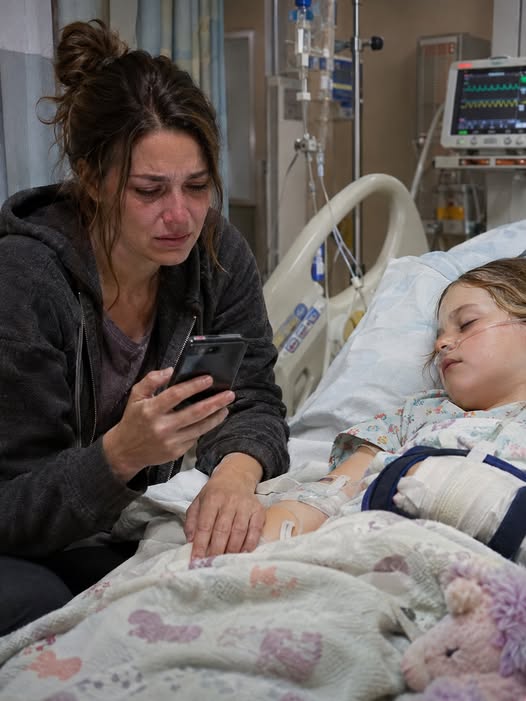
He stood beside Hazel’s bed and held her uninjured hand.
He apologized for not coming sooner.
I asked whether Dwayne had been drunk when he left the bar.
Dad looked down.
“I wasn’t there.”
I waited.
Then he said, “Your mother was.”
He didn’t explain further.
On Sunday, Mom finally visited.
She brought a get-well balloon from the bar’s party supplies, still carrying a price sticker from the grand opening.
She glanced at Hazel, then pulled me into the hallway.
“Dwayne had two beers. Shannon says so.”
Shannon Kirby was one of the bartenders.
“People are going to talk,” Mom continued. “I need you not to help them.”
“Did you see him, Mom?”
“I was in the kitchen all afternoon.”
She left without asking what the surgeons had removed from Hazel’s body.
Monday night, after Hazel fell asleep, I opened my laptop.
My password manager still contained the administrator credentials for the register system I’d installed in 2014.
Nobody had removed my access.
For several minutes, I stared at the login page.
I knew exactly what that system could show.
Every drink sold that Friday.
Every void.
Every manager code used to change a transaction.
But I no longer worked for the business.
Using those credentials without permission could jeopardize any investigation and give Travis a reason to accuse me of tampering.
I closed the page without logging in.
Then I wrote three things on a sticky note.
The register company’s name.
Audit trail.
Every void leaves a footprint.
On Tuesday, I met with Nolan Hartley, an attorney recommended by someone in my hospital’s legal department.
I told him about the crash, the messages, the orange shirt, and my mother’s phone call.
He explained that Ohio’s dram shop law could allow a claim against a bar if it knowingly served someone who was noticeably intoxicated.
The evidence would matter.
So would Hazel’s medical expenses.
Dwayne carried only $25,000 per person in auto liability coverage.
That wasn’t remotely enough for the damage he’d caused.
When I mentioned the register system, Nolan began taking detailed notes.
His office sent preservation letters to the bar and the company operating the system, instructing them to retain the records from August 14.
He asked whether I understood that pursuing the case could mean taking legal action against a business bearing my last name.
I told him I understood.
I was less certain than I sounded.
Wednesday morning, Travis called.
“Your lawyer sent us a letter. You’re suing Dad?”
“It’s a request to preserve records, Travis.”
He grew angry.
Then he said something I hadn’t expected.
“You did the books for ten years. I’ll tell the state you skimmed money the whole time. Who do you think they’ll believe?”
He hung up.
I opened a notebook and wrote down his words, along with the date and time.
I hadn’t accused him of stealing anything.
But he’d immediately threatened me over the books.
That afternoon, someone from church sent me a screenshot of a message Mom had posted to the prayer chain.
She was asking people to pray because her daughter was being pushed by lawyers into suing her own parents while her child remained hospitalized.
Within days, several women I’d known for years stopped answering my messages.
Mom had found a way to make my daughter’s injuries about my loyalty to the family.
On Thursday, Hazel came home.
I taped her medical instructions to the refrigerator.
Her new medication organizer was purple, her favorite color.
That evening, she asked whether Grandma was coming.
“Not today, sweetheart.”
“Okay.”
She said it softly, looking away.
I recognized the tone.
It was the way I’d been saying that word for thirty-six years.
And I realized Hazel was already learning it from me.
The night Hazel came home, Nathan called from Phoenix.
Travis had contacted him through Facebook.
He’d claimed I’d left Hazel with a stranger because I didn’t want to leave work early, and that I was using the accident to get money from my parents.
He’d even suggested Nathan should question whether Hazel was safe with me.
I sent Nathan screenshots of the family chat.
He was quiet for a long time.
Then he said, “I’ve got my problems with you, Patricia. This isn’t one of them.”
The next morning, he sent $3,000 to help cover the work I was missing.
I hadn’t expected it.
But his response made me wonder how many other people Travis had been contacting.
That Friday, Shannon Kirby sent me a message.
She was sorry about Hazel.
She needed to talk.
Not at the bar.
We met the following morning at a park near my house. Lorraine stayed with Hazel.
Shannon brought her six-year-old son, who went straight to the playground.
She sat across from me at a picnic table and told me what had happened the afternoon of the crash.



