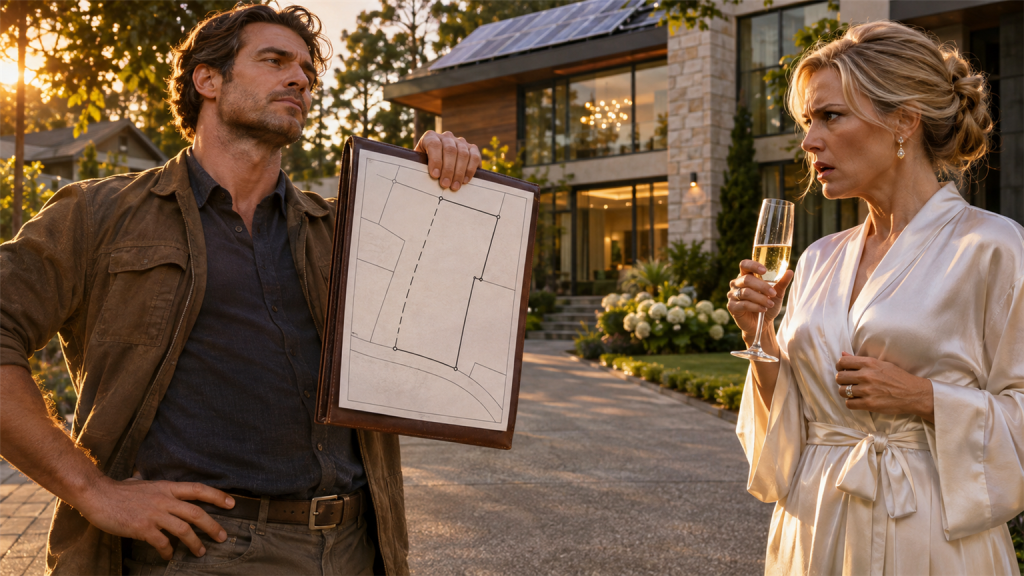
At 6:42 on a perfect Texas morning, I walked outside with a cup of coffee and watched a tow truck steal my car.
My gray Subaru was already halfway onto the flatbed.
The rear wheels hung in the air.
The winch screamed.
“Hey!”
I dropped the coffee and ran barefoot across the porch.
“That’s my car!”
The driver barely looked at me.
“Talk to the association.”
“What association?”
Then I heard a woman laugh.
Across the shared driveway, standing on the enormous porch of the luxury home next door, was Vivian Hale.
White silk robe.
Designer sunglasses.
Mimosa in one hand.
Smugness in the other.
She had moved into the neighborhood seven months earlier and immediately appointed herself unofficial queen of everything visible from her windows.
“Morning, Daniel,” she called.
“What did you do?”
“I enforced the community standards.”
I pointed at my Subaru.
“It’s parked on my property.”
“It has a flat tire.”
“Yes. I ran over a nail yesterday.”
Vivian took a sip.
“And it remained visible overnight.”
I stared at her.
“You called a tow truck because of a flat tire?”
“Our bylaws prohibit disabled vehicles from remaining visible longer than twenty-four hours.”
“It hasn’t even been twenty-four hours.”
“I rounded up.”
The tow driver secured the final chain.
I stepped toward him.
“Take it down.”
He shook his head.
“She signed the authorization.”
“She doesn’t own this driveway.”
Vivian lifted her glass.
“It’s partially shared.”
The truck driver shrugged.
“Not my argument, man. You can pick it up downtown.”
Then he drove away with my car.
It cost me $417 to get it back.
Four hundred seventeen dollars for a vehicle that had been sitting in my own driveway with one punctured tire.
By the time I returned home that afternoon, I wasn’t shouting anymore.
Anger had become something quieter.
More useful.
I parked the repaired Subaru in exactly the same spot.
Then I stood beside it and looked at Vivian’s house.
She called it Willow House.
It was sixty feet long, clad in reclaimed wood, fake river stone, and enough glass to make an airport terminal jealous.
The thing had arrived in prefabricated sections months earlier.
Crews assembled it on her lot, then wrapped a huge timber porch around three sides.
I had always thought it sat unusually close to the driveway.
That afternoon, I finally checked.
Inside my office was the survey from when I bought the property six years earlier.
Stamped.
Recorded.
Precise.
I carried it outside with a steel tape measure and found the survey pin near the curb.
Then I measured.
Once.
Twice.
A third time because I didn’t believe the first two.
Vivian’s porch was four feet over my property line.
Not the roof overhang.
Not a gutter.
Four full feet of structural footprint.
A support beam, decking, and part of the exterior wall all sat on land I owned.
I laughed.
Then stopped.
How had that passed inspection?
Austin inspectors could make you relocate a shed over six inches.
Yet somehow a luxury home had crossed a property line by four feet without anyone caring.
So I searched county records.
That was when the story became strange.
The tax database showed Vivian’s lot.
It showed the land value.
But under permanent residential improvements?
Zero.
I refreshed the page.
Still zero.
I downloaded the full assessment report.
Near the bottom was a classification code I didn’t recognize.
I searched it.
Then sat back in my chair.
Vivian’s million-dollar “eco-mansion” was not registered as a permanent house.
Legally, it was a multi-axle transportable recreational structure.
A trailer.
A forty-thousand-pound, sixty-foot-long trailer.
That explained everything.
No traditional foundation.
No normal residential assessment.
No standard building valuation.
She had used the structure’s transportable chassis to reduce the tax treatment and bypass some of the requirements a conventional permanent home would face.
I went outside after sunset and looked underneath the fake stone skirting.
There were wheels under there.
Actual commercial-grade tires.
Hidden behind removable panels.
A steel chassis.
Tow points.
The whole mansion was resting on blocking.
Vivian had spent the morning mocking my “broken-down station wagon.”
Meanwhile, her entire house was legally closer to a parked vehicle than a permanent dwelling.
And four feet of that vehicle was sitting on my land.
I called a property attorney named Rachel Donovan.
She listened quietly.
Then said, “Do not touch anything.”
“I wasn’t planning to.”
“Good.”
“Can I make her move it?”
“Probably. But you need a clean process. Survey confirmation first. Written notice. Local towing and property rules checked properly. No cowboy nonsense.”
“I live in Texas.”
“That is exactly why I said it.”
The next morning, a licensed surveyor confirmed the encroachment.
Four feet, three inches at the widest point.
Rachel sent Vivian a formal demand giving her an opportunity to correct it.



