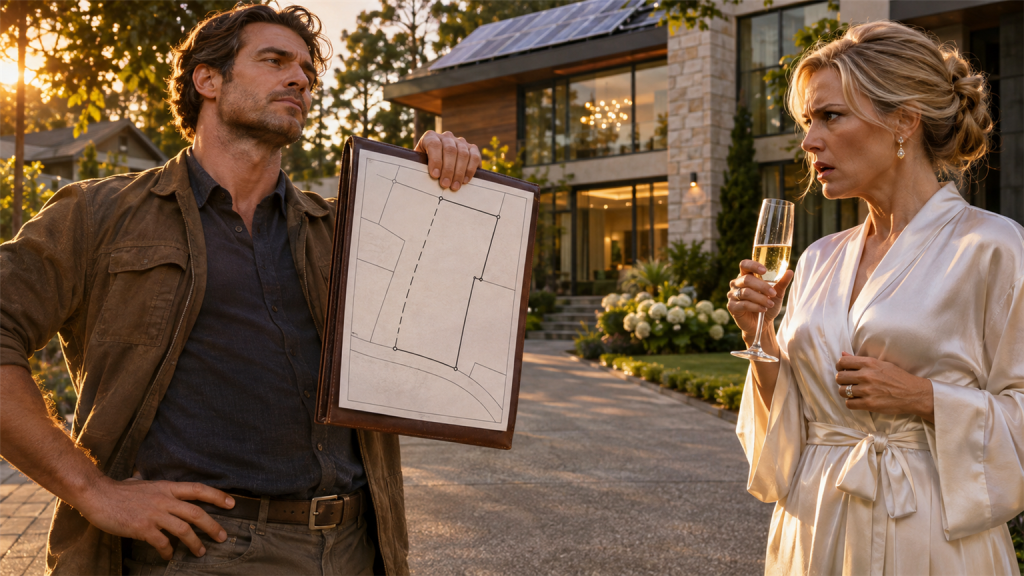
Vivian responded personally.
Not through a lawyer.
She walked into my driveway holding another mimosa.
“You’re upset about the Subaru.”
“I’m upset your house is on my property.”
She laughed.
“My house?”
“Four feet of it.”
“Daniel, please.”
“I had it surveyed.”
Her smile weakened.
“You’re being petty.”
“You towed my car for a flat tire.”
“That was different.”
“How?”
She pointed toward my Subaru.
“That is a vehicle.”
I looked at Willow House.
Then back at her.
“So is yours.”
The glass stopped halfway to her mouth.
For the first time since she moved in, Vivian Hale had absolutely nothing to say…
Rachel warned me that clever revenge made terrible evidence, so everything after that was painfully formal. We documented the survey, the property-line encroachment, the transportable classification, the chassis, and the hidden axles. Vivian received written notice directing her to remove the encroaching structure or arrange a lawful relocation. She ignored it.
Instead, she reported the warning signs I placed on my own boundary. A police officer came, examined the survey pins, and told Vivian the signs were legal. She screamed that they ruined the neighborhood aesthetic. The officer told her aesthetic disputes were not police emergencies.
Vivian then made the mistake Rachel had hoped for.
Standing directly beside the posted notice, she read it aloud mockingly while I recorded the encounter from my property.
“Unauthorized vehicle removal,” she laughed. “There isn’t even a vehicle here.”
I looked past her at sixty feet of timber, glass, hidden wheels, and steel chassis.
I said nothing.
The following day, Rachel confirmed that every required notice period had expired and every written opportunity to resolve the encroachment had been ignored. A specialized transport contractor named Jack Mercer arrived to inspect the structure.
He removed one decorative skirting panel and whistled.
“She really did keep the original transport chassis.”
“Can it move?”
He shined a light underneath.
“Without tearing it apart? Yes.”
“When?”
Jack looked at the mansion.
Then toward Vivian’s upstairs windows.
“Once your lawyer gives me written authorization.”
Rachel sent it at 5:17 that afternoon.
The next morning, at sunrise, a massive heavy-recovery rig turned onto our street.
Vivian opened her front door just as Jack’s crew exposed the first row of hidden wheels.
And then she started screaming.
of 5
Vivian ran from Willow House in slippers and a silk robe as Jack Mercer’s crew removed the decorative stone skirting. Beneath it sat a steel chassis, suspension, commercial tires, brake lines, and a towing assembly.
The million-dollar mansion had no permanent foundation. It was exactly what Vivian had registered it as: a transportable structure.
When Officer Thomas Gray arrived, Vivian accused us of felony theft. Rachel handed him the recorded survey, independent measurements, tax classification, notices, proof of delivery, and transport assessment. The house extended four feet and three inches onto my land, and Vivian had ignored every opportunity to correct it.
Officer Gray refused to stop the work. Her own filings classified Willow House as transportable equipment, and the crew was relocating it only after proper notice.
Vivian finally emerged with suitcases, medication, valuables, and her small white dog. Jack’s crew raised the structure with hydraulic jacks until its hidden tires touched the ground. Without the stone façade, Willow House no longer resembled timeless rustic architecture. It looked like an enormous luxury trailer.
Rachel gave me one final opportunity to pause. Vivian had offered no agreement, refused to move the structure herself, and still would not acknowledge the encroachment.
“Continue,” I said.
The diesel engine started. Neighbors appeared with phones as Jack connected the transport rig. Willow House moved six inches, then a foot, then three feet. Finally, its porch cleared my boundary.
I expected triumph. Instead, I felt relief as the shadow crowding my driveway slowly disappeared.
The journey through the neighborhood took nearly an hour. Utility clearances, traffic control, and the secure commercial storage yard had all been arranged in advance. Nothing was intentionally damaged, and every step was documented.
Rachel predicted Vivian would sue and wanted the judge bored by our organization.
Vivian stood beside her SUV crying as her mansion rolled away on its own hidden wheels.
Then she looked at my Subaru and wished it would catch fire.
Any sympathy I felt immediately vanished.
of 5
Vivian sued me, Rachel, Jack, the transport company, and even the HOA. Her complaint alleged conspiracy, unlawful eviction, trespass, destruction, emotional distress, and conversion. She demanded millions.
Then discovery exposed the trap she had created for herself.
The county produced documents Vivian had personally signed, classifying Willow House as a transportable recreational structure rather than a permanent dwelling. She had used that classification for years to avoid stricter permits, foundation inspections, property assessments, setbacks, and taxes.
Now she wanted the legal protections granted to a permanent residence.



