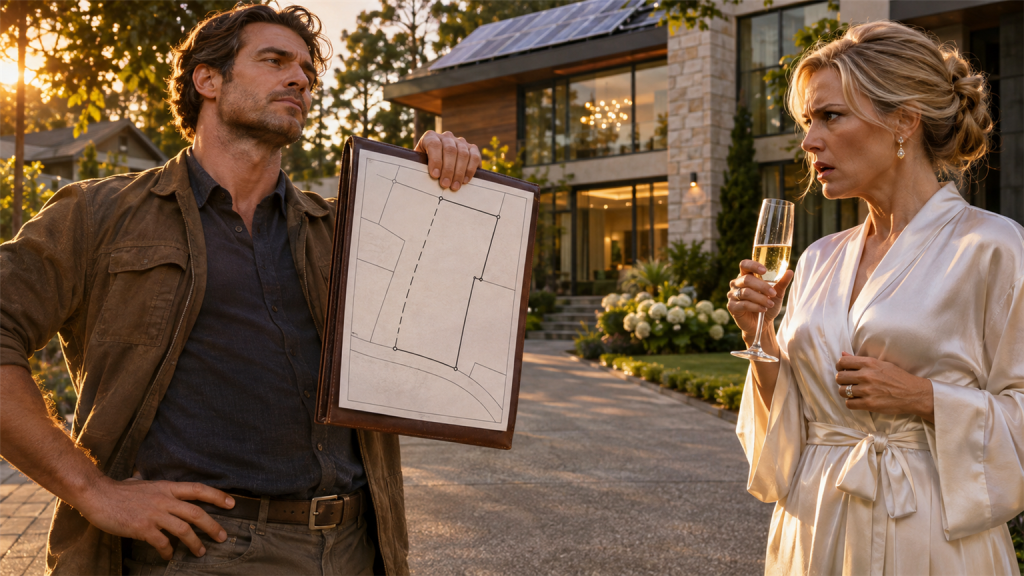
At the first settlement conference, her attorney reviewed the county and tax records, removed his glasses, stared at Vivian, and requested a private recess.
Rachel explained the problem. If Vivian insisted Willow House was legally permanent, the county could investigate years of questionable classifications, taxes, and permits. If she admitted it was transportable, our removal procedure became far harder to challenge.
She had enjoyed the advantages of one definition and now wanted the protections of another.
At the preliminary hearing, the judge examined the surveys, classification documents, written notices, and transport records. He asked whether Vivian wanted the court to treat Willow House as a permanent dwelling. When her attorney mentioned occupancy protections, the judge offered to direct the county to review its historical status as a permanent improvement.
After an uncomfortable silence, Vivian’s attorney admitted they needed to reassess their position.
Most of her claims were withdrawn. She settled rather than invite a broader tax and permitting investigation.
Vivian paid the specialized transport charges, storage costs, survey fees, and part of my legal expenses. She also reimbursed the $417 I had spent retrieving my Subaru after she had it towed.
Rachel called that demand petty.
She also admitted it was satisfying.
By then, the HOA had new leadership and stricter rules requiring conventional foundations, valid setbacks, and proper permits. Vivian could not simply return Willow House to her lot without confronting every regulatory problem she had avoided.
Instead, she sold the empty property.
of 5
A family named Chris and Amanda bought Vivian’s former lot and built a normal one-story house entirely within the property lines. They planted two oak trees between our driveways.
During their first week, Chris knocked on my door holding a wrench and nervously told me the Subaru’s rear tire needed air. I laughed so hard that I had to lean against the doorframe. He had no idea why.
I replaced the tire the following weekend.
Vivian reportedly moved Willow House to a private RV resort outside the city. Jack later sent me a photograph of it parked beneath pecan trees between a luxury motor coach and a fifth-wheel trailer.
His caption read, “FOUND HER NATURAL HABITAT.”
I framed the photograph—not because I hated Vivian, but because it captured the absurdity of how the entire conflict began.
One flat tire. One unnecessary tow. One neighbor so determined to prove she controlled everything around her that she never checked where her own property ended.
Months later, I stepped onto my porch shortly after sunrise. I carried dark-roast coffee into the cool Austin morning and looked across a clear driveway. My gray Subaru sat exactly where it belonged.
Nothing blocked the view. Nothing crossed the boundary. There was no tow truck, silk robe, or lecture about neighborhood aesthetics.
I stood there for fifteen uninterrupted minutes.
It was magnificent.
Vivian had believed rules were weapons meant to be pointed at other people. She eventually discovered what rules actually were: lines, definitions, documents, and boundaries.
Those things were not glamorous, and they were rarely dramatic. But they mattered most when someone decided that wealth, appearances, or confidence placed them above everyone else.
Vivian had demanded that every neighbor follow her interpretation of the rules perfectly. In the end, the same paperwork she had manipulated exposed her own million-dollar home as a transportable structure sitting four feet and three inches across someone else’s property line.
She wanted my Subaru removed from the neighborhood.
Instead, her entire house was towed away.
THE END



