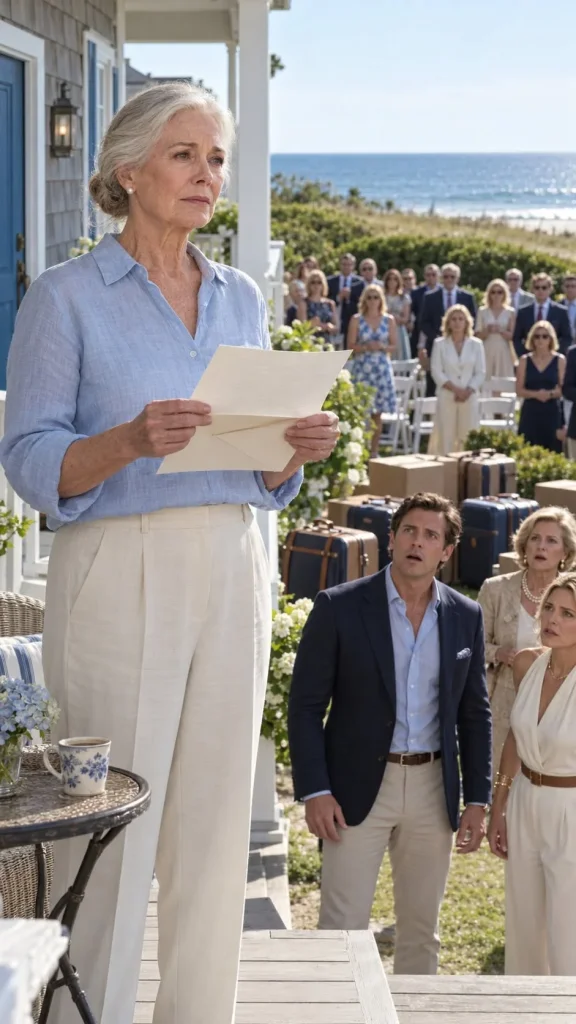
Miles straightened up from the Mercedes. His tan seemed to gray under the brim of his Panama hat. “What did you say, Margaret?”
“Ask him, Miles,” I said, gesturing with the document toward my son. “Ask him why Arthur Vance received three frantic calls from Cullen’s creditors in August asking if Pelican Point had been posted as collateral on a commercial mezzanine loan.”
The silence that followed was heavy and cold, broken only by the cry of a herring gull wheeling over the roof shingles.
Chapter 2 – The Paper Trail
Miles walked slowly across the crushed shells, the soles of his loafers crunching with deliberate weight. He was a man who lived by spreadsheets and offshore holding companies; I had known his type when Nile worked maritime insurance in Baltimore. They didn’t shout. They audited.
“Cullen,” Miles said, his voice dropping into a register that made Blythe shrink back against her mother. “Is there a lien against your firm?”
“Miles, look, it’s a temporary cash-flow restructuring,” Cullen stammered, his eyes darting toward the porch, toward the four suitcases on the lawn, toward the crowd of friends he had invited to witness his triumph. “The tech sector took a hit in Q2. Everyone knows that. The bridge loan was just an advance against receivables. Once we took possession of the house, the equity line—”
“You leveraged a property you didn’t own?” Laurelai whispered, her hand flying to her throat, her manicured fingers pressing into the strand of pearls at her neck. “To secure a business note?”
“I didn’t leverage it!” Cullen yelled, losing the thin veneer of polish he had cultivated over his five years in Boston. “I showed the lender the draft! They accepted the preliminary title guarantee because Vance’s letterhead was on it!”
I folded the paper carefully along its original creases and slipped it back into my pocket. “Arthur Vance never issued a title guarantee, Cullen. You photocopied his stationery from the estate settlement folder you stole out of the attic last Thanksgiving.”
A murmur broke out among the guests. Two of Blythe’s college acquaintances—young men in navy blazers who had arrived in an Uber—quietly began walking down the driveway toward the road, pulling out their phones to hail a ride back to town.
“You stole from your own father’s files?” Blythe’s voice rose to a shrill pierce. She reached out and grabbed Cullen’s forearm, digging her French-manicured nails into his sleeve. “My father gave you eighty thousand dollars for the caterer, the orchestra, and the suite at the Kahala! You said your family was putting up the estate!”
“Blythe, shut your mouth!” Cullen barked, shaking her off with a violent jerk of his shoulder. “You wanted the four-carat cushion cut! You wanted the private catamaran! Who do you think was paying for that? Your father’s firm hasn’t cleared a dividend since December!”
“That is enough,” Miles said. His tone was not loud, but it cut through Cullen’s tirade like a fillet knife. He took his daughter by the elbow and pulled her back. Then he looked up at me on the porch. “Margaret. Did you know about the mezzanine loan?”
“I found out Tuesday when the process server came looking for Cullen at this address,” I replied. “Nile taught me thirty years ago: never sign a document you haven’t read three times, and never let anyone put their name on your land until you’ve seen their balance sheet.”
“You set me up,” Cullen hissed, stepping closer, his jaw working as if he were chewing glass. “You knew I needed this. You knew I was drowning in the lease payments on the Newbury Street office. You sat out here in your old sweater, letting me think everything was fine, just to humiliate me in front of Blythe’s family.”
“No, Cullen,” I said, leaning over the cedar railing so he could see the cold calm in my eyes. “You humiliated yourself when you decided your mother wasn’t fashionable enough to sit in the front pew at your wedding. You decided I was an embarrassment. So I let you manage your own affairs. Isn’t that what people of status do?”
Mrs. Gable let out an audible snort from her folding chair.
Laurelai turned on her heel, her face mottled with scarlet patches beneath her bronzer. “We are leaving. Miles, get the luggage.”
“That luggage doesn’t belong to you, Laurelai,” I pointed out gently, pointing toward the three Hartmann bags and the leather trunk piled near the hydrangeas. “Those are Cullen’s and Blythe’s. They arrived via freight four days ago. I had them carried outside so the salt spray wouldn’t ruin the leather. It’s supposed to mist tonight.”
“Where are we supposed to go?” Blythe cried, tears cutting dark streaks through her foundation. “Every hotel on the island is booked for the regatta!”



