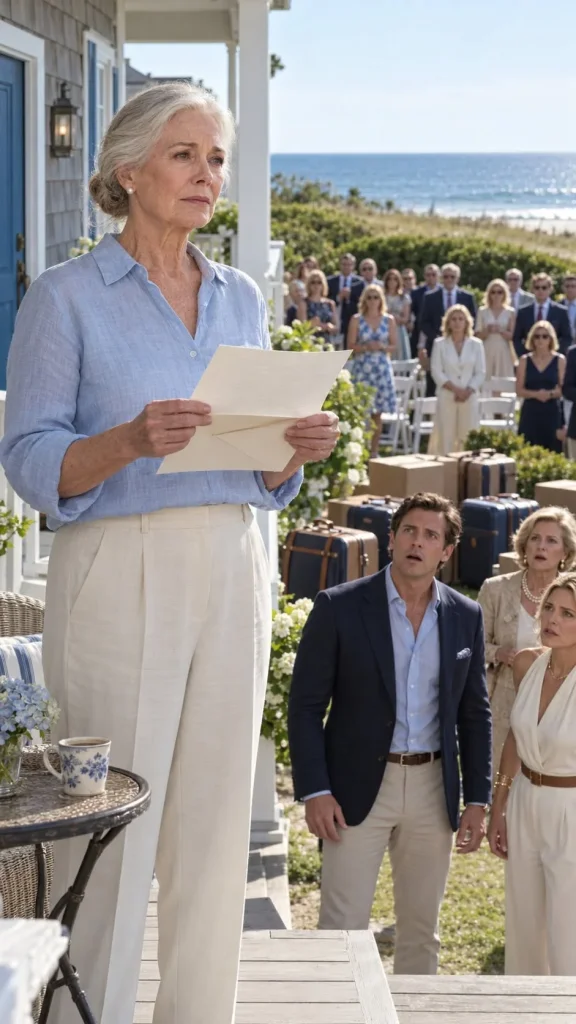
I took a slow sip of my tea. The mint was sharp and bitter on my tongue.
“Your suitcases are on the porch now,” I told him. “I moved them under the eaves before the mist turned to rain. There’s twenty dollars in the front pouch of your green duffel. Walk to the main road. The island shuttle runs until nine.”
“I’m your son!” he screamed, pounding both fists against the heavy oak. “I’m your only child!”
“Nile had a son,” I said through the screen. “His son knew how to swing a hammer, knew how to tell the truth, and knew that a man’s word is the only thing he owns that the bank can’t take. I don’t know who you are, Cullen. But you aren’t the boy who helped us build this porch.”
I turned off the kitchen light, walked into the living room, and sat down in Nile’s old leather armchair.
Outside, the rain began to fall in earnest, drumming against the shingles with a steady, relentless beat. After twenty minutes, I heard the sound of heavy wheels grinding through the gravel as Cullen dragged his luggage down the driveway toward the dark highway.
Chapter 4 – The Morning After
The island looked different after a northeaster. The salt air had stripped the leaves from the bayberry bushes, leaving them bare and gray, and the beach had been recarved by the swell, leaving ridges of black clam shells along the high-tide line.
At seven in the morning, a green Ford pickup rattled up the lane.
It was Frank Callahan, the town sheriff and Nile’s second cousin. He stepped out of the truck wearing his grease-stained canvas coat, carrying two paper cups of black coffee from the deli by the ferry dock.
“Saw your boy walking out near the bypass last night around ten,” Frank said, handing me a cup as he leaned against the porch rail. “Carrying two bags that looked like they weighed more than he did. Tried to flag down the oil delivery truck.”
“Did he get a ride?” I asked.
“Artie picked him up. Dropped him at the ferry terminal. He spent the night on the bench in the waiting room.” Frank took a sip of his coffee, squinting out toward the gray horizon where the mainland ferry was already cutting its white path through the channel. “Miles Vance called me at midnight. Demanded I come out here and escort Cullen onto the premises to retrieve his personal effects.”
“What did you tell him?”
“Told him Pelican Point is private property, Margaret Holloway is the sole deed holder, and if Cullen set foot past the mailbox without a written invite, I’d lock him up in the municipal tank for criminal trespass.” Frank looked at me sideways through his thick brows. “Miles sounded pretty rattled. Said something about twenty thousand dollars’ worth of custom suits still inside your cedar closet.”
“They’re not in the cedar closet,” I said. “They’re in the back of my station wagon. I’m driving them over to the church donation bin at noon.”
Frank chuckled, a dry, rattling sound like stones in a tin can. “You always were harder than Nile. Nile would have wavered.”
“Nile wasn’t here to see his picture shoved into a drawer under the takeout menus,” I said.
Frank’s face hardened. He looked down at the porch planks, nodding once. “Aye. That would have done it for him too.”
He reached into his pocket and pulled out a small, folded slip of paper. “Arthur Vance asked me to give you this. He’s already filed the restraining notice with the county recorder. Cullen can’t touch the property, can’t file an intent to lien, and can’t list it as an asset on any corporate filings. But there’s a wrinkle, Margaret.”
My fingers tightened around the warm paper cup. “What wrinkle?”
“The loan Cullen took out in July wasn’t from a bank,” Frank said, lowering his voice until it barely carried over the roar of the surf. “It was from an outfit out of Providence. Harbor Commercial Trust. They don’t do credit checks, and they don’t wait for probate to clear. They lend against contested assets at twenty percent interest.”
“That’s usury.”
“In Massachusetts it is,” Frank agreed. “In Rhode Island, under their corporate charter, it’s a mezzanine equity fund. And the man who runs it is Julian Thorne.”
The name fell between us like an iron bar.
Julian Thorne was the son of Donald Thorne, the man who had tried to buy the southern half of the island thirty years ago to build a deep-water marina. Nile had fought him at town meeting after town meeting, rallying the fishermen, the summer residents, and the conservation trust until Donald Thorne’s permits were revoked by the state supreme court. Donald had died broke, and his son Julian had built a business out of buying up distressed mortgages from people who were drowning in debt.



