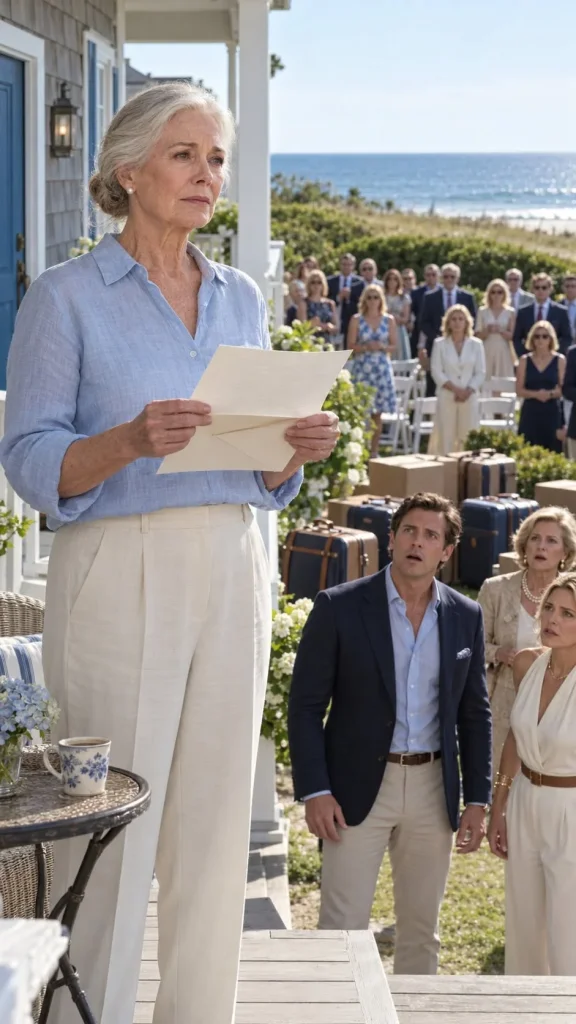
I didn’t answer Miles immediately. I finished cutting the peonies, wheeled the barrow to the compost heap behind the garage, and dumped the dead stalks. The smell of rotting leaves and damp earth was thick in the afternoon chill.
“Tell Thorne to send his lawyers,” I said over my shoulder as I walked toward the back porch.
Miles stared at me, his mouth slightly open, as if I had spoken in another language. “Did you hear what I said? He’s going to prosecute Cullen!”
“Cullen made his bed with Julian Thorne,” I said. “He can sleep in it. But Julian Thorne doesn’t own this town, and he doesn’t own this house. Tell him if he wants to talk to the owner of Pelican Point, he can come out here himself instead of using you as an errand boy.”
I went inside and bolted the back door.
The house was cold. I didn’t turn on the central heat; instead, I knelt before the hearth in the living room and built a fire using seasoned oak and drift-pine. As the flames caught, sending yellow sparks up the brick flue, I walked over to the corner of the room where the old upright piano stood.
Nile had bought the piano from an old Methodist church that was being torn down in Chatham. It was an 1898 Mason & Hamlin, heavy as an anvil, its rosewood case scarred by generations of hymnbooks.
I knelt beside the pedal lyre, reached underneath the lower soundboard, and felt for the recessed catch Nile had carved into the support block.
A soft click echoed through the wood.
A hidden compartment—six inches deep and twelve inches wide—slid forward on waxed maple runners. Inside lay Nile’s leather-bound field log from his thirty years with the Coastal Survey, three brass keys, and a bundle of letters tied with tarred marline twine.
I took out the field log.
The leather was dark and supple, oiled with neat’s-foot every winter. I flipped through the yellowed pages, past the hydrographic notes, past the tide tables from the seventies, until I reached the entries from October 1991—the week of the No-Name Storm.
Donald Thorne had owned the spit of land north of our boundary back then. He had claimed the low-water mark extended forty feet into our cove, which would have allowed him to dredge the channel for his private docks.
Nile had spent three weeks in the county archives in Barnstable, digging through colonial land grants dating back to the King’s Grant of 1684.
On page 142 of the log, Nile had pasted a certified photostat of the original crown patent for Lot 14.
I read the faded copperplate script Nile had traced in red ink:
*“…to include all sand spits, marshes, and sedge lands lying between the high water mark and the channel bar, with exclusive rights of access, anchorage, and timber salvage, held in perpetual freehold by the heirs of the patentee, exempt from municipal division, commercial easement, or foreign encumbrance without unanimous consent of the living inhabitants thereon.”*
Beneath the document, Nile had written one sentence in his heavy, sloping hand:
*“Donald Thorne thinks money buys the tide. He forgot that the King gave this dirt to people who wouldn’t bow.”*
I closed the log, my thumb resting on the worn leather.
Julian Thorne didn’t just want the house to settle Cullen’s debt. Julian Thorne wanted the patent. If he acquired Lot 14, the crown patent gave him the legal right to bypass the state coastal management commission and dredge the entire inlet for his fifty-slip marina.
Cullen hadn’t just tried to steal his mother’s home.
He had handed our worst enemy the key to the entire harbor.
Chapter 7 – The Messenger
On Wednesday morning, Julian Thorne didn’t send a lawyer. He sent his nephew, Derek.
Derek Thorne was thirty, had the same flat, shark-like eyes as his grandfather, and wore a five-thousand-dollar Barbour jacket that had clearly never seen a briar patch or a rainstorm. He drove a black Range Rover with Rhode Island plates and parked it directly across my driveway, blocking the mail carrier’s access.
I was sitting on the porch with a mug of chicory coffee when he walked up the steps, carrying a slim leather folder under his arm.
“Mrs. Holloway,” he said, not removing his sunglasses. “I’m Derek Thorne. Representing Harbor Commercial.”
“Take off the glasses, Derek,” I said. “Your grandfather had bad manners, but he at least had the decency to look a woman in the eye when he was trying to steal her property.”
Derek gave a small, practiced smirk, took off the glasses, and slipped them into his pocket. “My grandfather was a romantic, Mrs. Holloway. He thought he could win people over with town-hall speeches and donations to the volunteer fire department. I don’t do speeches.”



