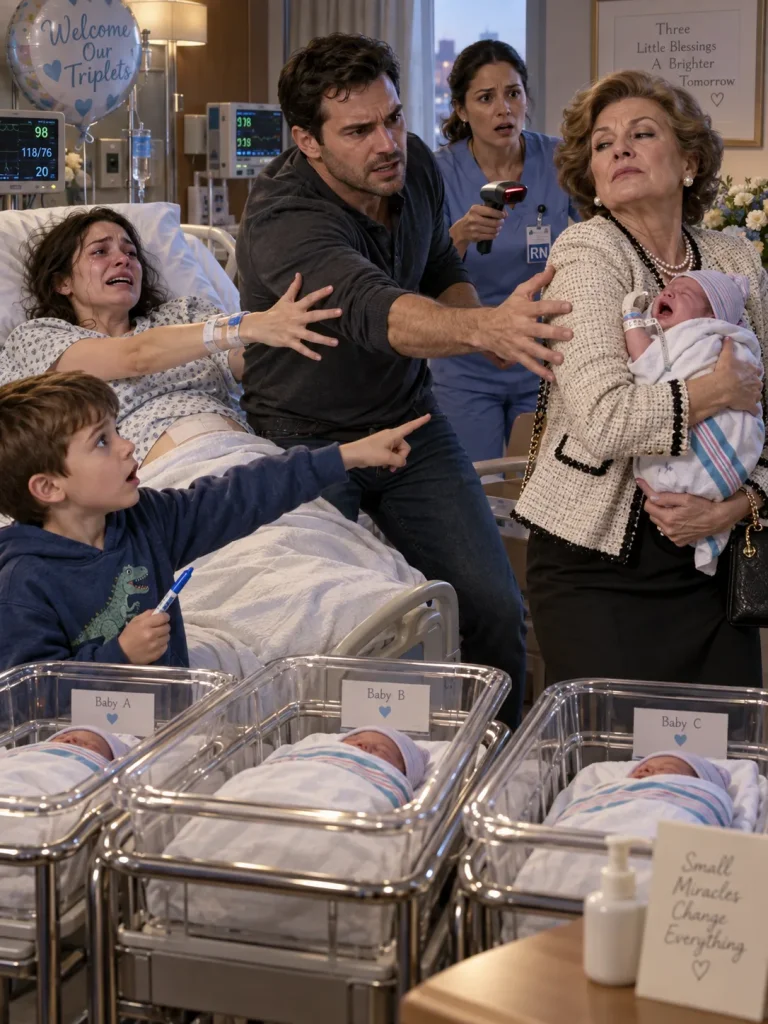
“Do you understand?”
“Yes.”
“And you will never discuss Rachel’s pregnancies as though they created a debt my children were supposed to pay.”
Rachel covered her mouth.
Evelyn whispered, “Yes.”
“And there is no ‘this one.’”
“What?”
“My daughters.”
I looked toward the three babies.
“There is Emma.”
I swallowed.
“There is Lily.”
My voice broke.
“And there is Grace.”
Daniel’s grip tightened.
“They are not three interchangeable babies. They are not three portions of something. There is no extra child in this house.”
“I know.”
“I hope someday you actually do.”
Nobody spoke for several seconds.
Then Evelyn said, “I am sorry.”
I closed my eyes.
For the first time, she didn’t add because.
No explanation.
No miscarriage.
No slap.
No hormones.
No misunderstanding.
Just four words.
It did not fix anything.
But it was different.
“I’m sorry, Claire.”
I breathed.
“Okay.”
“Can I talk to Daniel?”
I looked at him.
His decision.
He nodded.
I passed him the phone.
For the next fifteen minutes, I listened to my husband tell his mother things he should have told her years earlier.
He told her he loved her.
He told her love did not equal permission.
He told her he regretted slapping her and that he was responsible for controlling his own hands regardless of how frightened or angry he was.
Then he told her his regret did not rewrite what she had done before it.
He told her he would not allow her to use his guilt as a door back into our house.
He told her she needed help.
Not because she was evil.
Because she had spent years feeding Rachel’s grief until it became an obsession she could no longer recognize as hers.
Evelyn cried.
Daniel cried.
Neither one pretended that tears were a solution.
Then Rachel spoke.
Her conversation was shortest.
“I love you,” she told her mother.
“I love you too.”
“But I’m taking space.”
“Rachel.”
“I need to know who I am when I’m not trying to make you feel better about my life.”
“I only wanted you happy.”
“I know.”
Rachel smiled sadly.
“That was part of the problem.”
When we ended the call, the room became quiet.
Daniel looked exhausted.
Rachel remained on speaker.
“Are we monsters?” she asked.
Daniel laughed weakly.
“Probably.”
I looked at the three sleeping babies.
“No.”
Rachel sniffed.
“What are we, then?”
I thought about it.
“Finished pretending nothing happened.”
That night, Noah climbed into our bed after a nightmare.
He wedged himself between us.
“What happened?” I whispered.
“Grandma took all the babies.”
My chest tightened.
“It was a dream.”
“I know.”
“They’re here.”
“I know.”
“Want to check?”
He nodded.
Daniel carried him to the nursery.
I followed slowly.
We stood over three cribs.
Emma asleep.
Lily asleep.
Grace awake, staring suspiciously into the darkness as though she had been expecting us.
Noah smiled.
“Grace is watching.”
“She usually is,” Daniel whispered.
Noah reached between the crib rails.
Grace wrapped her hand around his finger.
He looked at me.
“She knows me.”
“Yes.”
The certainty in my answer felt like healing.
“She does.”
PART 6: NO CHILD OF MINE IS EXTRA
For a long time, I believed the story ended with the phone call.
It didn’t.
Real family disasters rarely end at the dramatic moment.
They fade.
They echo.
They reappear while you are washing bottles at two in the morning or buckling a child into a car seat.
They change the way you answer the door.
The way you hear certain phrases.
The way your body reacts when someone reaches toward your baby without asking.
For months, I watched hands.
Even safe hands.
My mother’s.
Rachel’s.
Daniel’s aunt’s.
A pediatric nurse’s.
I hated myself for it.
Then I remembered Marisol’s words.
Fear doesn’t always disappear when the danger leaves.
So I stopped treating fear like a moral failure.
I paid attention to it.
Then, slowly, I taught it when it could rest.
I talked to someone.
So did Daniel.
Noah did too, briefly.
Not because there was something wrong with him.
Because six-year-olds are not supposed to carry memories of adults fighting over newborns by themselves.
Rachel found her own therapist.
She did not tell us what they discussed, and we did not ask.
That itself felt healthy.
Evelyn stayed away.
At first, she sent letters.
We returned them unopened.
Then the letters stopped.
For four months, there was nothing.
I expected the silence to feel triumphant.
It felt sad.
Daniel missed his mother.
He didn’t say it every day.
He didn’t need to.
I could see it when Noah asked about the tomato plants she used to grow with him.
I could see it when an old family photograph appeared on his phone.
One night, while we folded tiny pajamas at the dining-room table, he said, “I keep remembering good things.”



