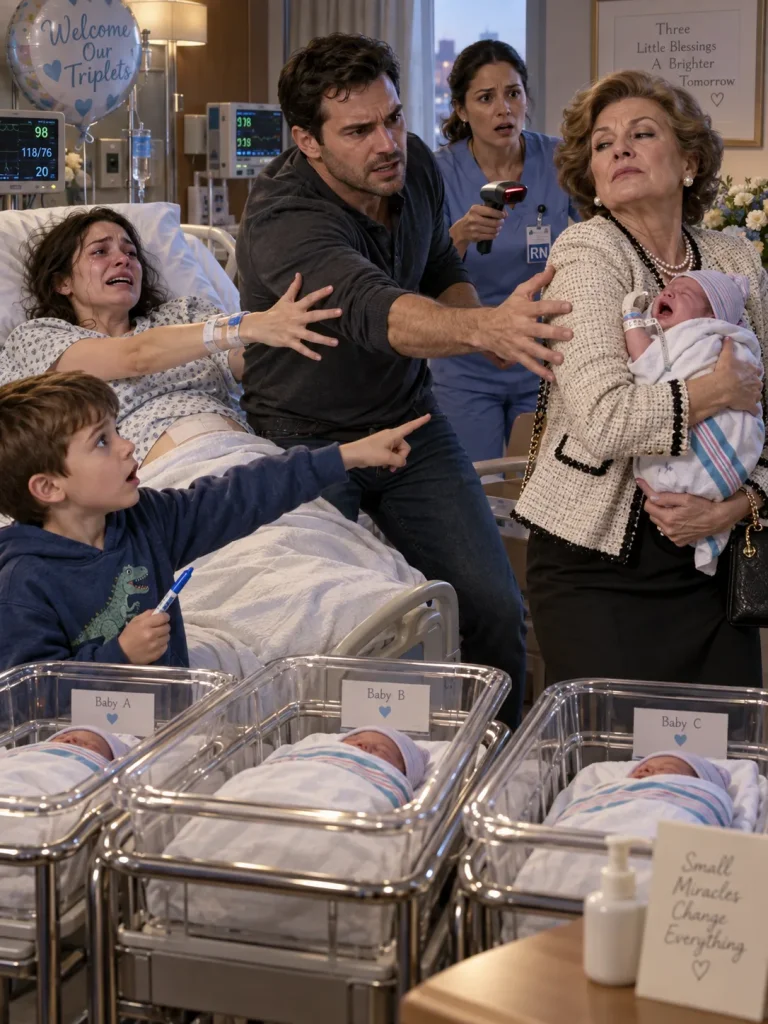
“If she asks you to carry a message—”
“No.”
I studied her.
“I mean it.”
“So do I.”
Daniel looked at his sister.
“Mom is saying Claire manipulated the hospital into banning her.”
Rachel closed her eyes.
“Of course she is.”
“She’s also telling people I attacked her.”
“You did slap her.”
Daniel flinched.
“I know.”
Rachel turned to him.
“And you need to own that part.”
“I do.”
“But she doesn’t get to use it to erase everything that happened before it.”
Daniel nodded.
“I know.”
Rachel stood to leave.
At the door, she stopped.
“There’s one more thing.”
My stomach tightened.
“What?”
“She called me after security removed her.”
Daniel stood.
“You answered?”
“For about thirty seconds.”
“What did she say?”
Rachel looked sick.
“She asked why I hadn’t helped her.”
I stared at her.
“Helped her do what?”
“She didn’t say.”
“Rachel.”
“She said, ‘I was trying to give you one chance at being happy, and you stood there like a stranger.’”
The room went cold.
Daniel muttered something under his breath.
Rachel opened the door.
“I told her never to call me about your children again.”
Then she left.
That night, after Daniel and Noah had fallen asleep, I lay awake listening to the three soft breaths coming from the bassinets beside my bed.
I should have been resting.
Instead, I stared at the ceiling.
I kept remembering Evelyn’s hands.
How confidently she had reached into the bassinet.
How naturally she had lifted Grace.
How casually she had announced a transfer of ownership over a human being.
You have three.
My daughter has none.
She gets this one.
The cruelty of it was obvious.
The deeper horror took longer.
Evelyn had not seen herself as stealing.
In her mind, she had been redistributing.
Making things fair.
And people who believe they are correcting an injustice can justify almost anything.
I turned my head.
Grace was sleeping.
Her new identification band was secure.
The hospital had placed a bright note on our room indicating restricted visitors.
Security knew Evelyn’s name.
Nobody could simply walk onto the floor and reach my children.
I knew all of that.
Still, I pressed the call button.
Marisol came in.
“Everything okay?”
“Can you check their bands?”
She didn’t tell me I was being ridiculous.
She checked each one.
Emma.
Secure.
Lily.
Secure.
Grace.
Secure.
“Thank you,” I whispered.
Marisol hesitated.
“You know, fear doesn’t always disappear when the danger leaves.”
I looked at her.
“I know.”
“It may take time before your body believes what your mind knows.”
I stared at Grace.
“What if I never stop checking?”
“You probably will.”
“And if I don’t?”
“Then you ask for help.”
It was such a simple answer.
No judgment.
No inspirational speech.
Just permission.
I nodded.
Marisol dimmed the lights before leaving.
I watched my daughters for another hour.
Then I made myself a promise.
Evelyn might have decided one of my children was spare.
She might have spent months turning Rachel’s grief into an argument.
She might tell relatives whatever version of the story made her feel righteous.
But from that moment on, she would never again benefit from our hesitation.
I had ignored discomfort because I wanted peace.
I had swallowed questions because I didn’t want to look paranoid.
I had trusted politeness more than instinct.
That version of me had disappeared the moment I saw Grace’s bracelet hanging open.
And I was not going to apologize for the woman who replaced her.
PART 4: NOBODY GETS “ONE”
We brought our daughters home three days later.
I thought leaving the hospital would make me feel safe.
Instead, I cried in the parking garage.
Daniel had secured all three infant carriers across the second row of our minivan.
Noah climbed into the back.
My mother stood beside me while I lowered myself painfully into the passenger seat.
The moment Daniel closed my door, panic shot through me.
“Wait.”
He reopened it.
“What?”
“The bands.”
He understood immediately.
The hospital identification bands had been removed at discharge.
There was nothing around the babies’ ankles anymore.
I knew that.
Still, the absence felt wrong.
“I know,” Daniel said gently. “They don’t need them now.”
“I know.”
“They’re coming home.”
“I know.”
My mother squeezed my shoulder.
“Claire.”
I closed my eyes.
Three babies.
Three car seats.
Three discharge folders.
Nobody missing.
Nobody changed.
Nobody being carried down another hallway.
I breathed.
“Okay.”
Daniel shut the door.
At home, our world narrowed.
Feedings.
Diapers.
Pumping.
Laundry.
Medication.
Sleep measured in forty-minute pieces.
Noah learning that “helping with the babies” mostly meant fetching burp cloths and informing us dramatically whenever one made a suspicious noise.
Our house was chaotic.
Evelyn had been right about that.
She had been wrong about what chaos meant.



