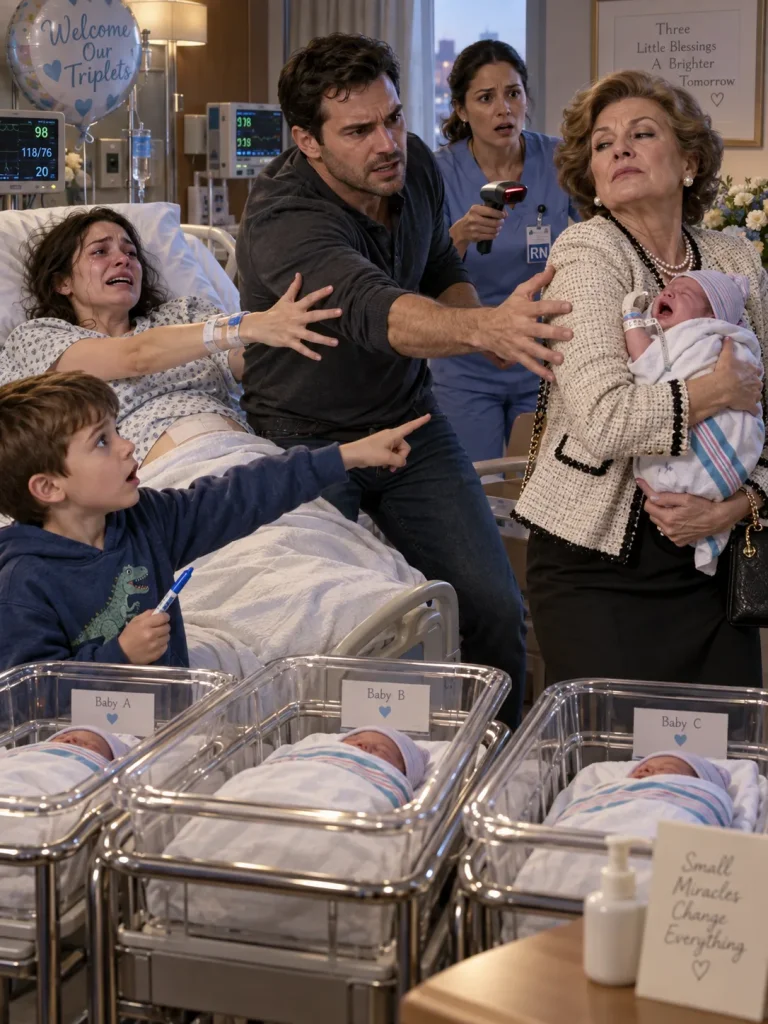
It did not mean we loved anyone less.
It did not mean one child disappeared into the crowd.
It did not mean there was a surplus.
Emma hated baths.
Lily slept with both hands beside her ears.
Grace settled fastest when Daniel hummed off-key.
Within two weeks, I could tell them apart from the backs of their heads.
That became important to me.
Maybe too important.
I memorized everything.
A faint birthmark.
A cowlick.
The shape of an eyebrow.
Sometimes I would wake in the night, look into a bassinet, and feel a flash of terror before recognition came.
Then I would know.
Emma.
Lily.
Grace.
Mine.
Ours.
The first week, Daniel’s phone barely stopped vibrating.
Evelyn called.
Texted.
Emailed.
Then contacted relatives.
We knew because they started contacting us.
Daniel’s aunt called to say there had obviously been “a misunderstanding.”
His cousin sent a message asking whether it was true Daniel had “knocked his mother down.”
An older family friend wrote me an entire paragraph about postpartum hormones.
I read the first two sentences and deleted it.
The story Evelyn told was simple.
She had lovingly picked up her granddaughter.
I had panicked.
Noah had misunderstood her adjusting an uncomfortable bracelet.
Daniel had assaulted her.
Hospital staff had overreacted because we were upset.
The sentence about giving Grace to Rachel became a joke.
Then a joke taken out of context.
Then something she claimed not to remember saying.
It was extraordinary watching reality change one small denial at a time.
Daniel wanted to respond to everyone.
I stopped him.
“No.”
“They think I just hit her.”
“You did hit her.”
“I know, but—”
“We’re not running a public-relations campaign.”
He stared at me.
“She’s lying.”
“I know.”
“I want people to know what happened.”
“The people who matter can ask us.”
“And the people who believe her?”
I looked down at Grace nursing against me.
“They can believe her.”
That answer surprised both of us.
Before the hospital, I cared too much about being understood.
I replayed conversations.
I softened boundaries.
I wrote long texts explaining why I had said no.
Something about nearly watching someone carry my newborn out of reach killed that instinct.
“I have three babies and a six-year-old,” I said. “I’m not using the energy I have left to convince your third cousin that your mother was wrong.”
Daniel sank onto the couch.
After a moment, he smiled.
“What?”
“I think childbirth made you terrifying.”
“Triplets made me efficient.”
He laughed.
For the first time in days, I did too.
But not everything healed so easily.
Noah started checking doors.
The first time I noticed, he was standing on a kitchen chair trying to make sure the deadbolt was turned.
“What are you doing?”
“Checking.”
“For what?”
He looked at me like the answer was obvious.
“Grandma.”
I lifted him down.
“She isn’t coming in.”
“How do you know?”
“Because the door is locked.”
“What if Dad opens it?”
“Dad won’t.”
“What if she says sorry?”
The question cut deeper than he knew.
I crouched carefully.
“Noah, saying sorry doesn’t automatically mean somebody gets to come inside.”
His forehead wrinkled.
“Even Grandma?”
“Even Grandma.”
“But Dad says we forgive people.”
Children remember every moral lesson you give them and return it at the least convenient moment.
I sat on the floor.
“Noah, forgiving someone and trusting someone are different things.”
“Why?”
“Because saying you’re sorry is about what already happened. Trust is about what you might do next.”
He thought about that.
“Do you trust Grandma?”
“No.”
The answer came easily.
His eyes widened.
Adults rarely spoke that plainly to him.
“Will you?”
“I don’t know.”
He nodded.
Then he whispered, “I should’ve told you sooner.”
My heart broke.
“What?”
“About the bracelet.”
“Oh, baby.”
“I saw her pulling it, but I thought grown-ups knew.”
I pulled him against me.
“You did exactly the right thing.”
“But if I told you when Dad went for water—”
“No.”
I held his face.
“This was not your job to prevent.”
“But—”
“You’re six.”
He looked down.
“You are not responsible for what Grandma did. You noticed something was wrong, and when you understood it mattered, you told us. That was brave.”
His eyes filled.
“Is Grace okay because I told?”
I chose my words carefully.
“Grace was already back with me when you told us. But what you said helped the nurses realize something important had happened.”
That mattered.
I did not want him believing his sisters’ safety rested on his vigilance.
He was a brother.
Not a guard.
That evening, I told Daniel what Noah had said.
He sat on the edge of our bed for a long time.
Then he went to Noah’s room.
I heard them talking quietly.
Later, Daniel came back with red eyes.



