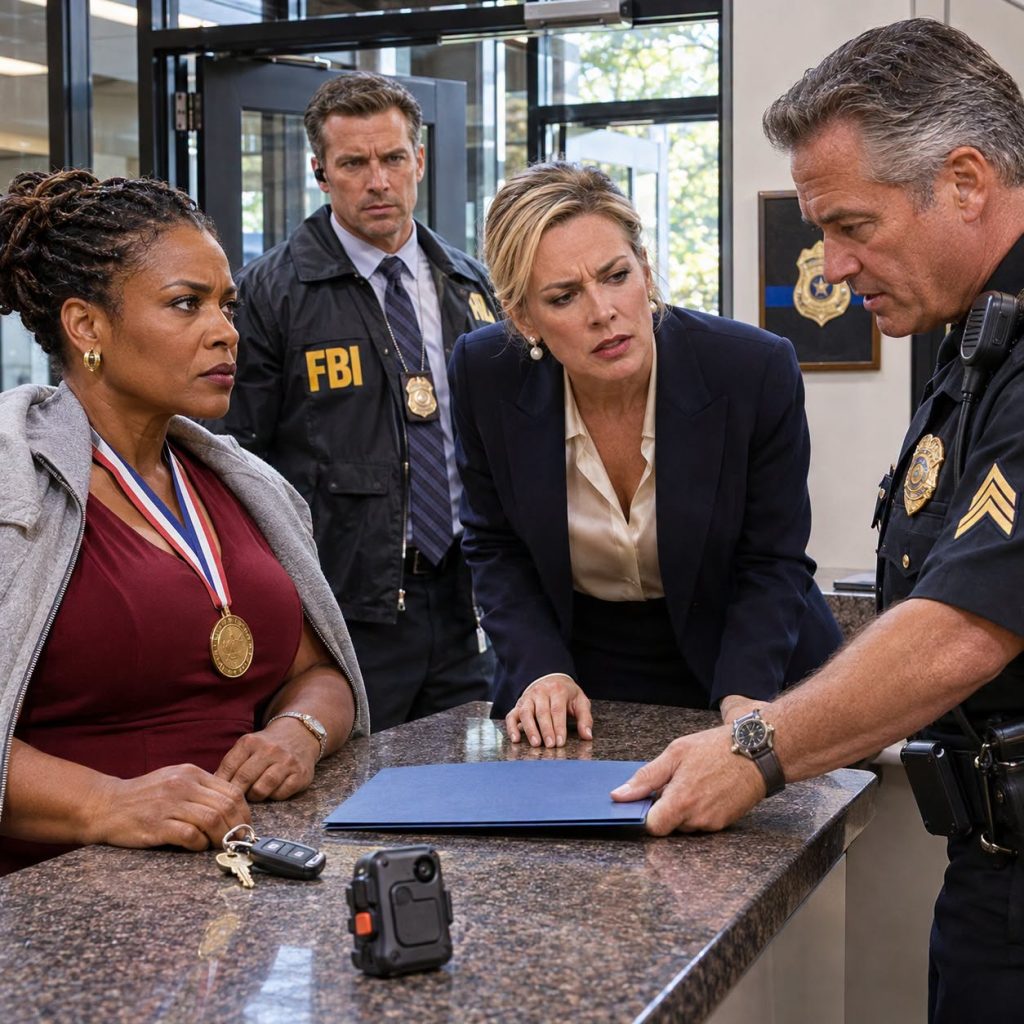
The handcuff closed on my right wrist just as a tractor-trailer passed close enough to rock my car. I took a step toward the guardrail. Officer Dunn caught my elbow and pushed me back against the trunk. “Stop pulling away,” he said. The truck had drowned out my first answer, so I gave him the second one loud enough for the microphone clipped to his chest. “I’m stepping away from traffic. I’ll stand wherever you tell me.” He looked down at the microphone. Then he told me to lower my voice.
My name is Monica Bennett. I was fifty-two, and I served as the Deputy Director of National Intelligence for Mission Integration. I’d come to Dayton for a colleague’s retirement dinner, and I was still wearing the burgundy gown I’d worn to the banquet. The Distinguished Intelligence Medal pinned above my heart had belonged in its case by then. My colleague’s granddaughter had asked me to leave it on for a picture. I was thinking about that little girl when Dunn leaned in to read the engraving.
“Somebody went all out for Halloween,” he said. It was February. My license and federal identification were already on the roof of my car, where he’d told me to put them. “Call your dispatcher and have them verify my identification,” I said. He lifted the federal credential by one corner and turned it toward his flashlight. “You expect me to believe they sent you?” The way he said you made me stop explaining. I asked for his supervisor. He put the credential in his coat pocket and closed the second cuff.
He left me beside the car while he went back to his cruiser. Sleet collected in the folds of my dress. Through his open door, I heard the dispatcher say, “Tyler, are you requesting a credential check?” He looked straight at me. “Negative. Subject refused to provide identification.” I called out that he had both cards. He shut the cruiser door. By the time he came back for me, I’d stopped trying to convince him and started memorizing every word he said.
At the Montgomery County substation, Sergeant Keith Spencer took one look at my bare shoulders and asked Dunn where my coat was. Dunn said he’d left it in the car for the tow driver. Spencer pulled a clean sweatshirt from a cabinet and draped it over me. “Her ID?” he asked. Dunn laid my driver’s license on the intake counter. Spencer waited. After a few seconds, Dunn reached back into his pocket and produced the federal credential. He set it down facedown.
Spencer made a verification call from the intake desk. He read the credential number, listened, and pulled up a restricted record on his terminal. “Ms. Bennett,” he said, keeping his eyes on the screen, “would you confirm your middle name?” I did. He turned to Dunn. “Take those cuffs off.” Dunn started to argue. Spencer held out his palm for the key, and this time Dunn handed it over. When Spencer freed my left wrist, I had to watch my fingers to see whether they were moving.
A door behind the desk opened. Captain Daniel Rourke came out in shirtsleeves with a clipboard. “I’ll handle the release,” he said. Spencer told him I’d asked to make a call. Rourke set the clipboard in front of me and offered me his pen. “Sign at the bottom and you can use my office.” The first page listed my belongings. I turned it over with the side of my hand. The second page said I’d been advised I was free to leave the roadside and had asked Officer Dunn to drive me to the station.
“My car is being towed,” I said. “You’ve got my keys. Am I free to leave now?” Rourke glanced down the hall. Dunn moved to the door we’d come through and rested his hand on the push bar. Spencer reached for the desk phone, but Rourke pressed a finger onto the cradle. Then he looked at Dunn. “Where’s the camera?” Dunn unfastened it from his uniform and put it in Rourke’s waiting hand. Rourke slipped it into his pocket. “Sergeant,” he said, “bring me the other release forms.”
Pinned Comment
I kept looking at the word “voluntary” on that release form. My wrist was still numb, my keys were behind the counter, and the man who’d written it had just asked for the others. The rest of the story is below 👇
Part 2
Spencer opened the bottom drawer and pulled out a stack of blue folders. Rourke held out his hand. Spencer laid them on the counter between us instead. The top folder had a woman’s name on the tab and an October date. Rourke put his palm over it. “I meant the blank forms.” Nobody moved for a moment. Then the radio on Dunn’s shoulder crackled. Dispatch wanted to know why the tow driver had been sent for a car whose owner was standing inside the station with a valid license.



