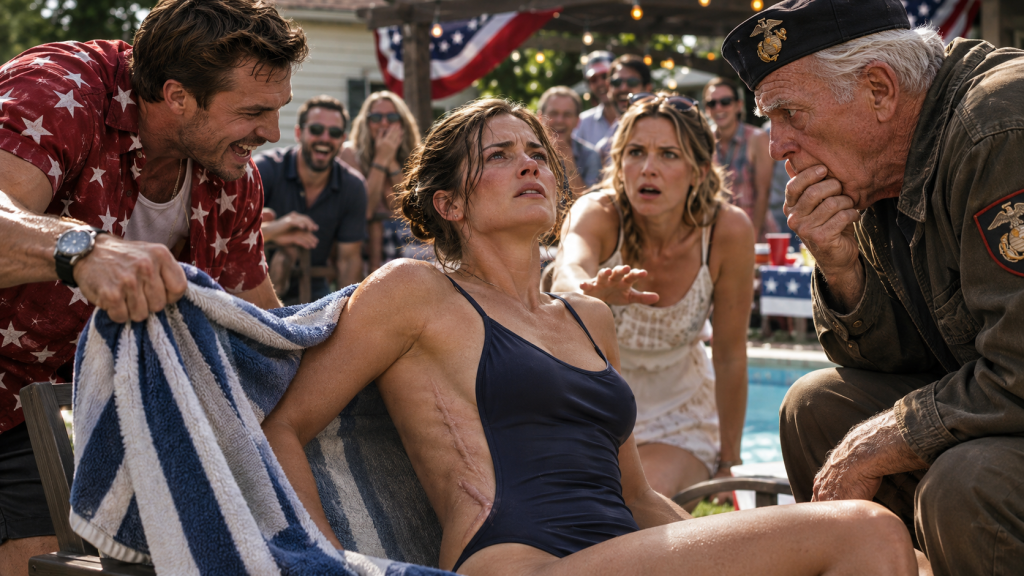
Not the laughter that came later. The ordinary kind. Kids shrieking as they flew down an inflatable water slide, arguing over whose turn was next, and splashing into my sister’s swimming pool with absolutely no concern for the amount of water they were sending onto the patio.
I’d been home from overseas for exactly six days.
Six days of sleeping in my own bed, waking up at every unfamiliar noise, and trying to remember how to be a normal 34-year-old woman instead of Captain Rachel Dawson.
Eleven years in the Army had taught me how to function on very little sleep, make decisions when everything around me was falling apart, and recognize trouble before it reached me.
It hadn’t taught me how to relax at a family barbecue.
My sister Megan had insisted I come.
“You’ve been gone forever, Rach. Just come eat some ribs and sit by the pool. Nobody’s expecting anything from you.”
That last part sounded wonderful.
I’d spent the previous week discovering that coming home involved more expectations than I’d anticipated. People wanted to know whether I was glad to be back, what my plans were, whether I was seeing anyone, and why I looked tired when I was supposedly on leave.
The woman checking me out at the grocery store had thanked me for my service and then asked whether I knew her cousin stationed in Germany.
I didn’t have the heart to explain how many people were in the Army.
Megan’s backyard in suburban Ohio was packed by the time I arrived.
Brad, my brother-in-law, had rented an enormous inflatable water slide, bought enough ribs to feed a football team, and arranged coolers along the fence like he was catering a corporate retreat.
Country music played from a speaker near the grill.
Someone had hung little American flags along the deck railing. A few were already hanging crooked because the kids had been using them as obstacles in an imaginary race.
Brad stood beside the grill with a beer in his hand, telling a story to three men who were laughing a little harder than the story probably deserved.
I’d never been Brad’s favorite person.
He sold commercial insurance, drove a truck that cost more than his common sense could justify, and had a habit of turning every family gathering into a competition nobody else knew they were entering.
To be fair, he could also be generous. When Megan’s washing machine broke the previous winter, he’d replaced it without complaining about the cost. He remembered the kids’ birthdays. He coached Little League.
But he had an exhausting need to be the most impressive person in whatever room he entered.
The first Thanksgiving I came home in uniform, his father spent half an hour asking about my service.
Brad barely spoke to me afterward.
I hadn’t thought much about it at the time. I’d been too busy enjoying my mother’s sweet potato casserole and trying to convince Megan that, yes, I really did want a second helping.
Our mother had been gone three years now.
This was my first Fourth of July home since her funeral.
I suppose that was another reason I came. Megan was the only person left who remembered exactly how Mom used to complain about fireworks while standing on the porch to watch every single one.
“Rachel!”
Megan came through the sliding door carrying an enormous bowl of watermelon.
She was two years older than me, with the same dark hair and our mother’s habit of looking worried even while smiling.
“You’re actually wearing a swimsuit.”
“Try not to sound so surprised.”
“I thought you’d show up in cargo pants.”
“I considered it.”
She kissed my cheek, then lowered her voice.
“How are you really?”
“Hot.”
“Rachel.”
“I’m okay, Meg.”
She looked at me for another second.
Then she nodded.
Megan knew I’d been injured overseas. She knew there had been surgery, rehabilitation, and several months when I couldn’t climb stairs without getting winded.
What she didn’t know was exactly how it happened.
I’d told her it was a vehicle accident.
That was true.
It simply wasn’t the whole truth.
I found a lounge chair near the shallow end and settled down with a glass of lemonade.
I was wearing a navy-blue one-piece swimsuit and a beach towel draped over my left shoulder, tucked beneath my arm.
The scar underneath stretched from just below my ribs toward my hip. It was thick and uneven, with small indentations where surgical staples had once held my skin together.
I didn’t cover it because I believed there was something shameful about being injured.
I covered it because I was tired of explaining it.
Strangers had a way of asking questions about scars that they would never ask about somebody’s marriage or bank account.



