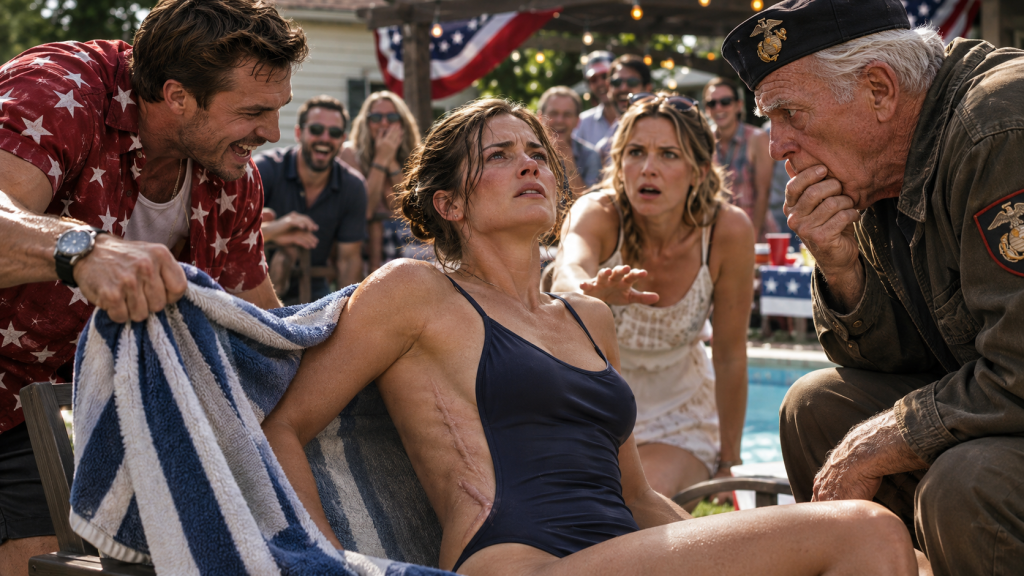
I looked down at my scar.
“That doesn’t make what he did okay.”
“I know.”
“Does he?”
“I think he’s starting to.”
I wasn’t ready to see him.
But I was curious.
And that annoyed me.
Over the next month, Brad stayed away.
He sent one text.
Rachel, I know I acted like an idiot. You don’t owe me a conversation. I’m sorry for what I did. I hope you’re doing okay.
I read it twice.
Then I put my phone down.
A few days later, Megan told me he’d stopped making jokes about me at family gatherings.
That might not sound significant.
But it was.
For years, Brad had treated me like a convenient punch line.
Captain America.
GI Jane.
The Army’s favorite overachiever.
Sometimes the jokes had been harmless.
Sometimes they hadn’t.
The difference rarely mattered to him.
Now, apparently, he corrected people who repeated them.
Megan told me one of his friends had made a remark about women in the military during a cookout.
Brad had told him to knock it off.
The friend had laughed.
Brad hadn’t.
I wanted to believe that meant something.
I also knew one month of better behavior didn’t erase nine years of careless remarks.
Meanwhile, I was facing decisions of my own.
My Army career had reached a point where I could apply for a stateside training assignment or return to operational duties after completing my leave and medical evaluations.
The second option was familiar.
The first scared me.
I’d always known how to be useful in an emergency.
I wasn’t sure I knew how to be useful when nobody needed rescuing.
During one counseling appointment, I admitted that.
My counselor asked whether I thought usefulness was the same thing as worth.
I laughed.
“That sounds like something you’d put on a poster.”
She smiled.
“Maybe. Doesn’t mean it’s a bad question.”
I stared out the window.
“I don’t know.”
“Then maybe that’s something worth exploring.”
I went home irritated.
Then I spent the evening looking at stateside training positions.
The following week, I met with an officer I’d served under years earlier.
Colonel James Mercer had recently taken a position overseeing medical readiness training.
He was fifty-eight, with a bad knee and a habit of answering questions with questions.
When I told him I was considering an instructor assignment, he raised an eyebrow.
“You?”
“That’s the idea.”
“I thought you were determined to stay operational until somebody physically dragged you out.”
“That was before I started appreciating chairs.”
He smiled.
“What’s changed?”
I thought about Danny and his children.
About the young soldiers I’d trained.
About the things I wished I’d known when I first deployed.
“Maybe I’ve learned something worth passing on.”
Mercer nodded.
“That’s generally how teaching works.”
I rolled my eyes.
He laughed.
Then he became serious.
“You know, Dawson, nobody’s asking you to prove you can still handle the worst day of your life.”
I looked at him.
He continued.
“You’ve already done that.”
I didn’t answer.
“Maybe it’s time to figure out what you want the ordinary days to look like.”
I left his office with an application packet.
It sat on my kitchen table for three days before I filled it out.
The following Saturday, Brad appeared at my front door.
He was alone.
No beer.
No loud jokes.
No exaggerated smile.
He wore jeans and an old Cleveland Guardians T-shirt, and he looked like he’d spent ten minutes arguing with himself in the driveway.
I opened the door.
“Brad.”
“Hey.”
We stood there.
He glanced past me into the house.
“I know you didn’t invite me.”
“That’s true.”
He nodded.
“I won’t stay if you don’t want me here.”
I considered closing the door.
Then I stepped aside.
“Come in.”
He looked surprised.
“Really?”
“Before I change my mind.”
He entered.
I offered coffee.
He accepted, even though I’d never seen him drink coffee without enough sugar to qualify as dessert.
We sat at the kitchen table.
For a while, neither of us spoke.
Then Brad looked at me.
“I’ve been volunteering at the VA.”
“Megan told me.”
He nodded.
“I don’t want you thinking I’m doing it to make you forgive me.”
“Why are you doing it?”
He rubbed his palms together.
“At first?”
I waited.
“Because Dad told me I ought to spend some time around people whose lives I didn’t understand.”
I almost smiled.
“That sounds like Frank.”
“Yeah.”
Brad looked down.
“I was angry with him.”
“Why?”
“Because he embarrassed me.”
I stared at him.
He gave a humorless laugh.
“I know. Pretty rich, coming from me.”
I said nothing.
“For the first couple of days, I kept telling myself he shouldn’t have called me out in front of everybody.”
He shook his head.
“Then I remembered your face.”



