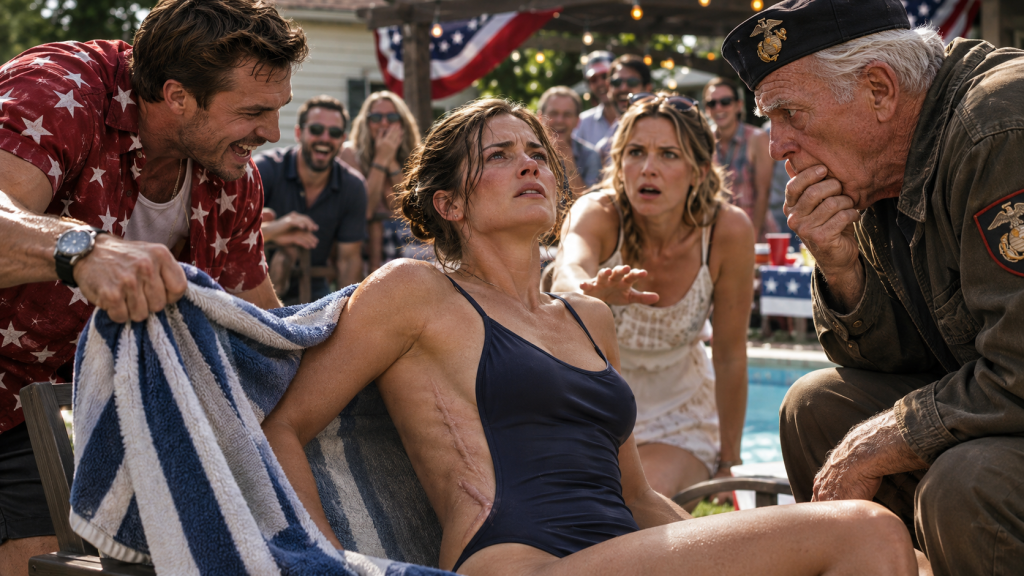
“Because you shouldn’t have done it in the first place.”
“Exactly.”
He nodded slowly.
Then he went back through the gate.
Frank watched him leave.
“I wish I’d taught him better.”
I looked at the older man.
“You probably taught him plenty. He still gets to decide what kind of man he wants to be.”
Frank considered that.
“Maybe that’s the hardest part of being a father.”
We returned to the backyard several minutes later.
Someone had turned off the music.
Brad stood beside the grill, speaking to the remaining guests.
His voice sounded different without the exaggerated confidence.
“I owe Rachel an apology,” he said. “And I owe all of you an explanation.”
Nobody interrupted.
“I pulled her towel off after she told me not to. Then I made fun of her injury.”
He paused.
“I didn’t know how she got hurt. But that doesn’t matter. I had no right to touch her or make her the joke.”
One of his friends shifted uncomfortably.
Brad looked directly at him.
“And I shouldn’t have encouraged everybody else to laugh.”
He took a breath.
“That was cruel. I’m ashamed of it.”
He glanced toward me.
“I’m sorry, Rachel.”
I nodded once.
I wasn’t ready to say anything more.
The party resumed in a strange, subdued fashion.
Parents called their children out of the pool. Someone began collecting paper plates. The woman who’d been standing near the cooler approached me and apologized.
A teenage boy asked whether I was really a captain.
I told him I was.
He looked at my scar, then quickly looked away.
“That’s pretty cool,” he said.
I almost smiled.
“Being a captain?”
“Yeah.”
“Depends on the day.”
He laughed awkwardly and went back to his parents.
Megan found me sitting on the back steps.
She brought two glasses of water.
For a while, we watched Brad stacking chairs near the fence.
Then she leaned her head against my shoulder.
We hadn’t sat like that since we were teenagers watching thunderstorms from our parents’ porch.
“Why didn’t you tell me?” she asked.
I knew what she meant.
“Because I didn’t want to.”
She nodded.
A few seconds passed.
“That’s fair.”
I looked at her.
She was crying.
“Aw, Meg.”
“I’m not crying because you didn’t tell me.”
“Then why?”
“Because you came home six days ago, and I promised you an easy afternoon.”
I looked out at the half-eaten ribs and the abandoned water slide.
“Well, you definitely oversold the amenities.”
She laughed through her tears.
Then she took my hand.
“Brad was an ass.”
“That he was.”
“I’m not going to make excuses for him.”
I squeezed her fingers.
“Good.”
She hesitated.
“He’s been awful about you for years.”
“I noticed.”
“I kept thinking he’d grow out of it.”
I didn’t answer.
Megan looked down at our joined hands.
“That was easier than admitting I should’ve said something.”
I thought about all the holidays when she’d smoothed over Brad’s jokes, changed the subject, or told me afterward that he hadn’t meant anything.
She loved him.
That didn’t mean she hadn’t helped him avoid consequences.
“I love you,” I told her.
“I love you too.”
“But I need you to stop asking me to be the bigger person every time he’s the one acting small.”
Her face tightened.
Then she nodded.
“Okay.”
It wasn’t a dramatic reconciliation.
There were no speeches.
My sister sat beside me until the shadows stretched across the patio, and for the first time in years, I believed she’d actually heard what I was saying.
That night, I drove home before the fireworks.
I told Megan I was tired.
That was true, although it wasn’t the only reason.
When I got home, I showered, changed into an old Army T-shirt, and stood in front of my bathroom mirror.
The scar looked the same as it always had.
The problem was that I was seeing it through other people’s eyes again.
I traced the pale ridge along my ribs.
Four years earlier, I’d spent weeks unable to stand upright without pain.
The surgeons had done their work well, but there had been complications. Infection. Physical therapy. Months of learning how to move without bracing for the next sharp pull beneath my skin.
I remembered the first time I managed to jog a full mile after rehabilitation.
I’d stopped beside a track and cried from sheer frustration because it had taken me nearly twice as long as it used to.
Nobody had seen that.
Nobody at the barbecue knew how many ordinary things I’d worked to get back.
For some reason, that bothered me more than Brad’s joke.
Not because I wanted recognition.
Because I was tired of being reduced to whichever part of my life happened to interest somebody else.
A captain.



