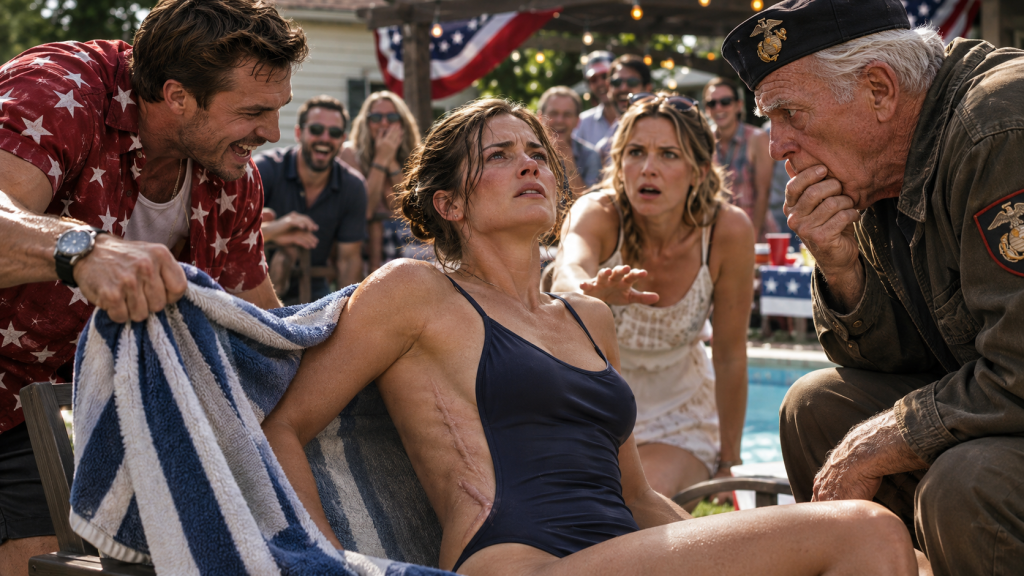
Frank came through the gate.
For a while, neither of us spoke.
Then he said, “I owe you an apology.”
I looked at him.
“You didn’t do anything.”
“I sat at your sister’s Thanksgiving table with you. Three times, I think. Asked you about your assignments. Heard you mention Afghanistan.”
He shook his head.
“I never put it together.”
“Why would you?”
“Danny described the woman who helped him. I should’ve recognized the details.”
“Frank, there were thousands of people serving over there. You couldn’t possibly have known.”
He stared at his hands.
“Maybe.”
I leaned against the fence.
“How is he really?”
Frank looked up.
“Danny?”
I nodded.
His expression softened.
“He’s doing well. Mostly.”
That word caught my attention.
“Mostly?”
“He walks with a limp. Had a rough couple of years. Pain. Nightmares. Some things he still doesn’t talk about.”
I understood that.
“He works at an equipment dealership now. His wife’s a schoolteacher. They bought a little house outside Dayton.”
Frank reached into his pocket and took out his phone.
“Mind if I show you something?”
I shook my head.
He scrolled through several pictures before turning the screen toward me.
A young man stood in front of a Christmas tree holding a little girl. A boy of about three was sitting on his shoulders.
The young man’s face had changed.
He was older, heavier through the jaw, with a beard and a tired smile.
But I recognized his eyes.
Not immediately.
Then all at once.
I remembered those same eyes looking at me through smoke.
“That’s him,” I whispered.
Frank nodded.
The little girl in the picture had one hand pressed against her father’s cheek.
“Her name’s Emma. His boy’s Caleb.”
I touched the edge of the phone without meaning to.
“They’re beautiful.”
“Yeah.”
He waited.
Then he said, “Would you be willing to talk to him?”
My first instinct was to say no.
Not because I didn’t care.
Because I cared too much.
The memories surrounding that day were complicated. Three men had survived, but not everyone involved in the convoy had come home.
For years, I’d carried the names of the dead more easily than I carried any praise for the living.
“Maybe,” I said.
Frank nodded immediately.
“That’s enough. I’ll leave it alone unless you tell me otherwise.”
I was grateful.
Then I heard the gate open.
Brad stood there.
Without his audience, he looked smaller.
His face was red, and he’d put down his beer.
“Rachel.”
I straightened.
He rubbed both hands over his shorts.
“I don’t even know what to say.”
I waited.
He glanced at his father.
“Can we talk?”
“You’re talking.”
He winced.
“Right.”
For several seconds, he stared at the driveway.
Then he looked at me.
“I’m sorry.”
It was the first time I’d heard him say those words without adding a joke afterward.
I wanted to accept them.
I also wanted to tell him exactly what he’d looked like while holding my towel above his head.
Both feelings were real.
“You embarrassed me in front of my family,” I said.
“I know.”
“I told you not to touch me.”
“I know.”
“You did it anyway.”
He nodded.
“Yeah.”
I studied him.
“Why?”
He looked genuinely confused by the question.
“What?”
“Why did you need to do that?”
He rubbed his jaw.
“I thought everybody was having fun.”
“Everybody?”
He didn’t answer.
“You saw me sitting alone, Brad. I wasn’t bothering anyone. You decided that wasn’t enough.”
His eyes dropped.
“I guess I wanted a laugh.”
There it was.
Not a complicated explanation.
Not some terrible childhood wound that justified his behavior.
He’d wanted attention.
And I had been convenient.
Frank made a faint sound behind me.
Brad looked at his father.
“Dad, I’m trying.”
“Then keep trying.”
Brad turned back to me.
“I can’t undo what I did.”
“No.”
“But I’ll apologize to everybody.”
I shook my head.
“You’re not apologizing to everybody because you hurt them. You’re apologizing because you hurt me.”
“Right.”
“And because you made twenty people think it was acceptable to laugh.”
His shoulders sagged.
“What do you want me to do?”
I thought about that.
The easiest answer would have been to tell him to leave me alone forever.
Part of me wanted exactly that.
But Megan was my sister. Brad was her husband. They had children, holidays, birthdays, and the messy collection of obligations that made families difficult to walk away from.
Besides, I’d spent eleven years learning that anger could be useful without necessarily being a good commander.
“Go back inside,” I said.
He looked surprised.
“Now?”
“Yes.”
“And?”
“Tell them what you did was wrong. Not because your father recognized my scar. Not because I helped somebody he loves.”
Brad swallowed.



