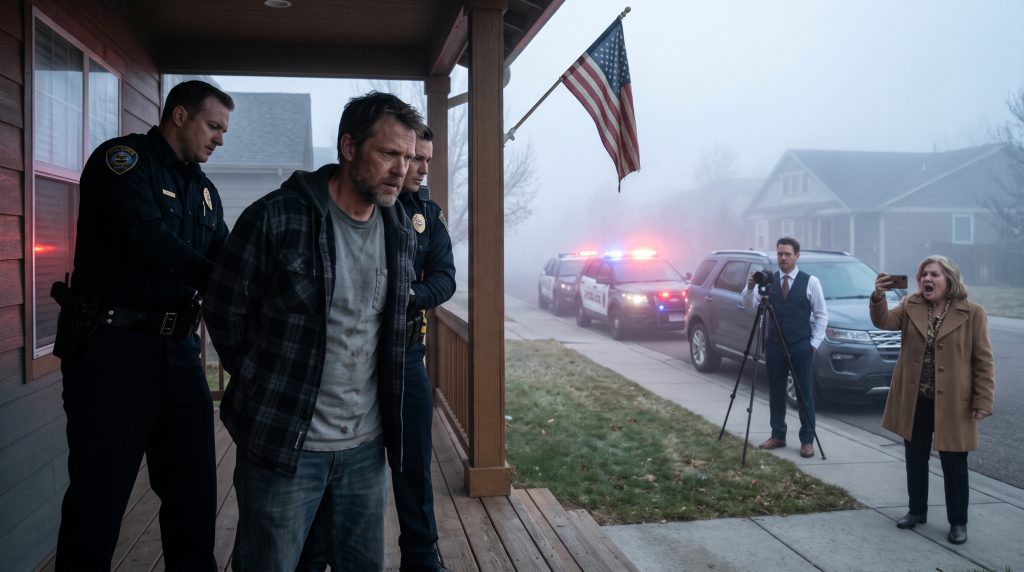
The strangest thing about that morning wasn’t the handcuffs.
It was that my mother had brought coffee.
I could see her across the street, standing beside Dalton’s silver SUV with a travel mug in one hand and her phone in the other. She was wearing the cream-colored coat I’d bought her for Christmas.
And she was smiling.
“Grady, turn around,” the deputy ordered.
I looked at him, then back at my mother.
“Mom? What’s going on?”
She didn’t answer. Dalton adjusted the camera he’d mounted on a tripod near the curb.
That was when I understood this wasn’t some terrible misunderstanding they’d rushed over to fix.
They’d come prepared to watch.
My father used to say you could tell a man’s character by how he treated something that couldn’t do him any favors.
He spent forty years building Ironclad Restorations in a small Colorado mountain town. Started with a dirt-floor garage, two borrowed tools, and a pickup that barely ran.
I grew up sweeping those floors. By fourteen, I could rebuild a carburetor. By thirty, I was running the shop beside him.
When he died five years ago, I inherited the business and responsibility for a $1.2 million family trust he’d established to protect it.
Mom received the house Dad had bought her and a generous monthly allowance.
I thought that was fair.
She didn’t.
“You got his whole life,” she told me after the funeral. “I got the leftovers.”
I’d never forgotten that.
Still, she was my mother. When she married Dalton a year later, I attended the wedding. When their investments went poorly, I helped with bills twice. When she started visiting the shop again, bringing coffee and asking about the trust, I wanted to believe we were finally getting somewhere.
Two weeks before my arrest, she’d sat in Dad’s old office, turning his antique pocket watch over in her hands.
“Your father trusted you with everything,” she’d said.
“He trusted me to keep the doors open.”
She smiled, but it didn’t reach her eyes.
“And if something happened to you, sweetheart? Who would take care of it all?”
I remembered that question while Deputy Bryce tightened the cuffs around my wrists.
“You’re under arrest for threatening and abusing your mother,” he said.
I stared at him.
“What? I’ve barely seen her this week.”
“Tell it to the judge.”
Across the street, Mom raised her phone higher.
“He’s been frightening me for months!” she called toward the deputies.
I wanted to scream that she was lying.
Instead, I watched Dalton give her a small nod, like a director pleased with a performance.
Bryce pushed me into the cruiser. As we pulled away, I caught one last glimpse of my front porch.
Dad’s old work boots were sitting beside the door.
I’d kept them there for five years.
At the county station, they took my fingerprints, my belt, and my wallet. Bryce told the booking clerk I was a dangerous man who’d terrorized his elderly mother.
I asked for my attorney, Orson, who’d handled Dad’s affairs for decades.
“You’ll get your phone call,” Bryce said. “Quit acting special.”
My wrists hurt. My stomach was empty. Mostly, I kept thinking about Mom’s coffee.
She hadn’t looked frightened.
She’d looked comfortable.
Nearly an hour later, the security door buzzed open.
A woman in a dark suit entered with the shift sergeant. She carried a federal badge and a thick folder.
“Which one is Grady?” she asked.
Bryce pointed at me.
“That’s him. Elder abuse.”
The woman opened her folder, read something, then looked directly at me.
“Mr. Grady, I’m Special Agent Kira.”
She turned to the sergeant.
“Why is this man in handcuffs?”
Bryce started explaining.
She interrupted him.
“Because three days ago, someone tried to transfer $1.2 million out of a trust belonging to this man.”
My stomach dropped.
“That’s impossible,” I said. “Nobody else has authorization.”
Kira slowly placed a document on the booking counter.
“According to this, your mother does.”
I looked down.
It was a power of attorney granting Selma control over my business, my property, and every account I owned.
At the bottom was my signature.
Except I’d never signed it.
And beside the signature was a statement claiming I was mentally unstable and incapable of managing my own affairs.
Kira watched my face.
“Mr. Grady, I need you to think carefully before you answer.”
She pointed to the date on the document.
“Where were you the afternoon your mother says you signed this?”
I remembered that afternoon immediately.
And I remembered who had been inside my father’s office.
Three weeks earlier, we’d been finishing a 1968 Shelby GT500 for a retired school principal from Fort Collins. The car had arrived at Ironclad on a flatbed eighteen months before, looking like something somebody had dragged out of a river.



