When the door closed, he leaned toward me.
“Grady, I need you to hear something you aren’t going to like.”
I almost laughed.
“That’s been the theme of my morning.”
“Your mother has spent the last six months calling me.”
“About what?”
“The trust. Your father’s will. Whether your authority could be challenged.”
I stared at him.
“Why didn’t you tell me?”
“I did. In September.”
He was right.
He’d called while I was helping Mac unload a transmission. I’d told him Mom was just upset about the estate again and asked him to handle it.
I’d forgotten the conversation almost immediately.
“She claimed you were becoming erratic,” Orson continued. “She said you were drinking, threatening employees, making irresponsible decisions.”
“That’s ridiculous.”
“I know. I told her so.”
I rubbed my face.
“Why would she think anybody would believe that?”
“Because people sometimes believe the person who tells the story first.”
That sentence stayed with me.
By early afternoon, Orson had arranged for me to appear before a judge regarding the county charges. The prosecutor, informed of the federal investigation, agreed not to oppose my release under limited conditions while the complaint was reviewed.
I wasn’t allowed to contact my mother.
That suited me fine.
I walked out of the courthouse carrying a folder of paperwork and wearing the same clothes I’d slept in.
Orson offered to drive.
I told him I needed to stop at home.
He hesitated.
“Let’s go by Harrison’s first.”
Harrison was my eighty-year-old neighbor, a retired Army mechanic who’d known Dad since the seventies.
He had a bad knee, an excellent memory, and a habit of calling everyone under sixty “kid.”
He opened his door before we knocked.
“Well,” he said, looking me over. “You look like hell.”
“Good to see you too.”
He stepped aside.
“Coffee’s on.”
Harrison’s house smelled like furniture polish and the cinnamon bread his daughter mailed him every Christmas.
He poured us coffee into mismatched mugs and set his tablet on the kitchen table.
“I watched the whole circus,” he said.
Orson leaned forward.
“Did you happen to record any of it?”
Harrison gave him an offended look.
“Son, I put cameras up after somebody stole my snowblower in 2019. Of course I recorded it.”
He opened his doorbell footage.
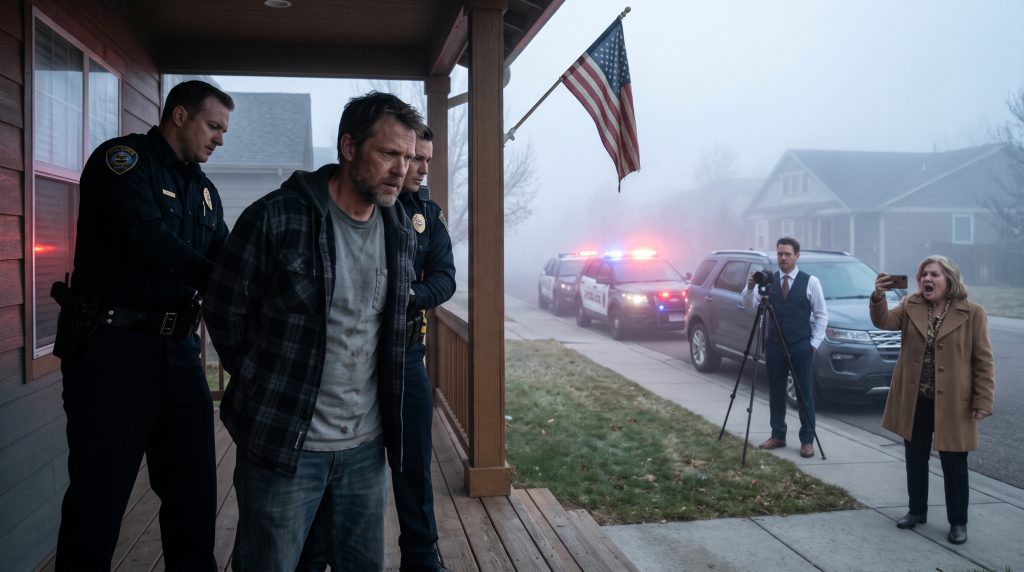
The video showed my street at 4:31 that morning.
Dalton’s SUV pulled up beside the curb.
Mom got out wearing her cream coat.
Dalton opened the rear hatch and removed the tripod.
They set up the camera, checked the angle, and stood drinking coffee.
At 5:17, Dalton walked toward the intersection and appeared to make a phone call.
At 5:46, he returned to the SUV.
At 6:02, the first deputy cruiser arrived.
I watched the recording twice.
Harrison folded his arms.
“Now, maybe I’m old-fashioned, but when a woman fears for her life, I don’t expect her to spend ninety minutes setting up a movie shoot outside the fellow’s house.”
Orson asked him to preserve the original video.
Harrison had already made two backups.
“One on the computer and one on that little drive my grandson bought me. Kid keeps telling me I need the cloud. I don’t trust anything I can’t put in a drawer.”
For the first time all day, I smiled.
Then Harrison turned serious.
“Grady, your dad would’ve been beside himself.”
“I know.”
“No, kid. He’d have been angry. But he’d have wanted you to keep your head.”
I nodded.
He touched my shoulder.
“Don’t let those two make you somebody you’re not.”
That was harder advice to follow than he knew.
My next stop was the grocery store.
I hadn’t eaten since the night before, and my head was pounding.
I bought a bottle of water, aspirin, and a sandwich.
Or tried to.
My debit card was declined.
Then my business credit card.
The cashier, a college-aged girl with a nose ring, looked embarrassed.
“Sorry, sir. It says to contact your financial institution.”
I checked my banking app.
My accounts were restricted.
There was a notice about disputed account authority and suspected unauthorized activity.
Kira had warned me that some accounts might be temporarily frozen while the bank examined the forged documentation.
Knowing why didn’t make standing there with a sandwich I couldn’t afford any easier.
I left the food on the counter.
Outside, I sat in Orson’s car and stared through the windshield.
“Forty-five years old,” I muttered. “I own a business worth millions, and I can’t buy lunch.”
Orson reached for his wallet.
“That’s temporary.”
“It doesn’t feel temporary.”
He handed me twenty dollars.
I hated taking it.
I hated needing it.
But I took it.
At Ironclad Restorations, the situation was worse.
The steel service doors were closed.
My key wouldn’t fit the side entrance.
Somebody had changed the locks.



