He said he’d remember.
Walter’s Shelby was finally completed three weeks before his granddaughter’s wedding.
The day we delivered it, he walked around the car twice without speaking.
The paint was a deep metallic blue.
The chrome shone.
The engine sounded better than it had in decades.
Walter touched the steering wheel.
“My wife loved this car,” he said.
I nodded.
He sat behind the wheel and looked through the windshield for a long moment.
Then he turned to me.
“Your dad would’ve liked this one.”
That nearly undid me.
We took a photograph beside the car.
Walter insisted Mac be in it.
Mac complained about having grease on his shirt.
Walter told him a mechanic ought to look like a mechanic.
The photograph still hangs in the shop office.
It’s one of my favorites.
Two years have passed since the sentencing.
Ironclad Restorations is doing well again.
We’ve expanded the paint department and hired two apprentices.
Mac still complains about everything.
Harrison still drinks too much coffee.
Orson has threatened to retire three times and hasn’t followed through once.
The shop’s steel doors open every morning at seven.
Sometimes earlier, if I’m restless.
I still work on the floor.
I still get grease under my nails.
I still forget to eat lunch when a project gets interesting.
Dad’s old desk remains in the office.
The mahogany cigar box was eventually recovered among property seized during the investigation.
His pocket watch came back too.
The case had a new scratch.
It still runs.
I wind it every morning.
Mom writes from prison.
The first letter arrived a few months after sentencing.
She apologized for embarrassing me.
Then she blamed Dalton.
Then she asked whether I could send some money for personal items.
I didn’t respond.
The next letter was longer.
She wrote about being lonely.
She asked whether the shop was doing well.
She mentioned Dad.
That was the part that hurt.
She wrote, “Your father always knew how to forgive.”
I sat with that sentence for a long time.
Dad could forgive plenty.
He forgave customers who paid late.
He forgave employees who made honest mistakes.
He forgave me for putting the wrong oil in his prized pickup when I was sixteen.
But I don’t know what he would have done if somebody had tried to steal his life’s work and use the law to destroy his son.
I don’t pretend to know anymore.
The third letter arrived yesterday.
A thin gray envelope with her prison address printed in the corner.
I carried it into the shop and placed it on Dad’s desk.
For most of the morning, I ignored it.
Then Mac came in with an estimate that needed approval.
He noticed the envelope.
“Her again?”
“Yeah.”
He waited.
I signed the estimate.
“You going to open it?”
“Probably not.”
Mac nodded.
Then he did something unusual.
He didn’t offer advice.
He didn’t make a joke.
He simply took the signed estimate and went back to work.
After lunch, I picked up the letter.
I held it for a while.
I thought about the cream coat.
The travel mug.
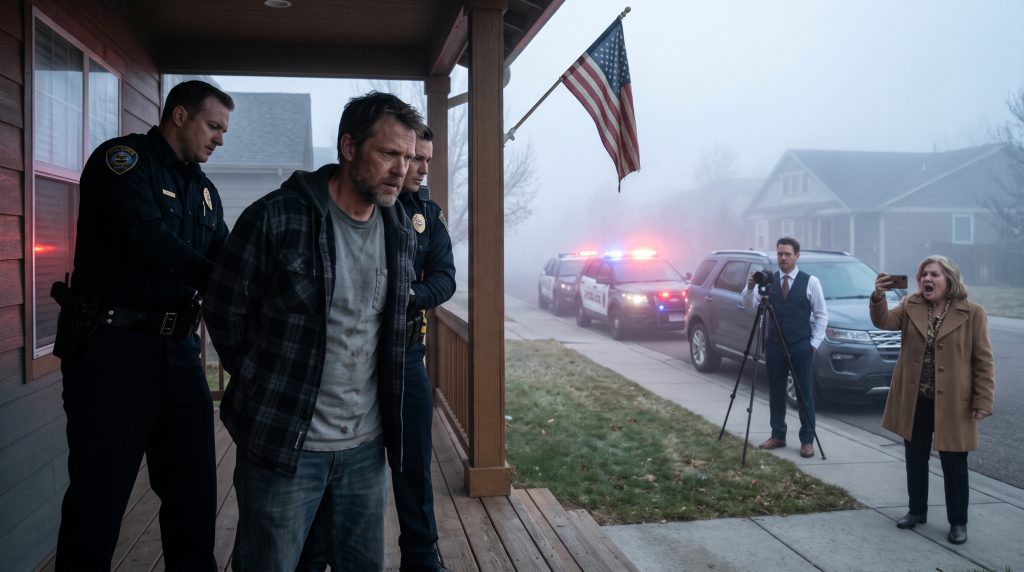
The sound of handcuffs closing around my wrists.
I thought about her sitting beside my bed when I was sick.
I thought about Dad’s funeral and how she’d held my hand while we lowered his casket.
People like simple stories.
Good mothers and bad mothers.
Loyal sons and ungrateful sons.
Heroes and villains.
I used to believe families worked that way too.
Now I know a person can give you beautiful memories and still do something unforgivable.
One truth doesn’t erase the other.
I didn’t open the letter.
I walked over to the paper shredder beside the filing cabinet and fed the envelope into it.
The machine hummed for a few seconds.
Then it stopped.
I stood there looking at the empty slot.
There wasn’t any satisfaction in it.
Not the kind people imagine.
But there was peace.
Later that afternoon, I went out onto the shop floor.
One of our apprentices was struggling to remove a rusted bolt from an old Mustang.
He was putting too much force on the wrench.
“Easy,” I told him.
He looked up.
“Thing won’t budge.”
“Give it a minute.”
I showed him how to apply penetrating oil and work the bolt gently back and forth.
He watched, impatient.
“Why not just break it loose?”
“Because then you’ll have a bigger problem.”
He grinned.
“Sounds like something my grandpa would say.”
I smiled.
“Your grandpa sounds like a smart man.”
When the bolt finally turned, he looked delighted.
I handed him the wrench.
“Finish it.”
Then I walked back toward the office.
The late afternoon sun was coming through the open service doors.
Mac had the radio playing quietly.
Somebody was laughing near the paint booth.



