Vance had operated a small notary business outside Denver for almost fifteen years.
He was behind on his mortgage and owed money to several creditors.
When confronted with the document and questions about whether he’d witnessed my signature, he initially insisted he couldn’t remember.
Then investigators showed him the bank records.
Eventually, he admitted Dalton had brought him the papers already signed.
Vance hadn’t seen me.
He hadn’t verified my identity.
He’d accepted payment to notarize documents without following the required procedures.
He also acknowledged that Dalton had described me as mentally unstable and unable to appear in person.
Vance agreed to cooperate with the investigation through his attorney.
His statement strengthened the evidence of forgery, but it also revealed something I hadn’t expected.
According to Vance, my mother had been present when Dalton delivered the papers.
She hadn’t merely accepted what her husband told her.
She’d participated.
I asked Kira whether there was any chance Dalton had manipulated her.
She studied me.
“Are you asking whether your mother understood what she was doing?”
“I guess.”
“That’s a question the evidence may answer.”
I looked down.
“She wasn’t always like this.”
Kira didn’t rush to reassure me.
“People can make terrible choices without having been terrible every day of their lives.”
That was the first thing anyone had said that felt close to the truth.
Mom had once stayed awake all night beside my bed when I had pneumonia.
She’d taught me how to fold a fitted sheet, although I’d never learned to do it properly.
She remembered every birthday and sent ridiculous cards with cash tucked inside, even after Dad left me the business.
Those memories were real.
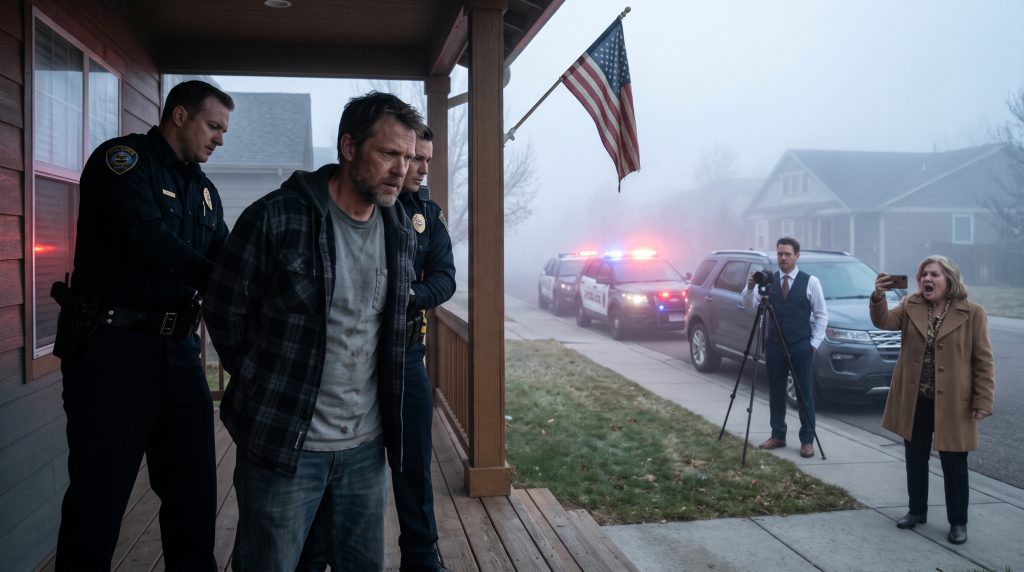
So was the woman who’d stood across the street filming my arrest.
I couldn’t reconcile them.
Maybe I never would.
A week later, Kira called with another development.
Investigators had obtained records showing repeated contact between Dalton and Deputy Bryce during the weeks before my arrest.
There were dozens of calls.
Several occurred late at night.
The calls alone didn’t prove corruption.
But financial investigators discovered deposits inconsistent with Bryce’s ordinary income.
They also located security footage from a gas station showing Dalton meeting Bryce two days before the arrest.
The footage captured Dalton passing him a large envelope.
Bryce accepted it.
Investigators subsequently obtained additional corroborating evidence, including messages and financial records.
Under questioning, Bryce admitted receiving $20,000 from Dalton.
He claimed he’d believed the accusations against me and had accepted the money to expedite what he considered a legitimate arrest.
Kira didn’t believe that explanation.
Neither did the county sheriff.
Bryce was suspended and later arrested.
I learned about it from Orson.
We were sitting in his office, eating takeout sandwiches because neither of us had time for lunch.
He answered his phone, listened, and wrote something on a legal pad.
Then he hung up.
“Bryce has been taken into custody.”
I stopped chewing.
“Deputy Bryce?”
“Yes.”
“What did he say?”
“Apparently, quite a lot.”
I leaned back.
The man who’d tightened my handcuffs while I begged him to loosen them was now facing charges related to his own conduct.
I expected to feel triumphant.
Instead, I remembered his face at the booking counter.
The contempt.
The casual certainty that I was guilty.
“Did he know the complaint was false?” I asked.
“That’s part of what the prosecution will have to establish.”
I considered that.
Then I said, “He didn’t care whether it was true.”
Orson didn’t disagree.
The sheriff’s office opened an internal review of the arrest, including the handling of my injuries and the conduct of other personnel.
Kira warned me not to discuss the investigation publicly.
I obeyed.
Mostly.
When Dalton posted another message suggesting I was trying to intimidate my mother through expensive lawyers, I typed a furious response.
I wrote four paragraphs.
Then I deleted them.
Mac came into the office while I was staring at the empty screen.
“Everything okay?”
“No.”
“Want to hit something?”
I looked at him.
He shrugged.
“We’ve got a transmission that needs rebuilding.”
That afternoon, I spent six hours working on the Shelby.
The bank had released enough operating funds under agreed safeguards for us to reopen, and Orson had obtained temporary court protections preventing Dalton from exercising control through the disputed documents.
We were still dealing with legal bills and anxious customers.
But the doors were open.
The guys came back.
The compressors ran.
The shop smelled like hot steel and coffee again.
For a few hours, I was simply a mechanic.
Then Mom called.
Her number appeared on my phone just before closing.
I stared at it.
The no-contact restriction imposed on me had been lifted when the county charges were dismissed, but Orson had advised me not to communicate directly with her while the investigation continued.



