I let the call go to voicemail.
A message appeared.
“Grady, honey, it’s Mom. I know you’re upset, but this has gotten completely out of hand. Dalton says your lawyers are making everything worse. I just want my son back. Please call me.”
She sounded tired.
Almost frightened.
For one terrible moment, I wanted to call her.
I wanted to hear her say she’d made a mistake.
I wanted to believe that if we sat at the kitchen table long enough, she might remember who I was.
Instead, I forwarded the voicemail to Orson.
He called me ten minutes later.
“Don’t respond.”
“I wasn’t going to.”
“Good.”
I hesitated.
“She sounded scared.”
“She may be.”
“Do you think she regrets it?”
“I don’t know, Grady.”
I looked at Dad’s empty chair.
“What if I wanted to help her?”
“Then I’d ask what kind of help you mean.”
I didn’t have an answer.
Dalton and Mom were becoming increasingly reckless.
Their attorneys had begun challenging the financial restrictions, claiming the disputed transactions were legitimate estate management activities.
They submitted statements portraying me as uncooperative and unstable.
But the evidence against them was growing.
The forensic report established the reproduced signature.
Vance’s cooperation supported the forgery allegations.
The financial records connected Dalton to the attempted transfer.
Bryce’s payments raised serious questions about the arrest.
Investigators also recovered digital records showing draft versions of the power of attorney and related documents.
The account used for the attempted wire transfer had been established through a company Dalton controlled.
Kira explained that prosecutors were preparing to seek indictments.
“They’re not going to just stop because the money was frozen,” she warned.
“What do you mean?”
“They still have debts. They still have an incentive to pressure you. And they may believe they can persuade you to settle.”
I almost laughed.
“Settle what? They tried to steal everything.”
“That doesn’t mean they won’t ask.”
She was right.
Three days later, Dalton sent Orson a proposed agreement.
He offered to withdraw the disputed documents and relinquish any claim to my business if I agreed not to pursue civil damages and provided financial assistance to my mother.
The amount requested was $300,000.
Orson read the letter aloud.
I stared at him.
“They want me to pay them?”
“That’s the proposal.”
“After all this?”
“Yes.”
I stood and walked to the window.
Outside, snow was beginning to fall.
I could see the parking lot, the cars moving slowly along the street, the ordinary business of people who didn’t know their mothers were trying to negotiate a price for their forgiveness.
“Tell them no.”
Orson nodded.
“That’s what I expected.”
“Tell them they’re getting nothing.”
“I’ll communicate our position professionally.”
“Fine. But make sure they understand.”
He looked at me over his glasses.
“Grady, they understand more than you think.”
The next significant event occurred at the bank.
Federal investigators had coordinated with the institution to obtain evidence surrounding a planned attempt by Mom and Dalton to complete the disputed transfer.
The bank had informed them that any release of funds required additional verification and an in-person meeting.
They agreed to attend.
Kira didn’t tell me every detail of the operation.
She did tell me that prosecutors had obtained arrest warrants.
I wasn’t permitted inside the bank during the enforcement action.
But I was nearby, sitting in Orson’s car across the street.
The morning was clear and cold.
Dalton’s silver SUV arrived shortly before ten.
He parked near the entrance.
Mom climbed out wearing her cream coat.
For a moment, seeing it made my chest ache.
I’d bought that coat because she’d admired it in a store window.
She’d told me it was too expensive.
I’d gone back the next day and purchased it anyway.
Now she wore it while walking into a bank to take money from the business Dad had entrusted to me.
Dalton held the door for her.
They disappeared inside.
Orson checked his watch.
I stared at the bank.
“Do you think she’ll be scared?”
“Probably.”
I nodded.
A few minutes later, unmarked vehicles arrived.
Federal agents entered the building.
From where we sat, I couldn’t see what happened inside.
I imagined Mom reaching for a pen.
I imagined Dalton smiling at the banker.
I imagined the moment somebody told them they were under arrest.
The real scene, as I learned later, was less theatrical.
Agents entered a private conference room, identified themselves, and executed the warrants.
Dalton argued.
Mom demanded to know whether there had been a mistake.
Both were taken into custody without serious physical resistance.
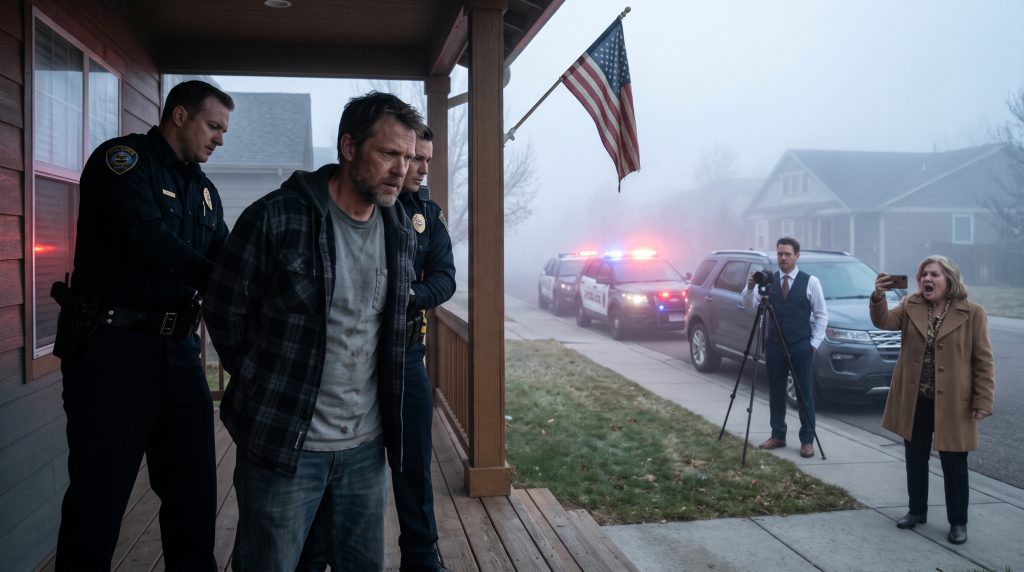
When officers brought them outside, Dalton kept his head down.
Mom looked around.
Then she saw me.
I hadn’t intended to get out of the car.
But when Orson opened his door, I followed him onto the sidewalk.



