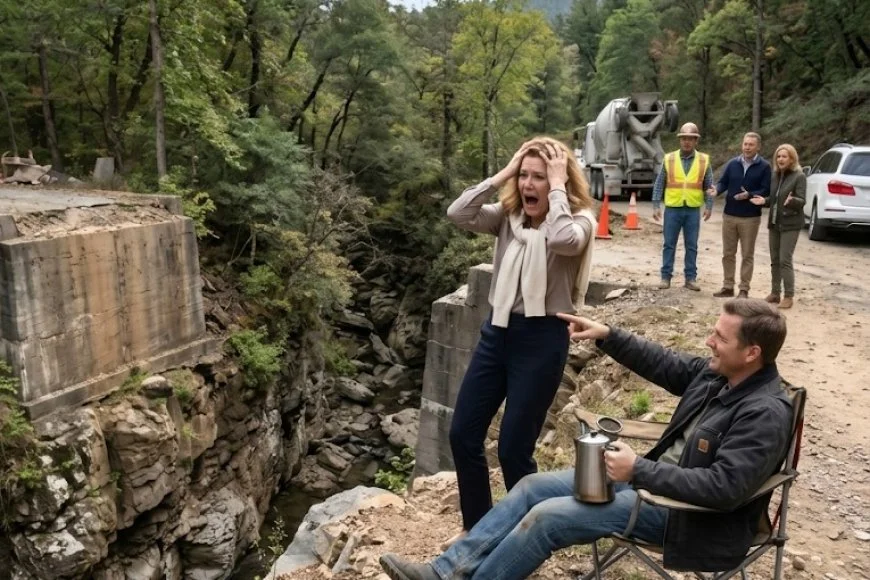
The invoice was for $45,000.
I read it three times before I realized the number wasn’t the worst part.
The worst part was the sentence underneath it.
PROPERTY OWNER RESPONSIBLE FOR EMERGENCY STRUCTURAL ABATEMENT.
My property.
My bridge.
Their project.
Their contractor.
And somehow, according to the Pinnacle at Cedar Ridge Homeowners Association, I was supposed to pay forty-five thousand dollars so their residents could drive golf carts across a bridge my grandfather had built seventy years earlier.
I called the HOA president.
Britt Stewart answered on the second ring.
“Pinnacle Association.”
“This is Alagan Ford.”
A pause.
Then that smooth, expensive voice.
“Ah. The bridge owner.”
“That bridge has been in my family since 1952.”
“Which is exactly why you’re financially responsible for making it safe.”
“For your golf carts?”
“For community access.”
“There is no community access.”
“Our attorneys disagree.”
I looked out the window toward Miller’s Creek.
The old bridge crossed the ravine below my cabin—surplus railroad steel, heavy timber decking, ugly iron rails my grandfather had welded himself.
It rattled in winter.
Creaked under delivery trucks.
And belonged completely to my ten-acre parcel.
Behind my land sat five hundred acres that had recently become the Pinnacle at Cedar Ridge, an exclusive gated development filled with enormous villas, golf greens, landscaped trails, and people who paid more in annual dues than my first truck had cost.
I didn’t care.
Until their trail map showed my bridge as a “community nature crossing.”
At first, people simply wandered onto my driveway.
Joggers.
Cyclists.
Families pushing expensive strollers.
One woman told me I couldn’t block “their trail” while standing beside my woodpile.
So I installed a steel gate.
PRIVATE PROPERTY.
NO PUBLIC ACCESS.
Three days later, Britt mailed me my first HOA violation.
She wanted the gate removed.
The bridge painted “Tuscan Sand.”
The timber deck resurfaced.
Then came a $500 fine.
I laughed.
I wasn’t a member.
My deed contained no HOA covenants.
No access easement.
No trail agreement.
No right-of-way.
I called Britt and explained that.
She told me I misunderstood “modern community planning.”
Then she said the Pinnacle’s lawyers had identified an access right.
“Send it to me.”
“Our counsel will handle that.”
“Then until they do, stay off my property.”
Her voice sharpened.
“You’re being unnecessarily hostile.”
“No. I’m being extremely clear.”
A month later, the fines reached $5,000.
Then landscapers appeared beside the bridge and planted hydrangeas.
On my land.
I removed them.
I did not dump them at the clubhouse.
My attorney later thanked me for showing that small amount of restraint.
The real trouble came in June.
I woke to diesel engines.
When I reached the bridge, a construction crew was cutting the chain from my gate.
Britt stood behind them wearing a wide-brimmed hat and holding a clipboard.
“Stop.”
The foreman lowered the bolt cutters.
Britt smiled.
“Good morning, Alagan.”
“What are you doing?”
“Correcting a hazard you refused to correct.”
She handed me court papers.
A county judge had issued a temporary emergency order after the HOA claimed my bridge posed an immediate public-safety risk because pedestrians had been using it.
The order allowed limited access to secure the site pending a full hearing.
I stared at the papers.
“You told the court this bridge was public?”
“We told the court people use it.”
“Because you sent them here.”
“That isn’t the issue.”
Then she showed me the contractor proposal.
New deck.
Decorative railing.
Reinforcement.
Lighting.
Golf-cart loading standard.
Stamped concrete approaches.
Total:
$45,000.
“You expect me to pay this?”
“The HOA is advancing the cost.”
“I didn’t authorize anything.”
“We intend to recover the expense through the proper legal process.”
“Meaning?”
“Lien rights, if necessary.”
She stepped closer.
“This could all have been avoided if you had cooperated.”
The foreman was a heavyset man named Gary Mitchell.
He looked uncomfortable.
“We’re only doing preliminary work today,” he said.
“Don’t pour anything.”
Britt laughed.
“You don’t control the schedule anymore.”
But the order in my hand said something slightly different.
That afternoon, I drove to see Gail Sullivan.
Gail had handled real estate and land-use disputes for thirty years and enjoyed arrogant paperwork the way some people enjoy crossword puzzles.
He read the order twice.
Then a third time.
Finally, he looked up.
“They got temporary authority to make the hazard safe.”
“That sounds bad.”
“It is.”
“Can they force this $45,000 project on me?”
“Not automatically.”
He slid the order back.
“The court has not ruled that the HOA owns an easement. It hasn’t ruled that you owe them money. It hasn’t ordered you to build a luxury crossing.”
“What has it ordered?”
“That the alleged hazard be secured while the underlying property rights are sorted out.”
I leaned back.
“So?”
“So there’s an obvious question.”
“What?”
“Do you need the bridge?”



