It was whether the development had been sold using access it never had…
PART 3
That brochure changed the case.
Not because a marketing document creates property rights.
It doesn’t.
But it showed intent.
The Pinnacle’s developer had marketed a trail connection across Miller’s Creek before negotiations with my family, before any easement agreement, and apparently before anyone had verified whether the crossing belonged to them.
Gail requested the planning files.
The developer resisted.
Then the court ordered limited production related to the claimed bridge access.
What came back was embarrassing.
Early planning emails referred to my crossing as the “existing north connector.”
One project manager asked whether an easement had been secured.
Another replied:
ASSUMED HISTORIC ACCESS. VERIFY LATER.
Later never happened.
Instead, the dotted line moved from internal planning maps into public brochures.
Then sales material.
Then homeowner trail maps.
By the time Britt became HOA president, hundreds of residents had been told the crossing was theirs.
She had inherited a false assumption.
Then turned it into policy.
That distinction mattered to me.
Britt had not invented the original mistake.
But every time someone questioned it, she chose authority over verification.
The HOA’s lawyers searched for historic use.
They found old photographs showing hunters occasionally crossing the bridge with my grandfather’s permission.
A utility worker had used it once.
A county truck had crossed during a flood in the 1980s.
None of that established the broad recreational easement the Pinnacle wanted.
Gail summarized it during mediation.
“Permission is not ownership.”
The HOA attorney responded:
“Longstanding use can matter.”
“Absolutely.”
Gail pushed the survey forward.
“Show me the legally sufficient facts that create the right you’re asserting.”
There weren’t enough.
Eventually, the HOA abandoned its claim to a permanent recreational easement.
But that created another problem.
Their expensive trail network now ended at Miller’s Creek.
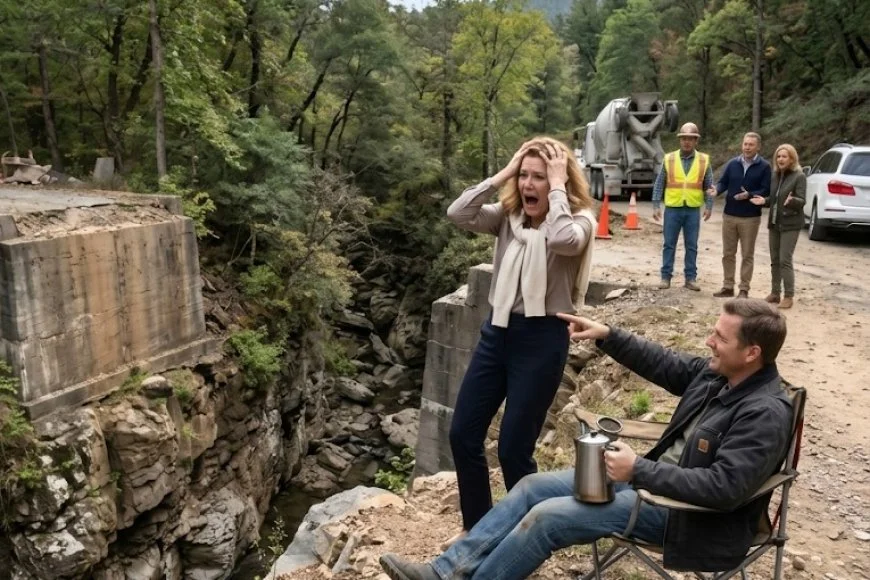
The Summer Solstice Wellness Weekend arrived three days after the demolition.
Contrary to the exaggerated rumors that spread afterward, nobody ran off a cliff.
The HOA closed the trail before the event.
Signs redirected runners.
Staff stood at the junction.
People were angry, not endangered.
That was bad enough.
Residents had paid for a resort-style community whose marketing emphasized direct state-park access.
Now they discovered the “direct connection” depended on crossing private property the developer had never secured.
Some demanded refunds for the event.
Others demanded explanations.
The first emergency HOA meeting lasted four hours.
I did not attend.
Gary Mitchell later told me Britt spent most of it insisting that I had sabotaged the community.
Then a homeowner asked a question she couldn’t answer.
“Why didn’t we have an easement before we sold houses using that trail?”
After that, the argument moved away from me.
That was where it belonged.
Mitchell and Sons submitted a cancellation invoice.
Not $15,000 in some magical punishment.
A documented mobilization and cancellation charge for equipment, labor scheduling, engineering preparation, and concrete arrangements.
The HOA disputed part of it.
They eventually settled.
Then the developer got pulled in.
Residents demanded to know who had approved marketing materials showing the bridge.
Sales files showed the trail connection had been promoted repeatedly.
That raised potential claims far beyond my little property dispute.
Britt had thought I was the expensive problem.
Now the expensive problem was inside the Pinnacle.
The HOA board tried one final civil claim against me, arguing that demolishing the bridge after receiving notice of their planned improvements had been an intentional interference with community operations.
Gail filed a motion to dismiss supported by the ownership record, engineering report, environmental approval, court notice, and the fact that I had removed a structure on my own property after the HOA itself had characterized it as dangerous.
At the hearing, Judge Harrison—the same judge who had signed the original emergency order—looked annoyed before anyone finished speaking.
He addressed the HOA attorney.
“My prior order did not establish your client’s ownership.”
“No, Your Honor.”
“It did not require this landowner to construct recreational infrastructure.”
“No.”
“It did not determine the existence of an easement.”
“No.”
“Then why am I being asked to treat demolition of his private structure as destruction of your client’s property?”
The attorney tried to shift toward reliance and historical use.
The judge stopped him.
“Reliance on an unresolved property assumption is not the same thing as a property right.”
The claim did not survive.
More importantly, the judge clarified the record.
No finding of HOA ownership.
No established recreational easement.
No authority to impose HOA fines on my parcel.
No basis for charging me for the proposed upgrade.
That was all I needed.
The court did not give me some giant revenge award.
It did award certain recoverable costs related to the improper claims.
The rest was handled through settlement.
Britt’s real consequences came from her own homeowners.



