I frowned.
“There’s another road along my south boundary.”
“Public?”
“Yes.”
“Then if a licensed engineer says this bridge is unsafe…”
I stared at him.
He continued.
“…you are not necessarily required to preserve it.”
My pulse changed.
“You’re saying I can remove it.”
“I’m saying we do not improvise with a seventy-year-old bridge over a creek because Britt Stewart irritated you.”
He held up one finger.
“First, engineer.”
Second finger.
“County.”
Third.
“Environmental clearance.”
Fourth.
“Written notice to the court and HOA.”
Then he smiled.
“If all of that says demolition is lawful, the HOA has a serious strategic problem.”
The next twenty-four hours were the longest of my life.
A structural engineer inspected the bridge.
His report was blunt.
The structure was serviceable for limited private use but not suitable for the public loading, lighting, concrete surfacing, and golf-cart traffic the HOA proposed without substantial rehabilitation.
More importantly, the bridge was not required for access to my property.
The county confirmed the southern road served my parcel.
The environmental office approved a controlled removal plan as long as no debris entered Miller’s Creek and the abutments were stabilized.
Gail filed notice with the court.
The HOA objected.
The judge refused to stop demolition before the scheduled hearing because the temporary order did not require me to preserve the crossing itself.
That was the moment Britt’s strategy collapsed.
She had gone to court arguing that my bridge was an emergency hazard.
I was going to solve the emergency.
Permanently.
At 6:10 the next morning, Big Dan Henderson arrived with two flatbeds, a hydraulic crane, and six men who dismantled industrial structures for a living.
I stood beside the bridge with one hand on my grandfather’s rusted rail.
For seventy years, it had connected our land to the north road.
I hated seeing it go.
But I hated the idea of handing it over more.
Dan looked at me.
“You sure?”
I nodded.
“Take it down.”
By sunset, the bridge was gone.
Steel beams loaded.
Timber removed.
No debris in the creek.
No dramatic explosion.
No wreckage.
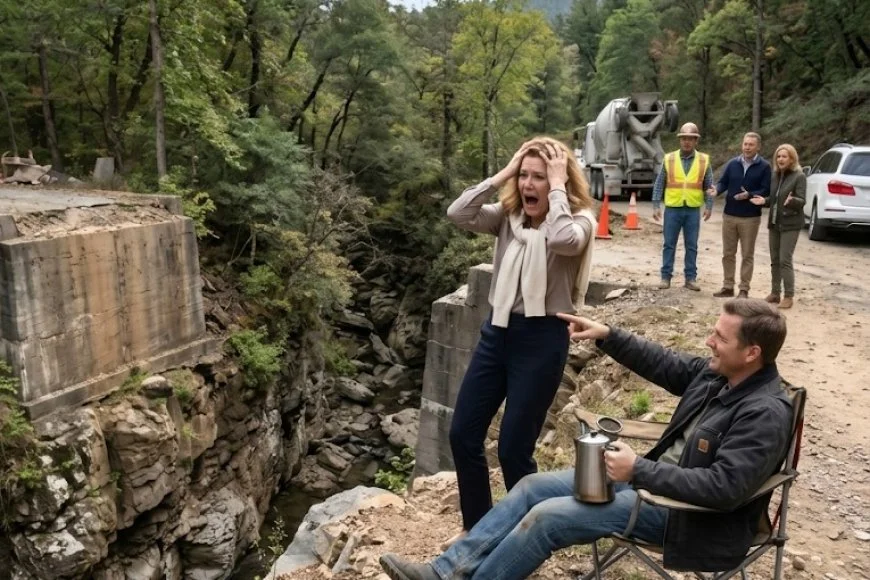
Just two old concrete abutments facing each other across thirty feet of empty air.
The next morning, Britt arrived with three cement mixers.
She stepped from her Mercedes smiling.
Then she looked toward Miller’s Creek.
The smile disappeared.
“Where is the bridge?”
I was sitting in a folding chair with coffee.
“You said it was dangerous.”
She stared at the empty ravine.
“You destroyed it.”
“I removed a private structure after engineering review, county notice, environmental approval, and court notice.”
“You can’t do that.”
Gail’s truck pulled in behind her.
He stepped out carrying a folder.
“Actually,” he said, “that’s exactly what we’re here to discuss.”
Britt turned toward him.
Then toward the contractor.
Then back toward the empty space where her luxury trail crossing had been.
And for the first time since this started, she understood the problem.
The Pinnacle had spent months fighting over how my bridge should look.
Nobody had stopped to ask what happened if I decided there shouldn’t be a bridge at all…
Gary Mitchell climbed out of his truck, removed his hard hat, and stared across the ravine.
“So… there’s nothing to renovate.”
“That’s correct,” Gail said.
Britt immediately called the sheriff, claiming I had destroyed community infrastructure. Sheriff Miller arrived, reviewed my deed, survey, demolition permit, engineering report, and the court filings, then asked Britt for the easement giving the HOA a property interest in the bridge.
She didn’t have one.
Her lawyer arrived twenty minutes later and wisely stopped her from arguing further on the roadside.
The real fight moved back to court.
The HOA claimed I had acted maliciously to interfere with its trail system. Gail answered with the simplest timeline imaginable: the Pinnacle advertised my private bridge, sent residents across it, called it dangerous when I blocked access, obtained emergency relief based on that alleged danger, and then tried to use the order to force a luxury upgrade onto my property.
The judge was not amused.
He clarified that his emergency order had never established HOA ownership, never granted a recreational easement, and never authorized a $45,000 renovation at my expense.
The HOA’s claim for reimbursement was denied.
But Gail warned me not to celebrate yet.
“They still have one argument left.”
“What?”
“They’re going to claim historic public use created access rights.”
“Can they win?”
“Maybe. Property cases get ugly.”
Then he handed me the developers’ original trail brochure.
My grandfather’s bridge was drawn in.
Construction began on the Pinnacle three years earlier.
The brochure was dated four months before the developer even bought the land.
Someone had planned to use my bridge before they owned the property behind it.
And that meant the next question wasn’t whether residents had crossed it.



