The Pinnacle had to explain why association money had been spent pursuing a bridge the HOA didn’t own.
Why a $45,000 private upgrade had been planned before property rights were settled.
Why contractors had been mobilized.
Why legal fees kept growing.
Why residents had been told state-park access was guaranteed when nobody had an executed crossing agreement.
The reserve account dropped.
Not to zero.
Not because the entire community collapsed.
But enough that residents noticed.
Then the board proposed a special assessment to replenish reserves and fund a feasibility study for a legitimate bridge on Pinnacle property.
That was the moment homeowners stopped treating the dispute as somebody else’s problem.
A special meeting was called.
Britt stood at the front of the clubhouse.
Residents asked questions for nearly two hours.
One man had purchased his home specifically because he was a trail runner.
He held up an old brochure.
“This says direct access.”
Britt replied that marketing language was not a legal guarantee.
He stared at her.
“Then why did you spend association money suing the man who actually owned the crossing?”
Another resident asked why the HOA had issued fines against me when I wasn’t a member.
Another asked why the board voted on bridge aesthetics before obtaining a title opinion.
Another wanted to know who approved the $45,000 project.
Britt kept answering with some variation of:
We acted in the community’s best interest.
Finally, an elderly homeowner named Susan Bell stood.
“I don’t care whether you meant well.”
The room went quiet.
“I care whether you checked.”
That sentence ended Britt’s presidency more effectively than anything I could have said.
The board voted to remove her as president under its governing procedures pending the next election.
Her husband later resigned from the architectural committee.
Other directors stayed long enough to complete the transition.
No dramatic exile.
No mob.
Just people losing confidence.
Britt and her husband sold their house several months later.
Whether they moved because of the bridge dispute, family reasons, money, or simple embarrassment, I never knew.
I didn’t ask.
By then, the Pinnacle had hired engineers to study real options.
A new bridge was possible downstream.
Expensive, but possible.
This time, the crossing would sit entirely within land the developer controlled or within properly negotiated rights.
No assumption.
No dotted line over somebody else’s property.
The residents eventually approved the project.
Construction took more than a year.
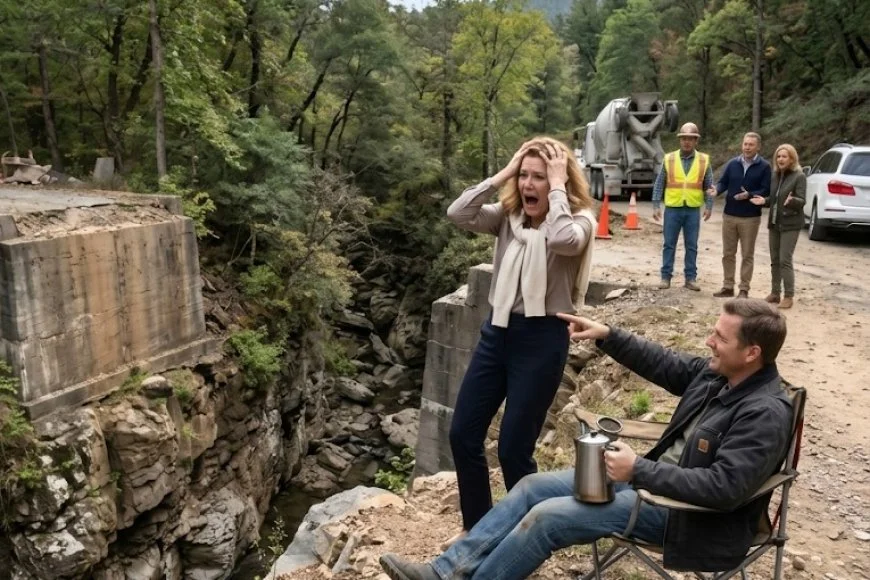
I watched part of it from my hillside.
Piles driven.
Concrete abutments poured.
Environmental inspections.
Actual easement documents.
Survey stakes.
Permits.
All the boring things that should have happened before the first trail brochure was ever printed.
One afternoon, Gary Mitchell stopped by my cabin.
His company had won part of the new bridge job.
He brought coffee.
“You know what’s funny?”
“What?”
“They’re spending almost two million dollars now.”
“I heard.”
He looked toward the empty ravine.
“They really thought forty-five thousand on your old bridge was a bargain.”
“It would have been.”
“If you paid.”
“That was the part I disliked.”
Gary laughed.
Then he looked toward the old abutment.
“You miss it?”
The question surprised me.
“Yes.”
I did.
The bridge had been ugly.
Rusty.
Loud.
But my grandfather had built it.
My father had driven me across it when I was a kid.
I had replaced planks beside him in summer heat.
Removing it had solved the legal problem.
It still felt like cutting down an old family tree.
Dan had saved one section of rail for me.
I mounted it beside the cabin.
Not as a trophy.
As a piece of family history.
The scrap value from the steel covered most of the demolition cost.
Dan refused to charge his normal rate because he had his own history with the development, but I paid him anyway.
“Your grandfather would haunt me if I worked for free,” he complained.
“Exactly.”
I kept using the southern road.
It added six minutes to the drive into town.
I survived.
The ravine became quiet again.
No joggers.
No golf carts.
No maintenance crews planting hydrangeas.
Just Miller’s Creek moving through rock.
The first winter after demolition, snow covered the old approaches.
From my porch, the two concrete abutments looked like ruins from something much older than seventy years.
I thought about rebuilding a smaller pedestrian bridge for myself.
Then decided against it.
Not yet.
Maybe someday.
On my terms.
A year later, the Pinnacle invited me to the ribbon cutting for its new crossing.
That surprised me.
The new HOA president, Daniel Price, called personally.
“You don’t have to come.”
“I know.”
“We thought you should be invited.”
“Why?”
“Because this bridge exists partly because we finally learned where our property ends.”
I laughed.
“That’s not much of a ribbon-cutting slogan.”
“No.”
I went.
The new structure was impressive.



