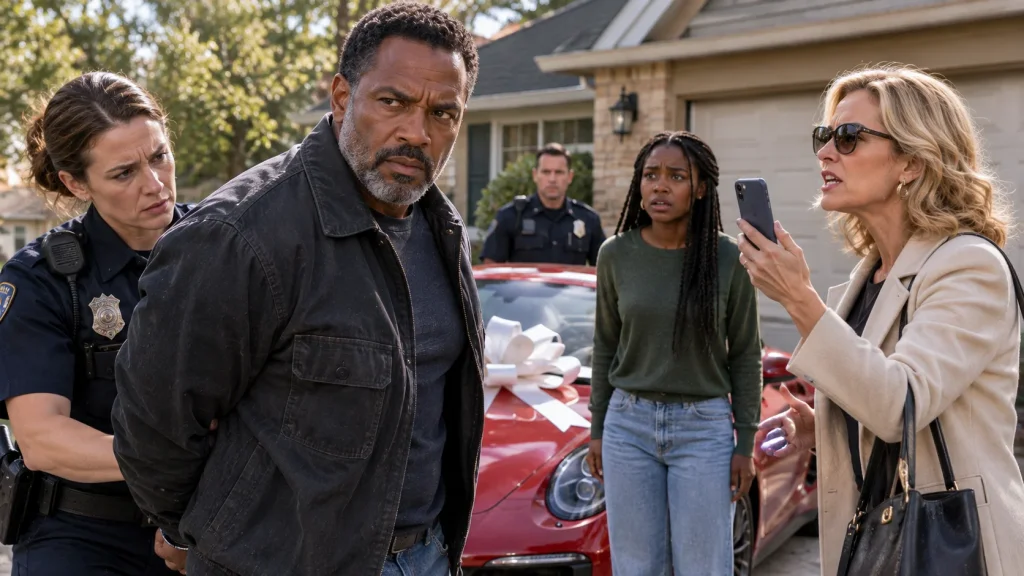
The first thing the police told my daughter was to step away from me.
Not happy birthday.
Not congratulations.
“Miss, move away from him. Now.”
Twenty seconds earlier, I had been standing in our driveway holding out the key to a red Porsche with a ridiculous white ribbon across the hood.
Now two patrol cars blocked the street.
My neighbor stood beside my garage pointing at the key in my hand.
“That’s what he threatened me with.”
My daughter, Nia, looked from the officers to me.
“That’s my birthday present,” she whispered.
Nobody seemed to hear her.
My name is Dorian Bellamy.
I was forty-nine years old and repaired refrigeration systems for supermarkets, usually at hours when sane people were asleep.
I was not wealthy.
I was not connected.
I did not have an attorney on speed dial.
And that Porsche was not some impulsive luxury purchase.
It belonged to my late wife.
Sabine loved engines.
Not expensive cars.
Engines.
She could listen to a rough idle for ten seconds and tell me which cylinder was misbehaving.
Years earlier, she bought an old red Porsche 911 from her uncle’s estate.
Faded paint.
Cracked windshield.
Worn seats.
Nia was twelve.
She climbed into the passenger seat before the tow truck driver had even finished unloading it.
Sabine promised they would restore it together.
“Then we drive east until we hit the ocean.”
They never did.
When Nia was sixteen, Sabine got sick.
Cancer first became appointments.
Then treatment.
Then remission.
Then the conversation where the doctor stopped using the word cure.
I responded the only way I knew how.
I worked.
Overnight refrigeration calls paid better.
So I took them.
Sabine said she understood.
Nia did not.
On Sabine’s last night, a supermarket freezer failed forty minutes away.
I had already refused two jobs that week.
Sabine squeezed my hand.
“Go. We’ll be here.”
At midnight, Nia called.
I did not hear my phone over the compressor.
Seventeen missed calls.
By the time I got home, Sabine was gone.
Nia stood in the doorway wearing her mother’s cardigan.
“She kept asking if you were coming.”
Then she went upstairs.
We never really recovered.
After the funeral, the Porsche became a covered shape in the garage.
Nia avoided it.
I stacked boxes around it.
For three years, my daughter and I lived in the same house while speaking mostly through grocery lists,
appointment reminders, and text messages about who needed milk.
Then I found Sabine’s notebook.
It was beneath the passenger seat.
Parts lists filled most pages.
On the last was a route to the coast.
A diner circled.
A beach marked with three stars.
At the bottom:
NIA DRIVES THE LAST MILE.
I sat on the garage floor until sunrise.
The next morning, I called my friend Ellis, who owned a body shop.
It took eighteen months.
Fuel system.
Brakes.
Rust.
Paint.
Interior.
I sold my fishing boat.
Worked extra shifts.
Repaired Ellis’s shop cooling system in exchange for labor.
Nia thought I had sold the Porsche.
I let her believe it.
On her twentieth birthday, Ellis delivered it just after sunrise.
The red paint looked like fire in the morning light.
I tied the bow myself.
Badly.
When Nia came home from her breakfast shift, she dropped the paper bag in her hand.
“Dad…”
I held out the key.
For the first time in years, I saw my daughter before I saw her grief.
Then our neighbor Corliss Vane crossed the street.
She had lived opposite us for six years.
The day we moved in, she asked Sabine whether we were the movers.
When Sabine told her we owned the house, Corliss laughed and called it an understandable mistake.
I had never forgotten that laugh.
Corliss stopped beside the Porsche.
“Whose car is this?”
“My daughter’s.”
She looked Nia up and down.
“Really?”
“Yes.”
“There have been stolen cars in the area.”
“This one isn’t stolen.”
“Then show me the paperwork.”
I stared at her.
“You’re my neighbor. You don’t inspect my property.”
Something changed in her face.
“You know, people work very hard to live in this neighborhood.”
“What does that mean?”
She glanced at the key.
“You know exactly what it means.”
Nia stepped beside me.
“Get off our driveway.”
Corliss pulled out her phone.
“There’s no need to become aggressive.”
Then she called 911.
“There’s a stolen sports car,” she said loudly. “The man is threatening me.”
I had not moved.
Nia shouted:
“He’s my father!”
Corliss turned away.
“Yes,” she told the dispatcher. “Black male. There’s a young woman here too. I don’t think she’s safe.”
My stomach went cold.
I raised both hands.
The Porsche key hung from one finger.
Then Corliss said one more thing.



