She kept telling Sabine:
“He’s coming.”
She had no idea whether I had even seen her calls.
Sabine’s breathing changed.
Nia held her hand.
She was sixteen.
She had no idea what to do.
“I kept promising Mom you were coming,” she said.
My eyes burned.
“I’m sorry.”
“I know.”
“No. I mean I am sorry you had to do that alone.”
She started crying.
So did I.
Neither of us looked away.
After our third counseling session, I finally gave her the letter I had found inside Sabine’s notebook.
I had been saving it for the Porsche reveal.
Then the police came.
After that, nothing about the car felt safe.
The letter was addressed to Nia.
Most of it sounded exactly like Sabine.
DON’T LET YOUR FATHER PICK THE MUSIC.
PACK SANDWICHES. COASTAL DINERS ARE A RIP-OFF.
STOP WHEN YOU SEE SOMETHING INTERESTING.
Near the bottom:
IF THIS TAKES LONGER THAN WE PLANNED, THAT DOESN’T MEAN WE FAILED.
Nia read that line twice.
Then she pressed the page against her chest.
We sat on the garage floor beside the Porsche until evening.
Corliss’s life became more complicated too.
During the proceedings, we learned her husband had died unexpectedly two years earlier.
Her adult son rarely visited.
She had become increasingly isolated.
For a moment, I understood her loneliness.
I knew what the empty side of a bed could do.
But empathy is not the same thing as absolution.
Her husband’s death did not make her claim true.
Her loneliness did not move my feet toward her.
Grief did not put threatening words in my mouth.
The prosecutor eventually offered Corliss a plea agreement.
She resisted at first.
Then the defense received the complete recordings.
Not excerpts.
Everything.
Her 911 call.
Mr. Ibarra’s audio.
The uninterrupted driveway footage.
Her social-media post.
After another conference, Corliss changed her plea.
In court, she admitted that she knowingly described movements and threats that had not occurred.
Her voice was so quiet the judge told her to repeat it.
She did.
Clearly.
For sentencing, both Nia and I prepared statements.
My first draft was furious.
My second sounded like someone trying too hard to appear noble.
The third was simply what happened.
The Porsche.
The bow.
The muffins.
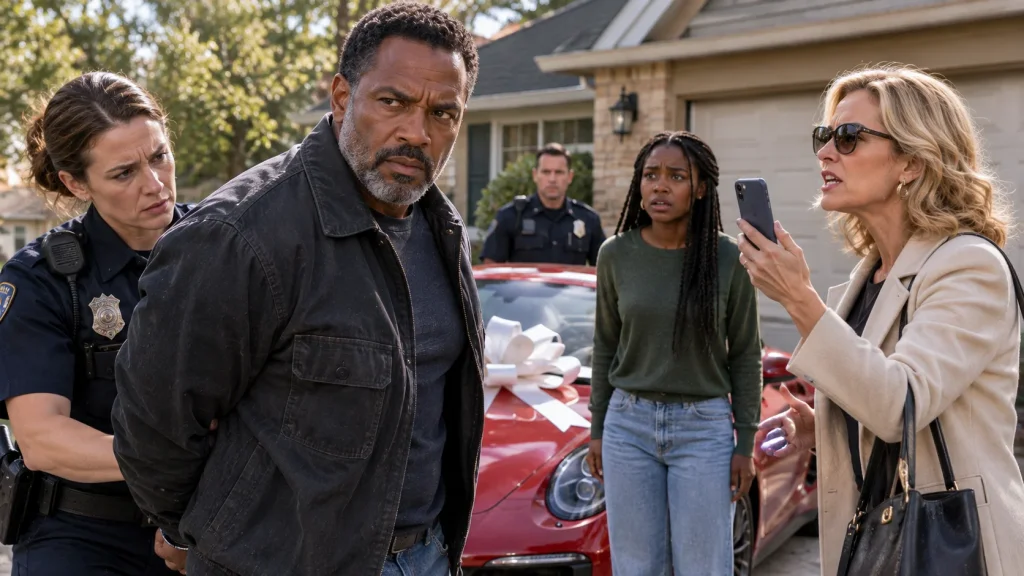
The key on the hood of the patrol car.
The cuffs.
My daughter standing beside the vehicle her mother had loved.
Nia wrote hers alone.
Outside the courtroom she asked:
“Can I talk about Mom?”
“It’s your story too.”
Her hands shook.
Still, she walked into the courtroom ahead of me.
When Nia spoke, Corliss stopped looking around.
“My mother died when I was sixteen,” Nia said. “I watched her leave my life once. When officers pulled me away from my dad, I felt that same helplessness again.”
The courtroom was silent.
“I knew he was my father.”
She looked toward the judge.
“I knew the car belonged to us. I knew the key was my birthday present. But the officers didn’t know any of that because somebody chose to tell them another story.”
Then Nia lifted a photograph.
Sabine beside the unfinished Porsche.
“She didn’t just ruin my birthday.”
Her voice cracked.
“She made something my mother loved feel dangerous.”
Nobody interrupted.
When Corliss spoke, she talked about her husband.
Her loneliness.
Her fear.
Neighbors avoiding her.
The judge listened.
Then he asked:
“Do you understand why Ms. Bellamy was afraid?”
Corliss started to say she had never intended—
“That was not my question.”
Corliss stopped.
After a long silence:
“Yes.”
“Why did you report a threat?”
She looked down.
“I wanted the officers to take me seriously.”
The judge glanced at the transcript.
“So you supplied danger because the facts did not supply it.”
Corliss said nothing.
The sentence included a short county-jail term, supervised probation, restitution for documented medical expenses and lost wages, community service, and a court-approved accountability program.
The court also imposed a no-contact order protecting Nia and me.
Because Corliss lived across the street, the order had practical rules.
No visits.
No calls.
No messages through neighbors.
No approaching us outside.
If we crossed paths, she kept distance and moved on.
Amara told us something important afterward.
“Do not make watching her your new job.”
I understood immediately.
Justice could become another kind of prison if Nia and I spent every day checking Corliss’s windows.
The civil matter continued.
During sworn questioning, Corliss admitted she had never checked whether the Porsche was stolen.
She admitted her online post omitted the fact that police verified my ownership.
Eventually, we reached a separate settlement.
It covered documented remaining damages and civil claims while crediting overlapping restitution so nothing was paid twice.
The agreement also required a public correction in the same neighborhood group.
No “misunderstanding.”
No “both sides.”



