“He told me he’d hurt me if I didn’t leave.”
Nia stopped shouting.
She looked at me.
Fear replaced anger.
The first cruiser arrived within minutes.
An officer stepped behind his door.
“Sir, show me both hands.”
They separated Nia from me.
Corliss began talking immediately.
Stolen car.
Threats.
Weapon.
Suspicious behavior.
I kept saying the registration was in the glove compartment.
Nobody checked it yet.
Then an officer told me to turn around.
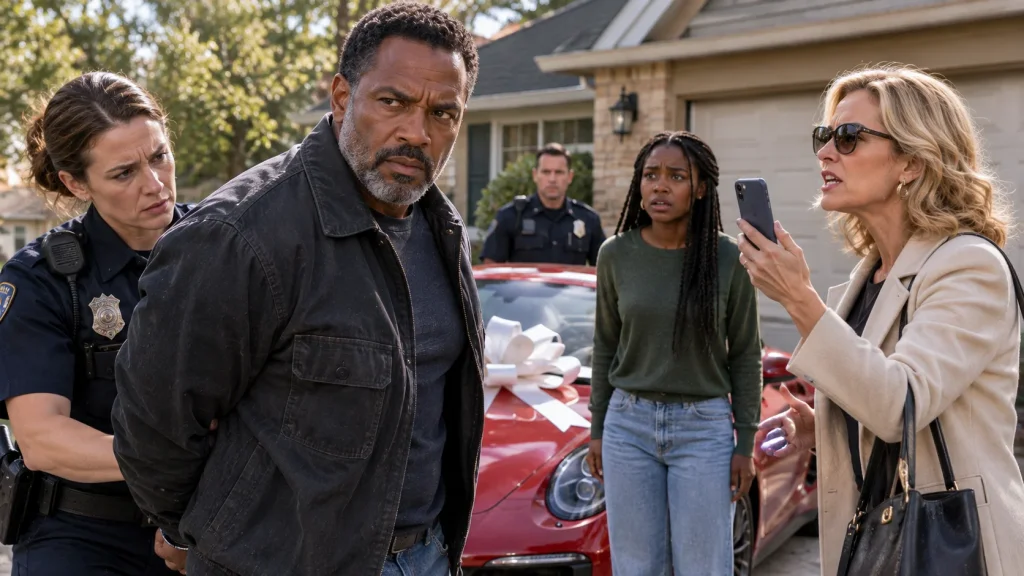
The handcuffs clicked behind my back.
My damaged shoulder screamed.
Across the driveway, Nia stood beside the Porsche her mother had once promised to finish with her.
And my daughter watched another ordinary day become something she would never forget.
Then Officer Leona Rusk finally opened the glove compartment.
She found the registration.
My name.
My address.
No theft report.
She looked at Corliss.
“What made you believe this vehicle was stolen?”
Corliss stared at me.
Then she said four words that silenced the entire driveway.
“Just look at him.”
Officer Rusk’s expression changed.
So did mine.
Then I remembered the security camera above my garage.
And for the first time that afternoon, Corliss stopped talking…
My Neighbor Called Police on Me While I Gave My Daughter Her Late Mother’s Restored Porsche—Claiming the Car Was Stolen and I’d Threatened Her. I Ended Up Handcuffed on My Own Driveway… until two security cameras exposed every lie, leading to 90 days in jail, probation, restitution, and a $40,000 civil settlement.
21 November 2026 · bonnie
My garage camera had no microphone, but it showed enough. Corliss stepped onto my driveway, moved between Nia and me, and called police while I remained in the same place. When she claimed I had approached her, the timestamp showed I had not moved.
Then our seventy-year-old neighbor, Mr. Ibarra, walked into the street holding a tablet. “Mine has sound,” he said. His doorbell camera had recorded everything: my request that Corliss leave, Nia calling me her father, and Corliss saying people “worked hard to live here.” There was no threat.
Officer Rusk removed my handcuffs.
Corliss immediately changed her explanation. Maybe she had misjudged the distance. Maybe my tone frightened her. Maybe she only wanted officers to respond quickly.
Rusk wrote each answer down.
That seemed to scare Corliss more than the cameras.
Nobody arrested her dramatically in the street. The officers separated everyone, collected statements, preserved the recordings, and gave me a report number. Corliss was instructed not to return to our property while investigators reviewed the emergency call.
Nia was furious.
“She just gets to go home?”
I had no satisfying answer.
After the patrol cars left, I found her birthday muffins crushed beside the driveway.
That evening my shoulder hurt badly enough for urgent care.
But Nia never touched the Porsche key.
At breakfast the next morning, she finally said why.
“You keep doing things for me without talking to me.”
“I restored Mom’s car for you.”
“I’m not talking about the car.”
I stopped.
Then she said the sentence that hurt worse than anything Corliss had done.



