I had spent three years believing the worst thing Nia remembered about me was that I missed Sabine’s final moments.
That morning, I learned the deeper wound.
She remembered needing me.
And me always finding something useful to do instead.
Work.
Bills.
Repairs.
Groceries.
Anything with a solution.
Grief had no wrench size.
No wiring diagram.
No pressure gauge.
So I stayed busy enough not to touch it.
“I thought if I kept everything running,” I said, “you wouldn’t have to watch me fall apart.”
Nia looked at her untouched toast.
“I needed you even if you fell apart.”
I had no defense.
For once, I did not try to build one.
“I’m sorry.”
She nodded.
Not forgiveness.
Not yet.
But she stayed at the table.
That mattered.
The next day, Corliss posted her version in the neighborhood Facebook group.
She described herself as a concerned resident punished for reporting suspicious behavior.
She said nothing about the registration.
Nothing about my daughter.
Nothing about the camera.
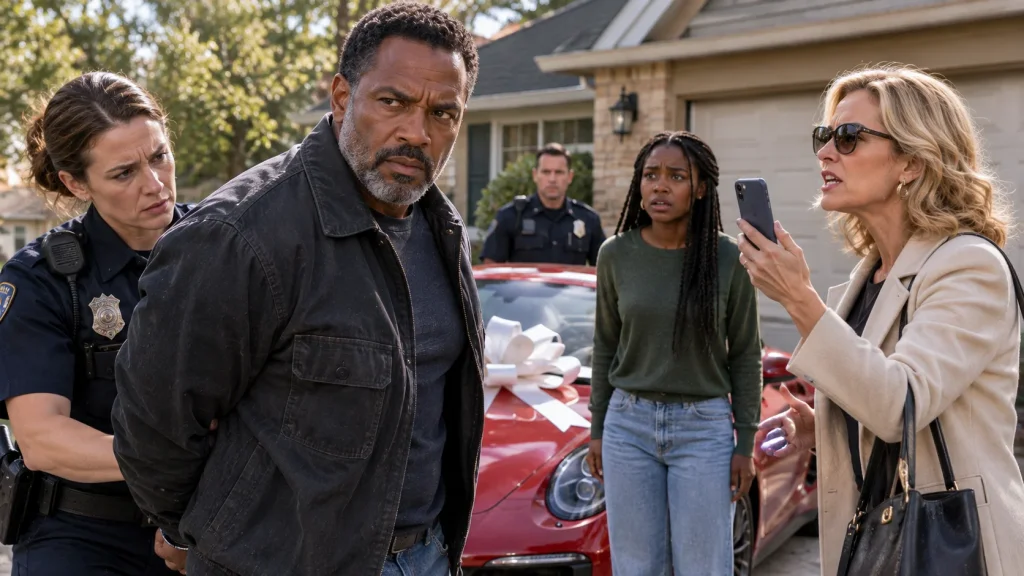
Someone uploaded a photograph of me in handcuffs.
By evening, strangers were debating whether Nia was really my daughter.
Nia showed me the posts with shaking hands.
For years, silence had been my preferred method of surviving pain.
This time, I understood silence would help the wrong person.
I called the investigator.
“Save everything,” he told me.
So we did.
Screenshots.
Timestamps.
Comments.
Deleted posts where possible.
Mr. Ibarra gave investigators the original video file.
The police obtained the 911 recording.
Hearing it was worse than watching the driveway footage.
Without pictures, Corliss sounded convincing.
Breathless.
Frightened.
Certain.
“There’s a man threatening me.”
“He has something metal.”
“There’s a young woman here.”
“I don’t think she’s safe.”
Nia paused the recording.
“That metal thing was the key.”
“Yes.”
She stared at the computer.
“She turned the nicest thing you’ve done for me into a reason they might hurt you.”
I did not know what to say.
So I sat beside her.
That became something we practiced.
Sitting instead of fixing.
Listening instead of explaining.
An attorney named Amara Quill agreed to help us with the civil side after reviewing the recordings.
She made no promises about dramatic verdicts or enormous settlements.
She asked for receipts.
Medical bills.
Lost-work records.
Dates.
Screenshots.
Counseling expenses.
“We document what happened,” she said. “And we document what it cost. Nothing more.”
I liked her immediately.
The criminal investigation continued separately.
Corliss was interviewed again.
Her story shifted.
First, she had misunderstood my movement.
Then she said my voice frightened her.
Then she said the neighborhood had changed and “somebody needed to be careful.”
But cameras do not get tired.
They do not become embarrassed.
They do not rearrange a memory to make it more comfortable.
My garage footage showed my position.
Mr. Ibarra’s recording captured the words.
The 911 call preserved what Corliss claimed at the exact moment she made those claims.
Eventually, prosecutors charged her over the knowingly false emergency report and false statements tied to the investigation.
Nothing happened quickly.
That surprised Nia.
Television teaches us consequences arrive with music.
Real consequences involve fluorescent hallways.
Paper numbers.
Rescheduled hearings.
Waiting three hours for your case to be called.
Missing work.
Parking receipts.
Sitting near vending machines that eat your dollar.
A month after Nia’s birthday, Corliss entered a not-guilty plea.
She walked into court wearing a navy suit.
No handcuffs.
No shouting neighbors.
Just a lawyer beside her.
Still, something had changed.
For years, she had behaved like a person who decided who belonged on our street.
Now somebody else was asking the questions.
Her attorney later contacted Amara with a civil settlement proposal.
Medical expenses.
Some lost wages.
Private apology.
In return, Nia and I would agree not to discuss the incident publicly.
Amara placed the draft on her desk.
Nia read the proposed apology.
“A regrettable misunderstanding,” she said.
I nodded.
“That’s what it says.”
“Where does it say she lied?”
“It doesn’t.”
“Where does it say she told police I wasn’t safe with my own father?”
“It doesn’t.”
She pushed the document away.
“No.”
I agreed.
We were not demanding humiliation.
But we were not signing a story that turned a deliberate accusation into weather.
During those months, Nia and I started grief counseling.
The first time our counselor asked about Sabine’s death, I immediately explained the failed refrigeration job.
The schedule.
The money.
Why I had gone.
The counselor waited.
Then she asked:
“Can you explain that later?”
I frowned.
“What do you mean?”
“Right now, could you hear what Nia experienced without defending why you were gone?”
That was harder than any courtroom.
Nia told me she stood at the living-room window waiting for headlights.



