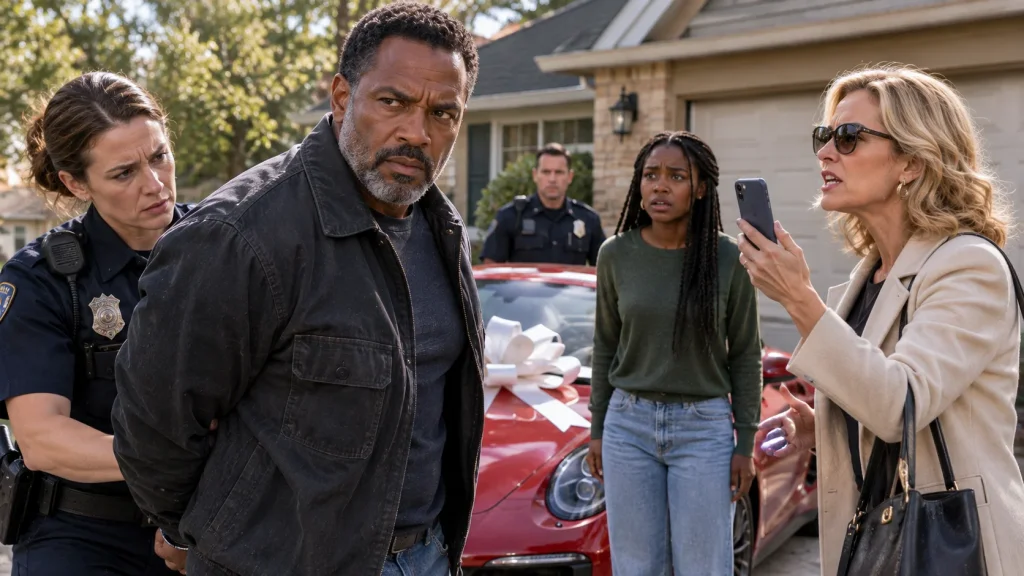
The correction stated that I legally owned the Porsche.
That Nia was my daughter.
And that Corliss’s reported claims that I had threatened her were false.
Mr. Ibarra printed the correction.
At the next neighborhood meeting, somebody called the entire situation “drama.”
Mr. Ibarra interrupted.
“A man was handcuffed because she lied.”
Then he sat down.
“Use the right words.”
Corliss served her sentence.
I did not watch her surrender.
Amara told us when it happened.
That was enough.
When she eventually returned home, her flowers were dead.
I saw her one morning carrying brown hanging baskets toward the trash.
She looked older.
For a moment, I felt sorry for her.
That surprised me.
Years earlier, I would have believed sympathy meant I needed to forgive everything and open the door.
I no longer believed that.
I could feel compassion for somebody’s pain and still maintain a boundary against what they had done.
That was another thing counseling taught me.
The Porsche took longer.
The first time Nia sat behind the wheel after the police incident, she did not start the engine.
She put both hands on the steering wheel.
“Sit with me.”
I took the passenger seat.
The leather still smelled faintly like the conditioner Sabine used.
We stayed there ten minutes.
The next week, Nia turned the key.
The engine came alive.
She immediately shut it off.
“That’s enough.”
“Okay.”
Another week passed before we drove around the block.
Sometimes she stopped halfway down the driveway.
Sometimes I became impatient.
Then apologized.
Nobody healed on schedule.
Eventually, we drove to the diner Sabine had circled in the notebook.
Nia ordered pancakes.
Then stole bacon from my plate.
“That was mine.”
“Mom said coastal food was expensive. We have to budget.”
“We are not even at the coast.”
“Preparation.”
I laughed.
It felt unfamiliar.
Then good.
We took Sabine’s trip in October.
The summer crowds were gone.
Nia drove most of the way.
I insisted on using the paper map.
She complained that phones had been invented.
At a highway rest stop, she asked:
“Do you still blame yourself?”
“For Mom?”
“Yes.”
I looked at my vending-machine coffee.
“Every day.”
She watched trucks move along the interstate.
“I still wish you’d been there.”
“I know.”
“But I don’t think you chose not to love us.”
I could not answer.
My hands started shaking around the cup.
Nia sat beside me until they stopped.
A mile from the beach, I asked her to pull over.
I opened Sabine’s notebook.
There it was.
The final instruction.
NIA DRIVES THE LAST MILE.
Nia laughed and cried at the same time.
“You planned this.”
“Your mother planned this.”
She put the Porsche back into gear.
We reached the ocean just before sunset.
Nia parked crooked.
Sabine would have hated that.
We left it crooked anyway.
On the beach, Nia set up her phone for a photograph.
We stood beside each other.
Then she moved slightly.
Leaving an empty space between us.
Enough room for Sabine.
The timer flashed.
Afterward, Nia leaned her head against my shoulder.
“She’d complain about your shoes.”
I looked down at my old work boots.
“She always did.”
We laughed until we cried.
Back home, the Porsche stopped living under a cover.
Nia drove it on Sundays.
Sometimes alone.
Sometimes with me in the passenger seat arguing about music.
Corliss still lived across the street.
She finished her obligations.
Made payments.
Kept her distance.
I stopped waiting for an apology that could make the birthday disappear.
There is no apology like that.
Some things do not become whole.
They become livable.
What mattered was smaller.
Nia leaving her bedroom door open.
Her calling me from the garage.
Her asking:
“You coming?”
One Sunday morning, I was washing dishes when I heard the Porsche start.
Nia leaned through the kitchen door.
“Dad?”
“Yeah?”
“Want to drive?”
For years, I would have finished the dishes first.
Cleaned the sink.
Checked the refrigerator.
Done something useful.
Instead, I left the plates where they were.
I grabbed my jacket.
And I followed my daughter outside.
The end



