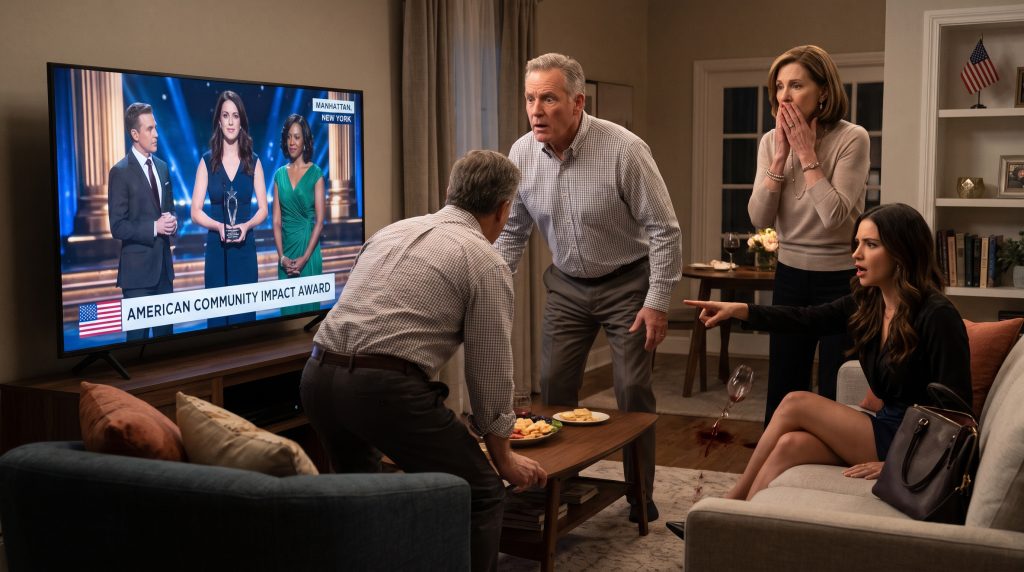
On the third call, I walked over to the window overlooking Sixth Avenue, where morning sunlight was glinting off the wet black asphalt and steam was rising from a manhole cover, and I pressed the green button.
“Hello, Dad.”
“Emily.” His voice was tight, roughened by bad sleep and the particular brand of defensive fury I had heard him use whenever a general contractor caught one of his foremen cutting corners. “We need to discuss what happened last night.”
I sat down on the edge of the crisp white hotel duvet. “Good morning to you too.”
“Do you have any idea what my morning has looked like?” he said. “Jim Reynolds called my cell at six-thirty from the golf course. Half the guys in the builders’ association saw that broadcast or read the Dispatch online this morning. Do you realize what you did to your mother and me on national television?”
“Yes, Dad,” I said calmly. “I accepted an award.”
“You made us look like monsters in front of millions of people,” he snapped. “Greg Henderson walked out of my house without finishing his drink.”
I closed my eyes, listening to the distant honk of a cab twenty-two stories below. “I didn’t call you monsters, Dad. I repeated what you, Mom, and Madison said to me on Sunday afternoon. Word for word.”
“You took it out of context!”
“What context would make ‘Find someone who enjoys that kind of nonsense’ sound better to Greg Henderson?” I asked quietly.
There was a sharp, heavy silence on the line. I could hear the kitchen clock ticking in Upper Arlington.
“You should have told us how big this was,” he said, his voice dropping into the aggrieved register of a man trying to regain higher ground. “You called me twenty minutes before kickoff and mumbled something about a charity dinner. You didn’t say a word about NBC, or celebrities, or Eleanor Price putting up five million dollars.”
And there it was. The single sentence that stripped thirty-four years of family history down to the bare studs.
I took a slow breath. “Dad, I told you it was the biggest award of my career. I told you the foundation was flying us to New York.”
“You didn’t say—”
“So if I had told you famous people were going to be in the room, you would have come?” I asked.
He didn’t answer.
“If I had told you a billionaire was going to hand us five million dollars and put my name in the Columbus Dispatch, you would have skipped the football game and been proud of me?”
“That’s not fair, Emily,” he said stiffly.
“No, Dad,” I said, and my voice didn’t shake at all. “What’s not fair is that you couldn’t be happy for me when you thought all I was getting was a little crystal trophy for helping poor people. You didn’t miss last night because you didn’t have the information. You missed it because I was the only thing on the invitation, and I wasn’t enough.”
He exhaled sharply through his nose. “I am your father. Everything you had growing up—your college tuition, the roof over your head—came from my business. You owe your mother and me some basic respect.”
I looked down at my scarred canvas tote bag by the hotel door. Something inside my chest didn’t break; it simply settled into place, heavy and permanent.
“Respect isn’t the same thing as covering up for you, Dad,” I said. “And it isn’t obedience.”
He went quiet for so long I checked the screen to see if the call had dropped. When he spoke again, the bluster had drained out of his voice, leaving something older and uncomfortably raw.
“Your mother cried for two hours after the Hendersons left last night,” he said.
I swallowed hard. “So did I, Dad. Outside Kroger on Sunday.”
He had no answer to that.
“I have a flight to catch,” I said, and ended the call.
When we landed back in Columbus on Monday morning, the world inside our little storefront office on West Broad Street had tilted on its axis.
Two strangers recognized me near the baggage claim carousel at the airport—a middle-aged woman in a Buckeyes sweatshirt who asked to shake my hand, and a retired postal worker who pressed a folded twenty-dollar bill into my palm and told me his sister had lived in transitional housing in the nineties.
When Ben dropped me at our office at noon, the volunteer crew had taped a butcher-paper banner across the brick facade that read WELCOME HOME CEO EMILY ($5,500,000!!) in purple marker. Inside, the landline was ringing off the hook. By five o’clock that afternoon, we had processed more than four thousand individual online donations—$10 from college students, $50 from nurses at Riverside who worked with Angela, $250 from a pediatric dentist in Bexley. More importantly, three commercial property owners who had ignored my cold calls for two years left voicemails offering to show us vacant apartment buildings near bus lines.



