“Our tenants aren’t delinquent,” I said quietly. “We have a ninety-four percent housing retention rate after twenty-four months.”
“And what does that pay you?” he asked, setting the pen down. “Forty-two thousand a year? Tyler’s youngest project manager makes seventy-five straight out of state school. When your mother and I are gone, I don’t want Madison and Tyler having to subsidize you because you spent your thirties collecting crystal plaques from social workers.“
Madison didn’t even pretend to look uncomfortable. She took a grape off my mother’s platter. “Honestly, Em, Tyler said the same thing last week. He’s got that new leasing office opening in New Albany in the spring. You’re organized, and you know how to deal with difficult people. If you came on as his assistant property manager, you’d make sixty grand plus health insurance, and you could still volunteer on Saturdays.“
My mother reached across the counter and patted my forearm, her diamond tennis bracelet cool against my wrist. “They’re only saying it because we worry about you, honey. You’re so intense about those people. When I had the girls from the Junior League over last month, Judy Miller asked what you were doing now, and I told her you were managing housing placements for the city. It just sounds more stable.“
I looked at the three of them standing under the recessed lights of the kitchen my father had paid seventy thousand dollars to renovate two years ago. They weren’t twirling mustaches. They didn’t even think they were being cruel. In the private mythology of the Carter house, Richard was the pragmatic patriarch trying to save his stubborn older daughter from poverty, Diane was the diplomatic peacemaker protecting the family’s social standing, and Madison was the generous sister offering me an entry-level job working for her thirty-two-year-old husband.
“I don’t work for the city, Mom,” I said. “And I don’t need a job from Tyler.“
I walked down the basement stairs, pulled my black wool coat out of the plastic bin, and carried it back up through the mudroom without saying goodbye. As I backed out of the driveway, I saw my father through the bay window, already walking back toward his den with a plate of prosciutto.
On Saturday morning, a cold October rain was slanting across the tarmac at John Glenn International Airport, but inside Terminal B, Rosa had bought everyone cinnamon rolls and was treating our boarding group like a papal delegation.
Ben was wearing his brother’s charcoal suit—the sleeves were half an inch too short, showing his thick wrists, which only made him look more earnest—and Angela was sitting by the gate window in a new cream cardigan, staring out at the Delta jet with her hands folded tightly in her lap. Two days earlier, one of our board volunteers who owned a bridal and eveningwear boutique in Short North had heard where Angela was going and donated a floor-length emerald-green silk gown, altered free of charge.
When we landed at LaGuardia, a black Suburban with a printed placard reading SECOND DOOR — COLUMBUS, OH was waiting at baggage claim. None of us had ever been met by a driver with a sign before. Ben insisted on carrying the driver’s umbrella while helping Rosa into the back seat, which confused the chauffeur so thoroughly he nearly dropped Angela’s garment bag.
Our hotel was on Sixth Avenue, four blocks from Radio City. My room was on the twenty-second floor. At five o’clock, while rain streaked the glass outside and yellow cabs backed up into a solid river of brake lights down below, I stepped into my $89 Macy’s clearance dress. Rosa insisted on pinning my hair up with pearl clips she had brought from home in a Sucrets tin.
When Angela knocked on my connecting door at five-thirty, I opened it and lost my breath.
The emerald silk caught the warm hallway light, and she stood with her shoulders back—the same shoulders I had once seen hunched over a steering wheel in a freezing parking lot while she counted nickels for milk.
“Emily,” she whispered, grabbing my hand. Her fingers were ice-cold. “I feel like Cinderella.”
I laughed, blinking back the sudden heat behind my eyes. “Then we’re all going to the ball.”
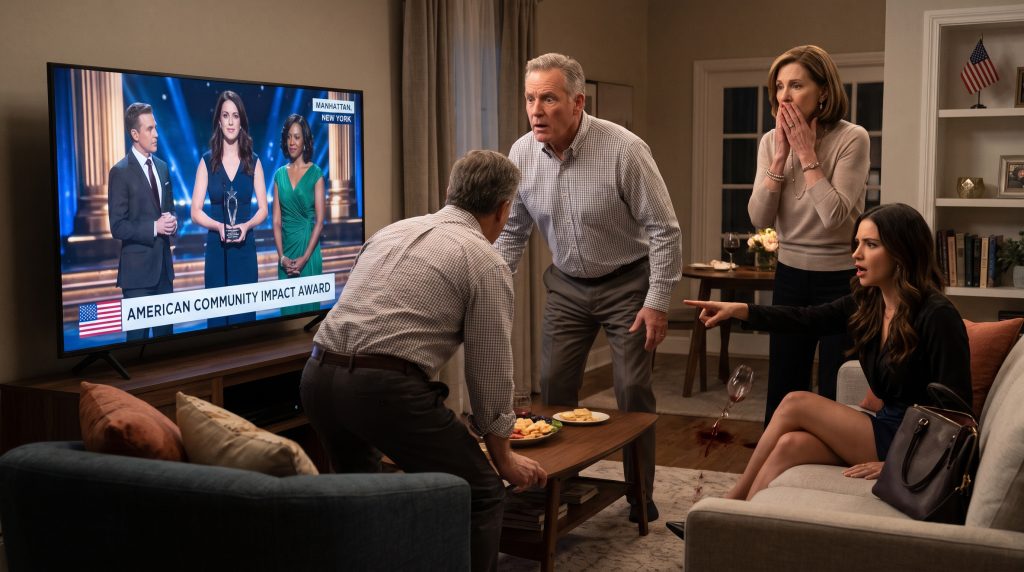
At the theater on West Fifty-Fourth Street, stainless-steel barricades lined the wet sidewalk under a blazing white marquee. Photographers in rain slickers were shouting names at a line of black sedans ahead of us—network news anchors, a Broadway revival cast, two senators from the Northeast, and philanthropists whose last names were carved into limestone hospital wings. For a second, stepping out onto the red carpet runner, my stomach dropped so hard I tasted coffee. I felt like an impostor in a department-store dress who had wandered through the wrong stage door.



