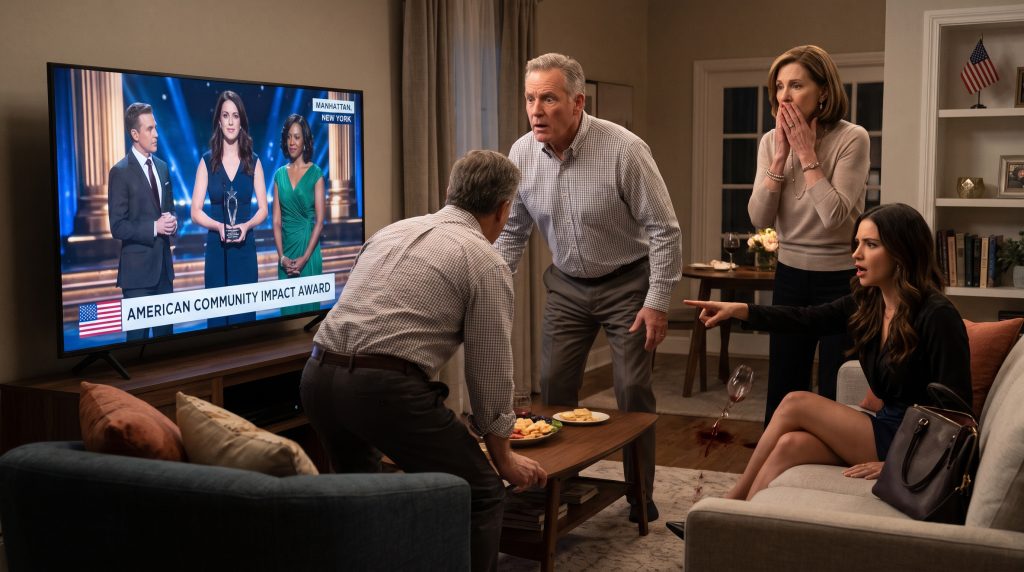
For five full seconds, the only sound in the conference room was the hum of the fluorescent tube overhead and a COTA city bus air-braking outside on Broad Street.
I looked at my mother, who was beaming as if she had just brokered the Camp David Accords. I looked at Madison, who had already calculated four percent of five million dollars on the drive over in her Tahoe. And I looked at my father, who finally looked proud of me—because for the first time in my life, I had a balance sheet big enough for him to manage and a spotlight bright enough for them to stand inside.
“Let me ask you a question,” I said quietly.
My mother’s smile flickered. “Of course, honey.”
“If I had come home from New York on Monday with just the crystal doorway,” I said, looking each of them in the eye, “and no five-million-dollar foundation fund, and no Columbus Dispatch article, and no calls from the country club—would any of you be sitting in this room right now?”
The air went out of the room like a punctured tire.
My mother’s hand fluttered to her pearls. “Emily, that is a terrible thing to ask your family.”
“Is it?” I asked.
Madison rolled her eyes, leaning back hard against the plastic chair. “Oh, come on, Emily. Are you seriously going to milk one missed dinner for the rest of our lives? You made your point on national TV! Everyone in Upper Arlington thinks we’re heartless jerks now. You got your revenge. We’re here trying to help you build something huge, and you’re still playing the martyr.”
“One missed dinner?” I repeated. A short, humorless laugh escaped me. “Madison, you missed my college graduation because you had a hydrafacial booked in Easton before a sorority formal.”
Her cheeks flushed crimson. “That was twelve years ago! That’s ancient history!”
“Mom,” I said, turning to my mother, “four years ago, when we held our very first thirty-dollar-a-plate spaghetti fundraiser at the parish hall down the street, you stayed for nineteen minutes, didn’t touch the food, and told me in the parking lot that the neighborhood made you afraid somebody was going to scratch your Lexus.”
My mother looked down at her lap, her jaw trembling.
“And Dad,” I said, looking up at my father, “you stood in your kitchen eight days ago and told me I was wasting my thirties begging retired schoolteachers for twenty-dollar checks, and that Madison and Tyler would have to subsidize you when you died.”
My father folded his arms across his chest, his jaw set hard. “I was trying to push you toward something practical. A father is supposed to worry about whether his daughter can survive in the real world.”
“No,” I said, standing up so I wasn’t looking up at him anymore. “You weren’t worried about whether I could survive. I’ve been surviving on my own for twelve years. You were embarrassed that you couldn’t brag about what I did at the nineteenth hole with Greg Henderson. And now that Eleanor Price put a dollar sign in front of my name, you want a seat on my board and Tyler wants a brokerage fee.”
Nobody spoke.
“The answer to the country club dinner is no,” I said evenly. “The answer to the Columbus Monthly family photoshoot is no. And Tyler’s company will not be bidding on a single Second Door contract—not because I’m punishing you, but because our conflict-of-interest policy forbids family self-dealing, and frankly, I wouldn’t insult Rosa and Ben by handing our capital budget to people who called their life’s work nonsense last week.”
Madison stood up so fast her chair scraped loudly against the linoleum.
“You know what?” she snapped, grabbing her leather tote off the floor. “This is unbelievable. Tyler was doing you a favor even offering to look at low-income properties. We came down here to offer an olive branch after you humiliated us on NBC, and you’re acting like you’re the Queen of England. Enjoy your little empire, Emily. Call Rosa next time you need family at Christmas.”
She marched out of the conference room, her heels clacking furiously down the hall toward the front door.
My father stood by the window for three seconds, looking at me. I could see the war happening behind his eyes—the lifelong habit of barking a final word versus the uncomfortable knowledge that every single thing I had just said was true. He didn’t apologize. He wasn’t ready for that. He just gave a stiff, tight nod toward the table, turned, and walked out after Madison to make sure she didn’t back her Tahoe into a delivery van.
But my mother didn’t move.



